49 works in this view — arrow keys or swipe to move between them.
Dance in Art
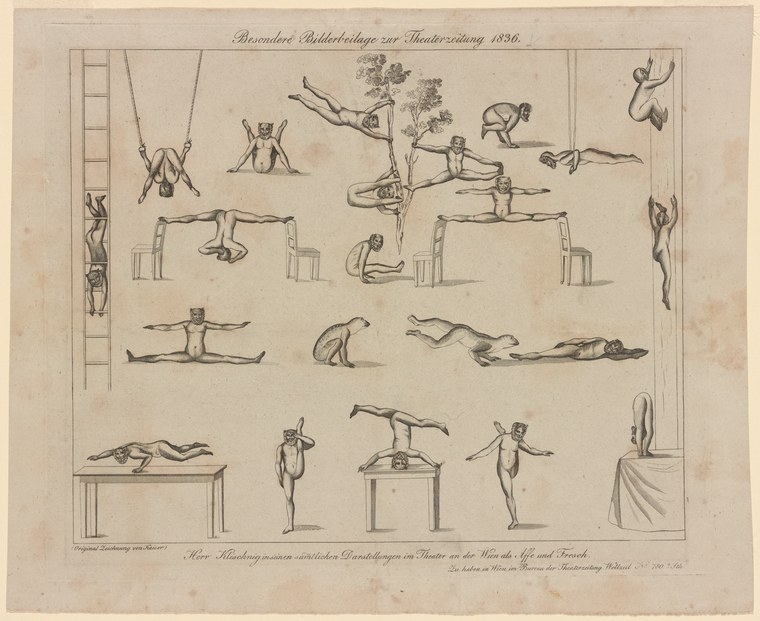
Herr Klischnig in seinem sämtlichen Darstellungen im Theater an der Wien als Affe und Frosch
Unknown artist
- Collection:
- Prints depicting dance
- Source:
- New York Public Library
- Rights:
- Public domain — free to use, share and adapt.
- Recorded as:
- Public Domain
This sheet shows the direct relationship between circus acrobatics, theatrical variety, and the culture of bodily display in early nineteenth-century Vienna. It documents a performer whose work would otherwise be invisible—no choreography, no text, only this promotional image survives. For historians of dance and performance, it expands the archive beyond ballet and social dance to include the athletic, virtuosic body work that drew paying audiences and influenced later theatrical practice.
What you are looking at
A comprehensive illustrated sheet showing acrobatic and gymnastic feats performed by a single male dancer or acrobat, identified in the title as Herr Klischnig. The composition is densely packed across the page with approximately twenty distinct poses arranged without strict registers. The figures are rendered in light brown ink on cream paper, nude or nearly nude to display the articulation of the body. The setting is minimal—a few poses occur on or near tables or benches, others involve ropes or apparatus suspended from above (visible at left and right margins), and still others take place on open ground. The poses range from contortionist extremes (deep backbends, splits, impossible compressions) to aerial and inverted positions (suspended upside-down, horizontal in mid-air). Several poses incorporate a rope, ladder, or suspended apparatus. The overall effect is a catalogue of virtuosity rather than narrative—each figure is complete in itself, demonstrating the range of the performer's body.
The dancing
All figures depict a single male body in extreme positions of flexibility and control. The musculature is indicated lightly but consistently across all poses. The body weight shifts dramatically between poses: some show the full body inverted or horizontal, others compress the spine into acute angles, still others extend limbs in maximum abduction or hyperextension. There is no partnering, no costume beyond the body itself, and no sense of flowing movement between poses—each is a held, demonstrative position designed to show what the body can achieve in isolation. The anatomical accuracy suggests close observation of live performance rather than imagination.
The dance depicted
This is not theatrical dance in the conventional sense, but exhibition acrobatics and contortion work. Klischnig was likely a circus or variety performer, and this sheet documents the full range of acrobatic feats that constituted his act. The positions shown—extreme backbends, suspensions, contortions, and inverted balances—align with nineteenth-century circus acrobatics and the German Turnen (gymnastics) tradition, which was flourishing in Vienna (the Theatre an der Wien is mentioned in the title) during the 1830s. The work sits at the boundary between dance and athletics: these are feats of body control performed for an audience, but they lack the rhythmic or narrative dimension of theatrical dance.
How it was made
This is an engraving or etching on paper, rendered in a fine linear technique with minimal shading or cross-hatching—the body is suggested through outline and light internal modeling rather than tonal buildup. The technique allows for sharp clarity and reproductive uniformity, which would have been essential for circulating this image as a souvenir or advertisement of the performance. The date given in the title (1836) and the reference to the Theatre an der Wien in Vienna place this within the early commercial culture of theatrical promotion in central Europe, when such printed sheets were sold to audiences and collected. The medium's clarity and the density of the composition suggest this was a specialized print, not a mainstream artistic publication.
About this work
This engraved sheet is a visual inventory of the acrobatic feats performed by Herr Klischnig at Vienna's Theatre an der Wien circa 1836. It documents the body's extreme possibilities through contortion, suspension, and gymnastic control—a performance genre that bridged popular entertainment, circus arts, and the German gymnastics movement. Although not dance in the strict sense, it represents a significant category of body performance that dominated nineteenth-century European theaters and fed into later circus and variety traditions. For dancers and historians interested in the full range of professional body work in the nineteenth century, this sheet is a window into a world of virtuosity that operated outside the ballet and social dance systems.
How to look at it
Approach this sheet as a catalog rather than a narrative. Each figure should be studied individually for its degree of difficulty and the anatomical knowledge required to execute it. Notice how the artist has chosen to display the body in moments of maximum extension, compression, or inversion—the 'peak' of each feat rather than its progression. The clarity of the line work and the absence of shadow or background allow the anatomy itself to become the subject. Compare the poses to understand the range: from deep backbends to impossible compressions to weightless suspensions. The variety across the sheet suggests a performance that lasted some time and comprised distinct 'acts' or demonstrations, each designed to elicit wonder at what the human body could do.
The artist
The artist is not recorded. The engraver was likely a commercial printmaker working for the Theatre an der Wien or a Viennese publisher specializing in theatrical souvenir prints. The style and technique are consistent with Austro-German reproductive engraving of the 1830s. Such prints were typically produced quickly and in quantity, aimed at audience members and collectors rather than art patrons, and the engraver's anonymity reflects this commercial, functional role.
The period
Vienna in the 1830s was a major center of theatrical innovation and popular entertainment. The Theatre an der Wien, opened in 1801, was renowned for its variety productions, including acrobatics, pantomime, and hybrid theatrical forms that blended music, dance, and athletic display. This period also saw the rise of the German gymnastics movement (Turnen), which celebrated the trained body as an instrument of national and physical culture. Acrobatics and contortion work were not marginal but central attractions in European theaters, drawing large audiences and commanding high fees. The sheet reflects Vienna's position as a nexus of Romantic-era entertainment, where the body's capacities were being explored and celebrated in multiple contexts simultaneously.
Where it lives
This print is held in the New York Public Library's collection of prints depicting dance. It functions as a historical record of a specific performance or performer and has been preserved as part of the broader documentary archive of theatrical performance. The reference to the Theatre an der Wien and the date in the title suggest it was produced as a promotional or souvenir print, likely sold or distributed to theater audiences.
Dance in this work
Questions about this work
Was Herr Klischnig a dancer or an acrobat?
Based on this sheet, he was an acrobat or contortionist—a specialist in feats of bodily control, flexibility, and suspension rather than rhythmic or narrative dance. However, the boundaries between dance, acrobatics, and athletics were less fixed in nineteenth-century variety theater than they are now. He may have moved fluidly between dance and acrobatic contexts depending on the venue and audience.
What does 'Affe und Frosch' mean in the title?
'Affe' means 'monkey' and 'Frosch' means 'frog.' These are likely the names or themes of two specific acts or roles within Klischnig's performance—comic or mimetic characterizations that framed his acrobatic feats. This suggests the performance combined athleticism with pantomime and character work.
Why are all the poses on one sheet?
This is a promotional and documentary strategy. By showing the full range of feats a performer could execute, the print advertised the variety and spectacle of the performance. It also served as a souvenir—audiences could purchase a sheet to remember what they had seen and to demonstrate the wonders they had witnessed to others. Such sheets were common in nineteenth-century theaters.
How do we know this was performed in Vienna in 1836?
The title states 'Theater an der Wien' (Theatre at the Vienna) and '1836.' The Theatre an der Wien was Vienna's major venue for variety and acrobatic performance, and this print was likely produced as part of the promotional apparatus for a specific production or run of performances.
More dance artwork





