49 works in this view — arrow keys or swipe to move between them.
Dance in Art
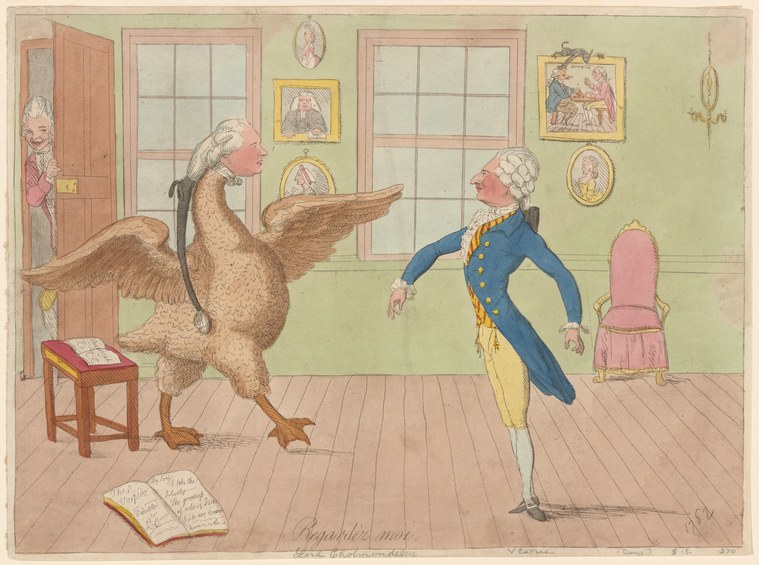
Regardez moi
Unknown artist
- Collection:
- Prints depicting dance
- Source:
- New York Public Library
- Rights:
- Public domain — free to use, share and adapt.
- Recorded as:
- Public Domain
This print captures a crucial moment in the history of dance satire: the moment when formal ballroom dancing was established enough to be instantly recognizable and therefore ripe for parody. For dance historians, it documents not only the costume and posture of late eighteenth-century social dance but also the cultural attitudes toward it—the sense that dancing masters were vain, that formal dance was mechanical, and that the whole enterprise could be deflated by removing the female partner.
What you are looking at
A man in late eighteenth-century dress—blue coat with yellow facings, white breeches, white stockings, and a white powdered wig—dances with or gestures toward a large, anthropomorphic goose in an interior room. The man's posture is animated and playful, one arm extended toward the bird in invitation or instruction. The goose, rendered with naturalistic feathering and musculature, stands upright on its talons and extends one wing toward the man, mirroring his gesture. The setting is a modest domestic interior with a wooden floor, tall windows with red frames and panes, red upholstered furniture, framed prints on pale green walls, and a red wooden chair in the foreground. A sheet of music or text lies open on the floor. A woman's head peers in from behind a red door at the left. The artist has captured a moment of whimsy: a social dance or instruction scene rendered absurd by the substitution of a waterfowl for a human partner.
The dancing
The man stands in a frontal or three-quarter stance with his weight on his feet, body upright, left arm extended at shoulder height with an open hand toward the goose, right arm at his side. His posture suggests both invitation and instruction—the formal bearing of a dancing master. The goose mirrors this with one wing extended and its body oriented toward the man, its neck slightly arched. Neither figure is in contact; the dance exists in this parallel gesture and mutual orientation across open space. The framing suggests equal partnership or mock-serious pedagogical encounter.
The dance depicted
This is a satirical print depicting social dancing of the late 1700s, most likely a minuet or contredanse, rendered absurd by having the gentleman partner a goose instead of a woman. The title 'Regardez moi' ('Look at me') emphasizes the performative, showy character of the scene—whether the man is showing off his technique or the artist is showing off his wit. The open sheet music on the floor and the domestic setting confirm this as a scene of fashionable dance instruction or practice, the kind of daily genteel activity that was a stock subject for satirical prints of the period. The print mocks both the pretension of formal dance and the vanity of its practitioners.
How it was made
This is a colored engraving or etching, hand-colored with watercolor or gouache, in the style of late eighteenth-century satirical prints. The fine linear detail in the figures and architectural elements, combined with the fluid line and the hand-applied color, suggests an intaglio print (engraving or etching) that was colored after printing. The delicate parallel hatching in the shadows and the precision of the drapery folds are characteristic of mid-to-late eighteenth-century reproductive printmaking. This technique allowed the work to be reproduced in multiple impressions, which was essential to its distribution as satire and humor to a middle-class urban audience.
About this work
This is a late eighteenth-century satirical engraving, hand-colored, depicting a gentleman in fashionable dress in a lesson or dance with a live goose. The work belongs to the tradition of European satirical prints that mocked the pretensions of fashionable society, particularly the formality and vanity of social dancing. The scene is set in a domestic interior furnished for music and dance, and the artist has captured the absurdity of the encounter through careful rendering of the man's earnest posture and the goose's involuntary mirroring of his gesture.
The print functions as social satire—mocking both the mechanical nature of courtly dance instruction and the gentleman's self-importance—while also serving as a document of late eighteenth-century ballroom fashion and the centrality of dance to polite society. It belongs in a history of dance imagery because it reveals what made dancing ridiculous to contemporaries: the formality, the asymmetry of instruction, the subordination of the partner, the sheer earnestness of the enterprise.
How to look at it
Look first at the exact moment the artist has frozen: not the beginning of a dance or the climax of a turn, but the moment of mutual regard and gesture—the 'regardez moi' of the title. The man's expression and posture promise instruction and polish; the goose's extended wing is an accidental echo of human convention. Notice how seriously the man takes the encounter: his careful stance, his formal dress, his patient gesture. The humor lies entirely in the viewer's recognition that what appears to be a formal social encounter is a fundamental mismatch. The artist has rendered the goose with enough anatomical precision that it never becomes a cartoon; it remains a real bird, which makes the man's earnestness all the more absurd.
The period
The print dates to the late 1700s, when social dancing—particularly the minuet and contredanse—was a required accomplishment for genteel men and women. Dance masters were common figures in urban society, and their instruction was formalized and often mocked. This was also the era of English satirical prints by artists like Gillray and Rowlandson, who used the conventions of social dancing to expose vanity and pretense. The print's humor relies on the viewer's familiarity with the formal poses and movements of the ballroom: the extended arm, the upright posture, the partnered position. By substituting an animal for the expected female partner, the artist exposes the mechanical, almost dehumanizing nature of the dance instruction.
Where it lives
The work comes from the New York Public Library's collection of prints depicting dance. It is a hand-colored engraving or etching, a form of mass-produced satirical art that circulated in the late eighteenth century as a commercial commodity.
Dance in this work
Questions about this work
Is this actually depicting a dance, or is it just a joke?
It is both. The work represents a genuine late eighteenth-century social dance—most likely a minuet or contredanse—with accurate costume and posture, but the artist has substituted a goose for a human partner to create satire. This allows us to see what the artist found ridiculous about formal ballroom dancing: its formality, its mechanical quality, and the power dynamic between instructor and student.
What is the title 'Regardez moi' doing in this scene?
'Look at me' is the imperative of the dancing master to his student, commanding attention and admiration. The title transforms the scene from a simple jest into a commentary on vanity: the man is demanding to be watched and admired, even as he stands with a goose. It suggests that the real subject of the print is not the dance, but the dancer's self-regard.
What does this tell us about how people danced in this period?
The print confirms that fashionable dance was formalized, required intensive instruction from a master, and involved specific postures and arm positions. It also suggests that the relationship between master and student (or partner) was hierarchical and often regarded with suspicion or mockery. The dance itself was so codified that it could be instantly recognizable even in a ridiculous context.
More dance artwork





