49 works in this view — arrow keys or swipe to move between them.
Dance in Art
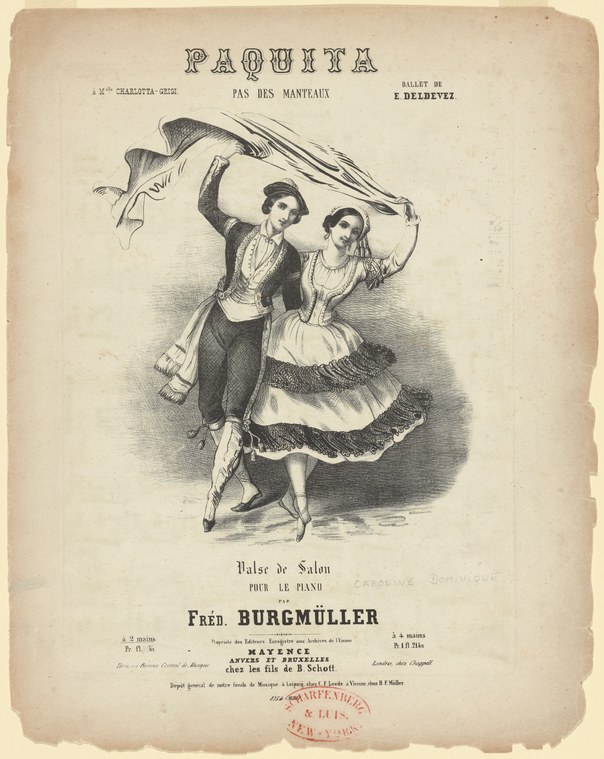
Paquita pas de manteaux, valse de salon pour le piano par Fréd. Burgmüller
Unknown artist
- Collection:
- Prints depicting dance
- Source:
- New York Public Library
- Rights:
- Public domain — free to use, share and adapt.
- Recorded as:
- Public Domain
This print documents the circulation of ballet into salon culture—the way a theatrical number became a parlor dance and was merchandised through music publishing. It shows the Romantic waltz at the height of its dominance and reveals how 19th-century dancers, musicians, and audiences moved between theatrical and social contexts, with the same steps and the same music. For historians of dance and material culture, it is evidence of how dance was consumed, taught, and remembered in the 19th century.
What you are looking at
A young couple performs a waltz, captured mid-movement in an energetic moment of social dance. The man, in dark coat and light waistcoat, supports the woman with his left hand at her waist while she leans into the turn, her right arm extended upward in a graceful line. She wears a full white skirt with deep ruching or pleating at the hem, which billows and catches the motion of the spin; the skirt's volume and the way it floats around her legs conveys rapid rotation. Behind them floats a large draped fabric—a shawl or manteau—held aloft, its folds creating a sense of weightlessness and movement that frames the couple from above. The background is plain, throwing all attention onto the dancers' bodies and the play of light and shadow across their forms. The engraving technique renders the dancers in sharp line work, with careful hatching to model their clothing and faces.
The dancing
The man's frame is erect and controlled, his weight anchored as he guides the woman through the turn. The woman's body follows the curve of the waltz, her torso tilted in counterbalance, her free arm raised in a flowing line that emphasizes the rotational movement. Her skirt, held by the momentum of the turn, describes the arc of the motion more eloquently than any limb. The composition shows a single couple, tightly focused, with the emphasis on the woman's grace and the fluidity of the embrace—a hallmark of Romantic-era waltz choreography and deportment.
The dance depicted
This is a waltz, most likely a *Valse de Salon* (salon waltz)—the title confirms it. The *Paquita pas de manteaux* (Paquita dance with mantles) belongs to the 1846 ballet *Paquita*, and this print advertises the piano arrangement of the waltz by Burgmüller. The shawl or manteau held aloft in the image is the characteristic prop of this number, which was danced in salons as well as on stage. The waltz at this period was the dominant social and theatrical dance of the European middle and upper classes, performed in the embrace shown here. The image captures not the stage version necessarily, but the salon adaptation—a piece of music and movement that traveled from the theatre into the drawing room.
How it was made
This is an engraving or steel engraving, a reproductive technique that allowed multiple impressions to be distributed widely and inexpensively. The title, artist credit (Burgmüller), and publisher mark indicate this is a commercial music cover or promotional print—part of the industrial production of sheet music and dance prints that flooded European markets in the mid-19th century. The fine line work and careful use of white paper to suggest the volume of the woman's skirt are characteristic of skilled engraving. The technique was ideal for this purpose: durable, reproducible, and capable of capturing both grace and commercial appeal.
About this work
A Romantic-era waltz captured in engraved form as a cover or advertisement for Burgmüller's piano arrangement of the *Paquita pas de manteaux* from the ballet *Paquita*. The image shows the waltz as it would have been danced in salons of the 1840s–1850s—a couple in closed embrace, the woman's skirt in full swing, framed by the floating manteau that gives the number its character. This is both a record of theatrical choreography and evidence of how ballet descended into social dance: the same movement, the same music, performed in different contexts and circulated through the new commercial networks of sheet music publishing. The engraving format reveals the scale of consumption: dance was not only seen on stage but purchased, printed, and performed at home.
How to look at it
Attend to the moment of suspension the engraver has chosen: the woman mid-turn, her skirt at full extension, the manteau floating overhead. This is not a static pose but a frozen instant of rotational movement. The artist has used the volume and shape of the woman's skirt as the primary vehicle for conveying motion—a dance-specific choice that shows understanding of how tutus and full skirts read on stage and in salons. The man's stillness and upright frame throw the woman's movement into relief; this is a composition that understands the hierarchy of the waltz frame.
The artist
Frederic Burgmüller (1806–1874) was an accomplished German-Swiss composer and pianist based in Paris. He was prolific in the genres of salon music and theatrical accompaniment, and his arrangements and original compositions for waltz were widely published and performed. He was not primarily a visual artist; the engraving itself was produced by a reproductive engraver working from a design, but Burgmüller's name as composer and the prominence of his credit on this print indicates his role in shaping how this music was marketed and understood.
The period
The 1840s–1850s were the height of Romantic ballet in Europe. *Paquita*, choreographed by Joseph Mazilier, premiered at the Opéra in Paris in 1846 and was a vehicle for the reigning ballerinas, particularly Carlotta Grisi. The waltz had become not only a social craze but a staple of theatrical ballet, often appearing as divertissements or character dances. The explosion of sheet music publishing during this period meant that music and dance from the stage were rapidly disseminated, adapted, and absorbed into domestic and salon practice. A piano arrangement of a ballet number was a common commercial product, and the cover art—as in this engraving—served both promotional and pedagogical purposes, showing purchasers how the dance could be performed.
Where it lives
This print is held in the New York Public Library's collection of prints depicting dance, catalogued as a music cover or promotional print. It represents the commercial apparatus of 19th-century dance publishing—one of thousands of sheet music covers, dance instruction prints, and theatrical souvenirs that circulated among consumers of dance and music in the era.
Dance in this work
Questions about this work
What is the manteau in the title and image?
A manteau (or mantle) is a long, draped shawl or cloak. In the *Paquita pas de manteaux*, the dancers held or manipulated flowing fabric as part of the choreography—a visual element that added lightness, drama, and movement to the waltz. The manteau floats in the air in this image, suggesting how it would have been tossed or held aloft during performance.
Was this danced in the theatre or in salons?
Both. The *Paquita pas de manteaux* was originally choreographed for the stage as part of the ballet *Paquita*. But the music and movement were adapted for salon performance by wealthy amateurs and professional teachers. This print advertises the piano reduction, which was made for home and salon use. The same waltz could be performed in a ballroom or in a theatre, depending on the context.
Who was Burgmüller?
Frederic Burgmüller was a respected composer and pianist active in Paris during the Romantic era. He specialized in salon music and theatrical arrangements. His waltz compositions and arrangements were commercially successful and widely performed by amateur pianists and at dance events.
How was this image made?
This is an engraving, a printmaking technique in which a design is carved into a metal plate and ink is applied to the incised lines. The plate could then be printed many times, making it an ideal format for the mass distribution of sheet music covers and promotional images. The fine, precise line work you see here is characteristic of mid-19th-century commercial engraving.
More dance artwork





