49 works in this view — arrow keys or swipe to move between them.
Dance in Art
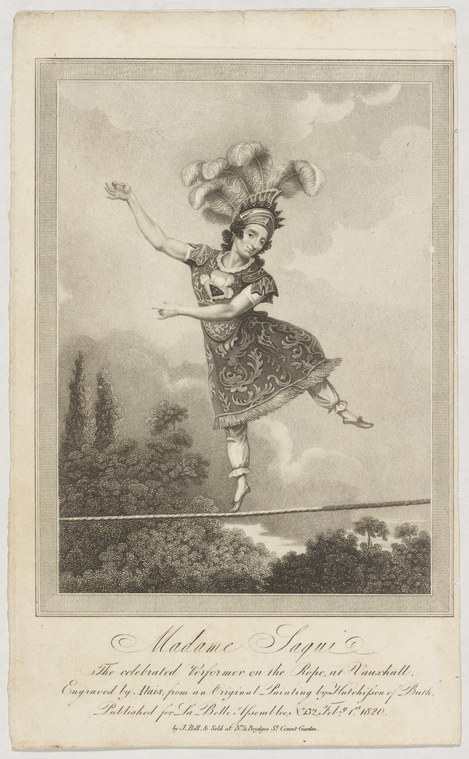
Madame Saqui, the celebrated performer on the rope, at Vauxhall
Unknown artist
- Collection:
- Prints depicting dance
- Source:
- New York Public Library
- Rights:
- Public domain — free to use, share and adapt.
- Recorded as:
- Public Domain
Rope-dancing is now largely invisible in dance history, overshadowed by ballet and other concert forms, but it was a major draw in public gardens and fairgrounds for centuries. This print documents both a real historical performer and a lost or marginalized genre of movement, preserving evidence of what audiences paid to see and what bodies were trained to do. It is a rare visual record of how an individual dancer solved the physical and theatrical problems of her art form.
What you are looking at
This is an engraving depicting Madame Saqui performing on a tightrope at Vauxhall Gardens, a famous London pleasure garden. She is captured mid-performance, balanced on a rope that stretches across the lower portion of the composition. Her body is in a dynamic pose suggesting movement and control—one leg extended behind her, arms raised in an expressive gesture that conveys both balance and theatrical display. She wears an ornate dress with elaborate patterning and decoration, fitted at the bodice and full in the skirt, typical of early 19th-century performance costume. Her hair is crowned with what appears to be an elaborate headdress or plume arrangement. The background is rendered in atmospheric perspective, with trees and landscape features fading into soft cloud-like shading, emphasizing the height and isolation of the performer. The composition frames her as the sole focus against a much larger, emptier space, magnifying both the difficulty and the spectacle of her feat.
The dancing
Saqui's body demonstrates the fundamental challenge of rope-walking: her weight is concentrated over one leg while the other extends behind for balance. Her arms are raised and asymmetrically positioned—one higher than the other—in a pose that suggests both active balance-work and theatrical embellishment of that work. Her torso is upright but animated rather than rigid, and the extension of her limbs gives the impression of arrested motion rather than a static pose. There is a single figure, alone on the rope, with no corps or supporting dancers.
The dance depicted
This documents rope-dancing, also called rope-walking or tightrope-dancing, a specialist performance art that occupied a distinct position in early 19th-century entertainment. Madame Saqui was a celebrated performer of this genre, and Vauxhall Gardens was a primary venue for such spectacles. Rope-dancing involved a combination of acrobatic balance, controlled movement along the rope, and theatrical gesture—the performer had to navigate the physical demands of maintaining equilibrium while entertaining a paying audience. The costume and setting confirm this is professional performance rather than circus or carnival; such acts were marketed as demonstrations of virtuosity and nerve. The image shows the characteristic vocabulary: extended limbs for balance, an ornate costume to catch light and eye, and an elevated, exposed position that made the danger and achievement visible to spectators.
How it was made
This is an engraving, as indicated by the fine line-work, the tonal shading built from parallel lines, and the formal border frame typical of the medium. The print is delicately executed with careful attention to rendering fabric texture in Saqui's dress and subtle atmospheric effects in the background. Engravings such as this were produced in quantity for sale as prints to a broad public market—they were affordable souvenirs and promotional images circulated among people who attended performances or read about them in newspapers. The technique allowed precise documentation of costume detail and pose, making this a valuable record not only of Saqui herself but of how rope-dancers dressed and positioned themselves for performance.
About this work
This engraving documents a star attraction of early 19th-century London entertainment: the rope-dancer Madame Saqui performing at Vauxhall Gardens. It captures a single moment of her performance—poised on the rope in an attitude that combines physical control with theatrical display. The work is both a portrait of a celebrated artist and a record of a now-obsolete performance tradition, one that occupied the space between dance, acrobatics, and spectacle.
Rope-dancing was more common in the 18th and early 19th centuries than it is today, and this image preserves crucial visual information about how such performances were executed and costumed. Madame Saqui was famous enough to be frequently depicted in prints and paintings; this engraving is one artifact of her celebrity. It belongs in a dance collection because rope-walking, however different from ballet or social dance, was a structured performance art that required training, musicality, and an understanding of how to move an audience—all central to dance.
How to look at it
Observe the precision with which the artist has rendered the moment of balance: one foot planted on the rope, one leg extended, the body's weight clearly over the supporting leg, the arms raised and separated in a configuration that serves both balance and display. The ornate costume is not incidental—it is part of what the audience paid for, and the engraver has carefully rendered the pattern and texture of the fabric to convey richness and expense. The atmospheric background, rendered in softer tones, emphasizes the isolation and exposure of the performer; she is suspended in space rather than grounded. The formal border and the inscription below place this squarely in the tradition of theatrical portraiture, announcing that this is a documented moment from a celebrated performance.
The period
Madame Saqui performed during the Regency and early Victorian period, when Vauxhall Gardens was at the height of its popularity as a destination for entertainment, dining, and social display. The early 19th century saw a vogue for spectacular and dangerous feats performed by individual artists, often women, in public venues. This was also the era in which theatrical ballet was becoming established as a dominant performance form in London, yet rope-dancing and acrobatics remained extremely popular and lucrative. The print format itself—a commercial engraving sold to souvenir-hunters and print collectors—reflects the celebrity culture that surrounded major performers. The taste for elaborate costume, dramatic pose, and documentation of technical virtuosity visible in this image matches the wider aesthetic values of the period.
Where it lives
This engraving is held in the New York Public Library's collection of prints depicting dance. The inscription below the image credits the artist and provides publication information. Such prints were commercial products, produced for sale to the public and circulated widely; multiple impressions of this engraving would have existed.
Dance in this work
Questions about this work
Who was Madame Saqui and why was she famous?
Madame Saqui was a celebrated rope-dancer (also called a tightrope-walker) who performed at Vauxhall Gardens and other venues in early 19th-century London. She was famous for her skill, nerve, and showmanship; rope-dancing was a popular and lucrative form of entertainment at the time, drawing large paying audiences. Her fame was sufficient to warrant her being depicted in multiple prints and paintings, making her one of the documented star performers of her era.
What is rope-dancing and how does it relate to dance?
Rope-dancing or tightrope-walking is a performance art combining acrobatic balance, controlled movement, and theatrical gesture. While not a form of dance in the modern sense, it shares key features: it requires trained bodies, it is performed to music, and it is built on the tension between difficulty and display. Performers like Saqui trained extensively and were recognized as artists rather than mere curiosities, making rope-dancing a legitimate strand of movement-based performance culture in the 18th and 19th centuries.
Why was Vauxhall Gardens significant for performers like Saqui?
Vauxhall Gardens was one of London's premier public entertainment venues in the 18th and early 19th centuries, drawing thousands of visitors who paid admission to enjoy music, food, fireworks, and spectacular performances. It was an ideal venue for rope-dancers because it combined a large audience with a tradition of presenting novelty and danger; the open-air setting and the garden's theatrical atmosphere made rope-dancing performances even more dramatic and appealing.
More dance artwork





