49 works in this view — arrow keys or swipe to move between them.
Dance in Art
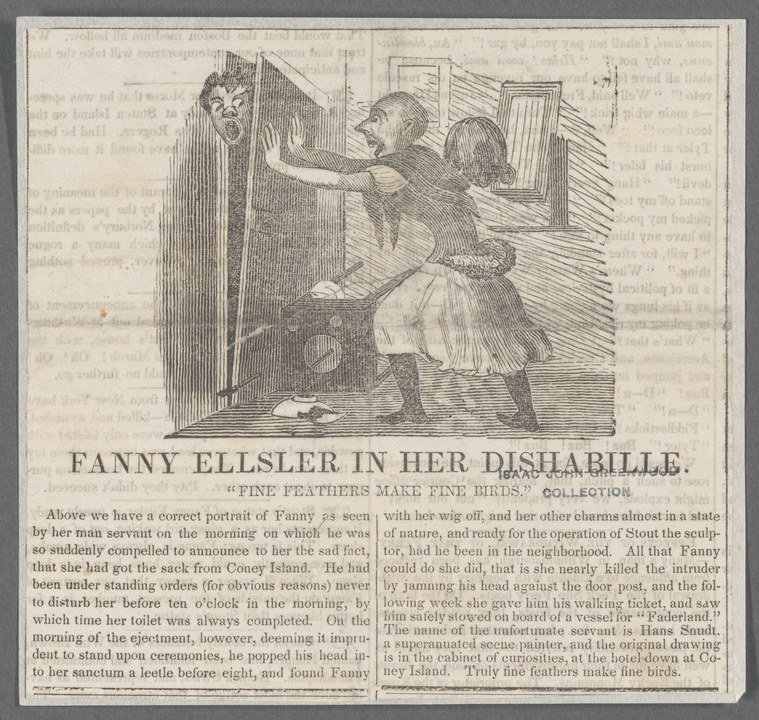
Fanny Ellsler [sic] in her dishabille: fine feathers make fine birds
Unknown artist
- Collection:
- Prints depicting dance
- Source:
- New York Public Library
- Rights:
- Public domain — free to use, share and adapt.
- Recorded as:
- Public Domain
This work documents how 19th-century visual culture represented one of the era's most significant dancers—not in performance, but through satirical commentary that reveals what audiences valued in her. It shows that Elsler's fame rested on her physical presence and dramatic power as much as on technical virtuosity, and that popular prints played a crucial role in constructing and circulating her celebrity. For dance historians, it is evidence of how dance bodies and personas were mediated and consumed in the pre-photographic era.
What you are looking at
A domestic interior scene depicts a woman in morning dishabille—loose dress, hair undone—confronting a man at a doorway. The woman is animated and gesticulating, her body lunging forward with raised arms toward the man's head, which she appears to be grasping or pushing against the door frame. The man recoils, his posture defensive. The setting is a modest room with wooden paneling and an open door; a small object (possibly a mouse or rat) is visible on the floor. The composition is tightly framed, emphasizing the physical comedy and social transgression of the moment. The engraving's cross-hatching creates strong contrasts between light and shadow, drawing attention to the figures' expressions and the energy of their interaction. A substantial block of text beneath the image provides context for the scene.
The dancing
The woman's body is entirely engaged in dynamic movement: her legs are bent in a deep lunge, her torso twisted and reaching forward, both arms extended upward with hands splayed toward the man's face and head. Her weight appears to be driving forward and down, creating a sense of forceful momentum. The man's posture is reactive and retreating, his body compressed against the door frame. The spatial relationship between them is intimate and charged, with the woman's movement encroaching decisively into the man's space. Neither figure is in a formal dance position, but the woman's physicality—the extension, the weight shift, the reach—displays theatrical control and clarity.
The dance depicted
This is not a formal dance but a scene of comedic theatrical action, likely from a 19th-century satirical or burlesque print tradition. The inscription identifies the subject as Fanny Elsler "in her dishabille," suggesting this documents or burlesques a moment from her performance or persona. Fanny Elsler (1810–1884) was one of the most celebrated Romantic ballet dancers of the 19th century; she was renowned for her dramatic range and for roles beyond classical ballet. The compositional energy and the woman's bodily control suggest the influence of theatrical dance vocabulary, even though the scene depicts domestic comedy rather than formal choreography. The print appears to be satirizing or celebrating Elsler's vitality and physical boldness—qualities that made her famous.
How it was made
This is an engraving, identifiable from the parallel lines (hatching and cross-hatching) used to create tone and shadow, the fine linear detail, and the characteristic printed surface. The technique allowed for mass reproduction and wide circulation, making this a form of popular visual commentary accessible to middle-class audiences. The crisp, detailed line work emphasizes facial expression and gestural clarity, which is essential to the comedy of the scene. Engravings of performers and theatrical scenes were a standard vehicle for celebrity culture and artistic criticism in the 19th century.
About this work
This is a 19th-century engraving depicting Fanny Elsler, one of the Romantic era's greatest ballet dancers, in a satirical domestic scenario. Rather than showing her in formal dance, it captures her in a moment of exaggerated physical comedy—lunging at a man with theatrical energy and abandon. The print belongs to a rich tradition of theatrical celebrity prints that used satirical scenarios to comment on performers' public personas and reputations. Elsler was famous not only for her technical mastery but also for her dramatic intensity and willingness to perform outside the strict conventions of classical ballet; this image trades on that reputation for boldness and physicality. The engraving circulated among audiences interested in theater, dance, and contemporary social satire, making Elsler's image and persona widely recognizable.
How to look at it
The engraver has captured a moment of maximum physical exuberance and comedic transgression: the woman's body is fully committed to forward momentum, and the artist has frozen that moment of contact and confrontation. Notice how the woman's weight is committed to her gesture—this is not a tentative or delicate movement, but one drawn from balletic training translated into physical comedy. The engraver emphasizes the liveliness of the woman's face and the clarity of her limbs, using the medium's linear precision to make every gesture legible. The satire lies in the contrast between the balletic control visible in her posture and the undignified, domestic chaos of the scene.
The period
Fanny Elsler's career (1830s–1850s) spanned the height of Romantic ballet, when dancers like Marie Taglioni and Elsler herself became international celebrities. Elsler was distinctly un-Taglioni: where Taglioni embodied ethereal, otherworldly spirituality, Elsler was earthy, sensual, and dramatically vital. She danced both classical ballet and character dances (particularly Spanish and Italian folk-derived roles), and toured Europe and the Americas to enormous acclaim. The 1840s, when this print likely dates, were peak years for Elsler's fame and for the proliferation of theatrical prints and lithographs documenting performers. Satirical prints that placed famous dancers in absurd or compromising scenarios were common—a form of affectionate mockery that also served as advertisement. The caption "Fine feathers make fine birds" suggests a commentary on Elsler's glamour and the trappings of theatrical celebrity.
Where it lives
This engraving is held in the New York Public Library's collection of prints depicting dance. The collection documents theatrical performance and dance culture through the visual media of its time, from engravings and lithographs through early photography.
Dance in this work
Questions about this work
Who was Fanny Elsler?
Fanny Elsler (1810–1884) was an Austrian ballet dancer and one of the most celebrated performers of the Romantic era, rivaling Marie Taglioni in fame. Unlike Taglioni, who was known for ethereal, spiritual roles, Elsler excelled in dramatic and character dances, particularly Spanish and Italian-influenced roles. She toured throughout Europe and the Americas and was known for her sensuality, technical mastery, and willingness to perform outside strict classical convention.
What is 'dishabille' and why is it in the title?
Dishabille (or déshabillé) refers to partial undress or informal, loosened dress—the state of being incompletely dressed, often suggesting intimacy or morning negligence. The term in the title signals that this is a satirical scenario, placing the famous and glamorous Elsler in an undignified domestic moment. It may also be a veiled reference to her reputation as a sensual, physical performer.
Is this engraving from an actual performance?
Likely not. This appears to be a theatrical satire or comedy print inspired by Elsler's persona and reputation, rather than a document of an actual stage scene. Such prints were common ways of engaging with celebrity: they exaggerated or reimagined performers in absurd scenarios, both mocking and promoting them.
What does 'fine feathers make fine birds' mean?
This proverb means that glamorous appearance can make anyone (or anything) seem impressive or valuable. In this context, it is likely mocking the notion that Elsler's fame and beauty rest on superficial trappings rather than substance—a common form of satirical critique of celebrity.
More dance artwork





