49 works in this view — arrow keys or swipe to move between them.
Dance in Art
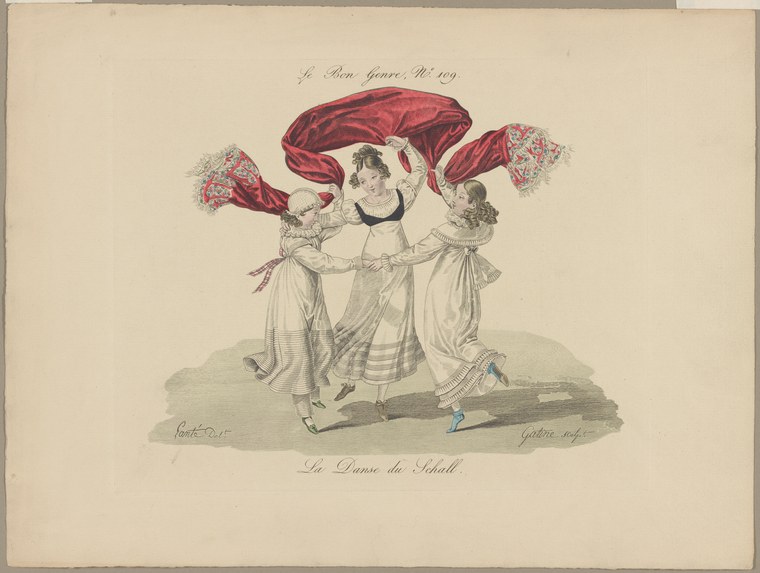
La Danse du schall
Unknown artist
- Collection:
- Prints depicting dance
- Source:
- New York Public Library
- Rights:
- Public domain — free to use, share and adapt.
- Recorded as:
- Public Domain
The shawl dance was a real but now-forgotten form of recreational dance for women in the early 19th century, and this print is visual evidence of its existence, costume, and social setting. It shows that dance history includes many popular, elegant forms that left few written records and no notated choreography—prints like this are among our primary sources. The work also demonstrates how dance and fashion were inseparable in Regency leisure culture, and how prints circulated images of fashionable movement to a broad audience eager to learn and imitate.
What you are looking at
Three young women in high-waisted white muslin dresses stand together on a pale ground, gathered in animated conversation or preparation. The central figure wears a black belt or sash at her waist. All three hold or wear brilliant red silk scarves or shawls that billow dramatically above and around their heads—the fabric rendered in vivid crimson with floral patterned borders in pink and green. The scarves create a sense of movement and airiness despite the figures' relatively static poses. The women wear small bonnets or caps trimmed with flowers, and their feet are just visible at the base, suggesting dancing shoes. The composition is intimate and informal, with the three figures clustered closely, their heads nearly touching as they engage with one another. The hand-coloured engraving technique allows the artist to achieve delicate shading in the drapery and precise detail in the printed outlines.
The dancing
The three dancers are shown in a close grouping with relaxed, sociable postures rather than formal alignment. Their arms are engaged with the scarves, holding and arranging them expressively. The stance is upright and graceful but not balletically rigid—the weight appears distributed naturally through the legs, and the bodies tilt slightly toward one another in a conversational manner. No couple is in closed ballroom hold; instead, they seem to be performing a group dance in which the scarves are central props that demand attention and coordination.
The dance depicted
The title 'La Danse du schall' (The Shawl Dance) directly identifies this as a shawl dance, a form of display dancing popular in late 18th and early 19th-century European ballrooms and theatrical contexts. The scarves—rendered as large, billowing silk shawls—are the essential content of the dance, manipulated by the dancers for visual effect. This was a recreational and semi-theatrical form, often performed at assemblies and in drawing rooms by accomplished young women. The image captures the moment of playful, coordinated shawl work, emphasizing the elegance of the fabric and the lightness of the performance rather than technical footwork or rigid choreography.
How it was made
This is a hand-coloured engraving, typical of early 19th-century popular prints. The fine engraved lines establish the structure and detail, while watercolour or gouache has been applied to pick out the brilliant red of the shawls, the pale muslin dresses, and the flowers in the women's hair and shawl borders. This hybrid technique was economical yet visually rich, allowing for wide distribution to an affluent audience interested in fashionable accomplishments and social dances. The precision of the engraving captures fine detail in the drapery and facial expressions, while the hand-colouring adds the vivacity and luxury that would have made the work desirable for collectors.
About this work
This is a document of recreational dance fashion in the Regency or late Georgian period—a moment when shawl dances held the status of refined accomplishment for women of leisure. The work captures a specific social dance form at the intersection of fashion, music, and movement, performed in ballrooms and private assemblies. The image shows not virtuosity but elegance, sociability, and the display of expensive fabrics. It belongs in a dance gallery because it records a vanished social practice: the shawl dance is no longer taught or performed, and this print preserves both the costume and the social context in which it flourished. The work is also a strong example of how popular prints functioned as models for aspiring dancers and as pleasurable records of fashionable accomplishment for those who viewed and collected them.
How to look at it
Attend to the scarves first—they are the dance. Notice how they billow upward and outward, creating an impression of buoyant, effortless grace. The artist has frozen the moment not at a pose but in the midst of motion: the fabric reads as just-released or about to be drawn up again. The three figures are very close together, and their faces are turned toward one another, emphasizing that this is a social, communicative dance rather than a performance to an audience. The high bonnets and flowers, the pale muslin, and the polished demeanour signal that this is a dance of leisured refinement—recreational, not virtuosic.
The artist
The artist is unknown, as is typical for popular commercial engravings of this period. The print bears the mark of a competent hand schooled in the conventions of Regency fashion illustration and theatrical or social-dance imagery. The style and technique are consistent with the output of London print workshops producing engravings for the middle and upper-class market in the 1810s–1820s.
The period
The shawl dance emerged in the late 18th century and reached peak popularity during the Regency period (c. 1811–1820) and into the 1830s. This was an era of neoclassical aesthetics applied to women's dress—high waists, flowing muslin, minimal ornamentation—combined with a taste for graceful, decorative movement that emphasised line and fabric rather than technical complexity. The Napoleonic Wars had created a taste for Spanish and Oriental exoticism, and shawls (imported or imitated) were luxury goods that signalled wealth and taste. Dance in this period was shifting: ballet was becoming more rigorous and theatrical, but social and recreational forms like the shawl dance, the cotillion, and the quadrille remained the primary contexts in which non-professional women danced. Prints like this one documented and promoted these fashionable accomplishments to an aspirational audience.
Where it lives
This print is held in the New York Public Library's collection of prints depicting dance, a significant archive of visual dance documentation from the 15th century onward. The work is catalogued with minimal descriptive information, suggesting that it entered the collection on the basis of its dance content rather than its artist or provenance.
Dance in this work
Questions about this work
What is a shawl dance?
A shawl dance is a form of recreational dance, popular in the early 19th century, in which performers—usually women—held and manipulated large silk scarves or shawls as an integral part of the choreography. The dance emphasized the beauty of the fabric and graceful arm movement rather than complex footwork. It was performed at private assemblies, balls, and in the drawing rooms of the leisured classes, and also appeared on the theatrical stage as a semi-professional form. The shawl dance declined after the 1830s as dance fashions shifted and as ballet became the dominant form of staged dance.
Who danced shawl dances?
Shawl dances were primarily performed by women of the middle and upper classes in Britain and continental Europe. They were considered an accomplishment—a sign of refinement, grace, and access to leisure time and fashionable instruction. Some women performed them semi-professionally in benefit concerts or as part of theatrical programmes, but the majority danced them for pleasure in private settings. The form was open to amateurs and required neither formal training nor exceptional physical ability, which is partly why it was so popular.
What does the hand-colouring tell us?
Hand-colouring was labour-intensive and therefore costly, indicating that this print was aimed at a prosperous audience. The vivid red of the shawls and the delicate watercolour accents signal luxury and desirability—owning such a print was itself a status marker. The fact that colourists took care to match and blend the hues suggests that the print was valued as a finished artwork, not a disposable ephemera. This technique was standard for fashion and dance prints of the period.
Why is there so little information about the artist?
Popular engravings of this era were typically produced in workshops where labour was divided and credit was not always clearly assigned. The engraver, the colourist, and sometimes the designer were different people, and commercial prints often omitted attributions. This print was part of a mass market aimed at quick consumption and profit, not at building individual artistic reputation. As a result, many such prints are now anonymous, though their style and period can be established from other evidence.
More dance artwork





