49 works in this view — arrow keys or swipe to move between them.
Dance in Art
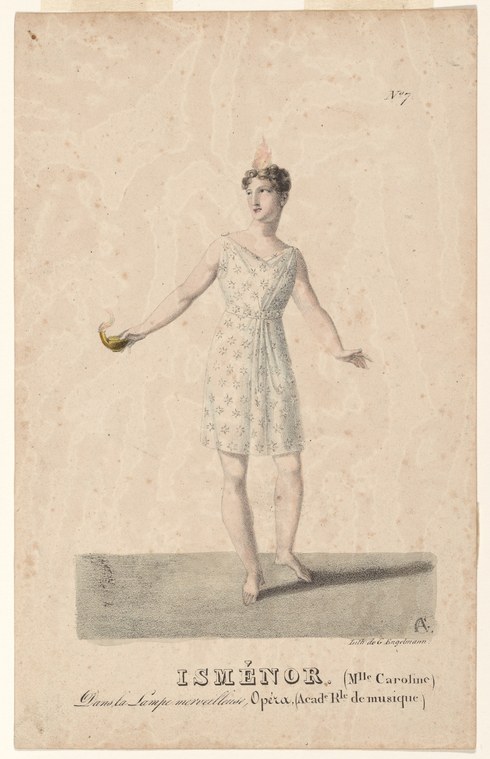
Isménor: (Mlle Caroline) dans La lampe merveilleuse, Opéra, (Acade. Rle. de musique)
Unknown artist
- Collection:
- Prints depicting dance
- Source:
- New York Public Library
- Rights:
- Public domain — free to use, share and adapt.
- Recorded as:
- Public Domain
This print is evidence of how early 19th-century audiences encountered and remembered dance: as images of named performers in specific roles, frozen in a gesture laden with emotional or narrative meaning. The record of Mlle Caroline's body in this pose—her dress, her stance, her upturned face—gives us concrete information about how theatrical danse d'action was performed and presented, and how it differed from the emerging aesthetic of classical ballet.
What you are looking at
A young woman stands alone against a neutral beige background, posed in a moment of theatrical stillness. She wears a high-waisted, lightweight dress with a small geometric or floral print, sleeveless and cut to knee length in the neoclassical style. Her dark hair is arranged atop her head in the fashion of the early 19th century. She stands on a narrow rectangular platform or stage, her body in a contrapposto stance with her weight shifted slightly to one side. Her left arm extends outward with palm open in a gesture of presentation or offering, while her right arm hangs more naturally at her side. Her gaze is directed upward and to the side, away from the viewer, in an attitude of reverie or theatrical address. The pose suggests a moment lifted from narrative action rather than social dance—the body held with deliberate grace, the platform isolating her as a figure to be observed.
The dancing
A single female figure occupies the composition, standing in a posed, asymmetrical stance that emphasizes the lengthening of the body. The extended left arm with open palm and slightly raised elbow creates a lyrical, expansive line; the torso is upright but not rigid, and the legs are straight and close together in a standing position that does not suggest active footwork. The raised head and averted gaze give the pose a quality of emotional introspection or dramatic address. The frame and bearing suggest training in theatrical movement—the body is arranged for visual effect rather than functional action.
The dance depicted
This is almost certainly a character or soloistic moment from *La lampe merveilleuse* (The Wonderful Lamp), an opera performed at the Académie Royale de Musique in Paris. The inscription identifies the performer as Mlle Caroline in this role. The pose and costume suggest a moment of pantomime or dramatic gesture typical of opera ballet or theatrical danse d'action of the early 19th century—a genre in which ballet was subordinate to narrative and character. The lack of turnout, the closed stance, and the inward emotional register distinguish this from classical ballet technique, suggesting instead a vocabulary closer to theatrical demi-caractère or pantomimic gesture.
How it was made
This is a hand-colored engraving or stipple engraving, a technique that allowed for fine tonal gradation and subtle modeling of the figure. The technique was ideal for theatrical portraiture and the dissemination of images of celebrated performers to a literate public. The delicate stippling and soft coloring of the dress and skin suggest professional execution and wide circulation; such prints were both souvenirs of theatrical performance and documents of dancing practice and fashion. The archival quality and surviving color indicate this was a valued keeper piece.
About this work
This is a theatrical portrait of a named performer in a specific operatic role, preserved as an engraved print with hand coloring. It documents a moment of dance or dramatic gesture from early 19th-century Parisian operatic spectacle. The work sits at the intersection of performance documentation, celebrity portraiture, and dance history: it records not a technique or a type of dance, but an individual artist's interpretation of a character and a moment chosen by the printmaker as exemplary or memorable. The isolation of the figure on a platform and the theatrical address of the pose suggest this was how the moment was understood—as a pose to be studied and remembered, a tableau rather than a fleeting step.
How to look at it
Observe the stillness and deliberate pose of the figure, which tells you this is not a step or a moment of technical display, but a gesture held for contemplation. The extended arm and upturned face are the vector of meaning—this is a portrait of feeling or address, not movement. Notice how the platform isolates the figure and turns the body into a sculptural object to be viewed from front. The lack of any suggestion of a partner or ensemble action is also significant: this is a solitary figure in a moment of theater, not a social or technical dancer. The print technique itself—the softness of the stippling, the careful hand-coloring—conveys the value placed on preserving and circulating the image of this particular performance.
The period
This engraving dates to the early 19th century, likely between 1800 and 1820, a period when the Académie Royale de Musique was the center of French operatic and balletic innovation. Dance was integral to opera, and celebrated dancers were celebrities in their own right. Theatrical prints depicting performers in role were a thriving commercial genre; they served as souvenirs, promotional images, and documents of performance. The costume and pose reflect the neoclassical aesthetic that dominated French theatrical design in the Revolutionary and Napoleonic era. Danse d'action—narrative ballet in which gesture and pantomime carried dramatic weight—was the dominant mode; pure technical display and the aesthetics of classical ballet were only beginning to emerge.
Where it lives
The print is held in the New York Public Library's collection of prints depicting dance. Such theatrical prints were widely circulated as souvenirs and advertisements, making them relatively common in institutional collections, though individual performers and roles are often now difficult to verify.
Dance in this work
Questions about this work
Who was Mlle Caroline?
The inscription identifies her only as the performer of this role. Early 19th-century theatrical prints often named performers without further biographical detail. Documentary research would be needed to determine her full identity, career span, and other roles. Such named female performers in Parisian opera were usually established artists of some reputation.
What was 'La lampe merveilleuse'?
An opera performed at the Académie Royale de Musique (later the Paris Opéra), the principal opera house in France. The title suggests a fantastical narrative—the magical lamp likely refers to the lamp of Aladdin or a similar orientalist fantasy, a popular theme in early 19th-century French opera. The specific music, libretto, and date of premiere would require further research.
Is this ballet or opera?
It is opera with integrated dance. In this period, opera and ballet were not separate forms; danced interludes and character dances were standard elements of operatic spectacle. Mlle Caroline performed a character or soloist role that included pantomime and gesture. The distinction between 'ballet dancer' and 'opera dancer' was not always clear in this era.
How was this image made and distributed?
As a hand-colored engraving, this was an expensive but reproducible luxury good. It would have been sold in print shops near the opera house and to collectors of theatrical imagery. Such prints commemorated celebrated performances and served as both art objects and documents of performance practice. The survival of color indicates it was carefully kept.
More dance artwork





