49 works in this view — arrow keys or swipe to move between them.
Dance in Art
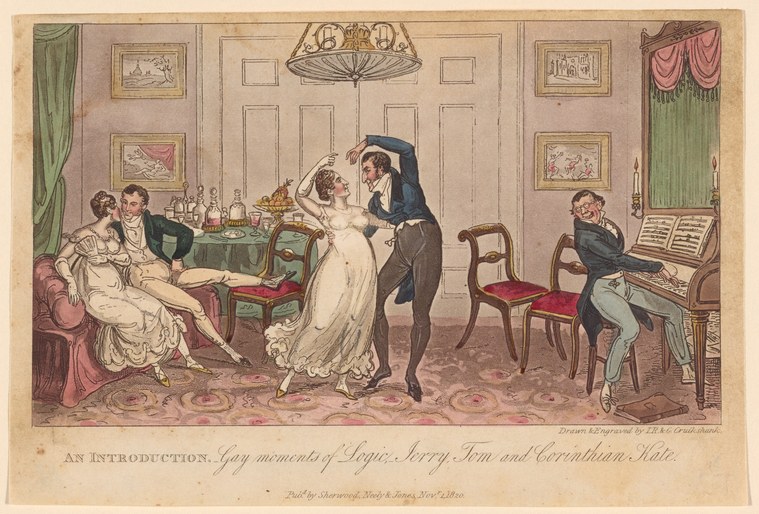
An introduction: Gay moments of logic, Jerry, Tom and Corinthian Kate
Unknown artist
- Collection:
- Prints depicting dance
- Source:
- New York Public Library
- Rights:
- Public domain — free to use, share and adapt.
- Recorded as:
- Public Domain
This work documents the Regency drawing room as a space where social dance and courtship were inseparable, and where the presence of musicians and the arrangement of figures reveal the period's understanding of dance as part of genteel social life. For historians of dance, it is evidence of how the ballroom extended into the parlor, and how the 'gay moments' of flirtation were understood as a form of performance akin to dance itself.
What you are looking at
An elegant drawing room scene of the early 19th century, with a polished wooden floor and fashionable furnishings. A young woman in a high-waisted white muslin gown stands at the center, her body turned toward a tall man in dark coat and breeches who appears to be adjusting her bonnet or headdress in a flirtatious gesture. To the left, two couples sit on pink upholstered furniture beside a small table with bottles and glasses; to the right, a man in light breeches sits at a pianoforte reading from sheet music. The room is lit by a ceiling fixture and framed by green curtains. The composition captures a moment of social interaction—the standing couple's interaction suggests courtship or romantic play, while the musicians and seated guests create a narrative of a genteel gathering, possibly a ball or drawing-room entertainment.
The dancing
The central female figure stands upright in a relaxed but graceful posture, wearing the high-waisted empire silhouette characteristic of Regency dress. The male figure bends slightly toward her head in a gesture that is intimate without being improper—his hand raised suggests he is touching or arranging her bonnet. The seated figures maintain the upright carriage and composed bearing expected in formal society; the pianist's posture is attentive. No closed ballroom hold is visible; the standing pair are at conversational distance rather than in dance position. The overall impression is of social propriety observed with flirtation at its edges.
The dance depicted
The title and scene suggest this may depict social dancing or its prelude rather than formal choreographed dance. The central figures are not in a recognizable ballroom hold, and no visible footwork indicates a specific dance in progress. The piano player and the general drawing-room setting suggest this is a Regency-era social gathering where dancing might occur, but the moment captured appears to be one of courtship, conversation, and musical accompaniment rather than the dance itself. The 'gay moments' referenced in the title may allude to the flirtation and social performance of Regency courtship rather than to dance steps. Without clearer evidence of a specific dance style—such as a waltz frame, quadrille formation, or cotillion positioning—the work should be classified as depicting Regency-era social life with dance as context rather than subject.
How it was made
This is a hand-colored engraving or aquatint, a technique well-suited to satirical social commentary and fashionable scenes of the Regency period. The fine linear work defining the figures and interior details suggests engraving; the soft color washes indicate hand coloring applied after printing. This technique allowed for multiple copies to circulate among the middle and upper classes, making such works popular for their social and satirical content. The combination of precise line work and delicate color is typical of British satirical prints of circa 1800–1820.
About this work
This is a Regency-era print depicting a fashionable drawing-room scene centered on the social performance of courtship. A young woman in high-waisted muslin dress is the focus of a gentleman's flirtation while musicians and other guests create an atmosphere of genteel entertainment. The print captures the ritualized social dancing and courtship of the Regency period, when drawing-room gatherings were occasions for both musical performance and the delicate choreography of romantic interaction. The title's reference to 'gay moments of logic, Jerry, Tom and Corinthian Kate' suggests these are named characters engaged in witty social exchange, typical of satirical prints that documented fashionable life and its foibles. The work belongs in a gallery of dance in art because it documents the social context in which Regency dances—waltzes, cotillions, and quadrilles—took place, and because the entire scene is structured as a kind of social performance in which courtship itself follows a choreography.
How to look at it
Attend to the precise moment chosen: not the dance itself, but the instant before or beside it—the gentleman's gesture toward the lady's bonnet as an act of flirtation performed under the watchful eyes of witnesses. Notice how the artist has structured the scene as a kind of performance, with the seated audience to the left, the musicians to the right, and the young couple at center stage. The drawing-room setting, with its fashionable furnishings and careful arrangements, shows that Regency social life was understood as theater. The title's reference to named characters suggests this is not documentary but social satire—a witty commentary on the recognizable types and rituals of fashionable courtship.
The artist
The artist is not recorded. The print was published by Sherwood, Neely & Jones on Friday, November 27, 1801, suggesting it was issued as part of a series of fashionable satirical scenes. The style is consistent with London satirical and social-commentary printmaking of the early 19th century, a tradition that included artists such as James Gillray and Thomas Rowlandson, though this work lacks their distinctive signatures. The naming of characters in the title suggests the print was meant to be read as a scene from a play or narrative of fashionable life.
The period
The Regency period (1811–1820, though this print predates the formal Regency by a decade) saw an explosion of fashionable social dancing in London's drawing rooms and assembly rooms. The waltz—still considered daring for its closed hold—was beginning to circulate, while the cotillion, quadrille, and English country dances remained dominant. This print dates to 1801, when the high-waisted empire silhouette was at its height, and when drawing-room entertainment by amateur musicians was a staple of genteel life. The satire of the period often focused on the pretensions and rituals of fashionable society, documenting how young people navigated courtship within strict social codes. The presence of a piano and the fashionable dress indicate an urban, prosperous setting where such entertainment was accessible.
Where it lives
The print is held in the New York Public Library's collection of prints depicting dance. It was published by Sherwood, Neely & Jones on Friday, November 27, 1801, suggesting it was issued as a commercial print for the London market.
Dance in this work
Questions about this work
Is this a scene of actual dancing?
Not in the formal sense. The central couple are not in a ballroom hold, and the moment captured is one of flirtation and social interaction rather than choreographed dance steps. The piano player and drawing-room setting indicate that dance and music were the context for this scene of Regency courtship, but the print focuses on the social performance of flirtation rather than dance itself.
What does the title tell us?
The title 'An introduction: Gay moments of logic, Jerry, Tom and Corinthian Kate' suggests these are named characters—Jerry (the gentleman with the bonnet), Kate (the lady), and possibly Tom and another character among the seated guests. 'Gay moments' refers to lighthearted, witty social exchanges; 'logic' may be ironic, suggesting the supposedly rational arguments lovers use to justify their flirtation. This is a satirical scene of fashionable courtship.
Who are these people?
They are unnamed types of fashionable Regency society. The gentleman's dark coat and the lady's high-waisted muslin gown are the uniform of fashionable youth; the other figures represent the social context—musicians, witnesses, and companions. The named characters in the title suggest they may be recognizable types or archetypes of fashionable life, but their identities beyond that are unknown.
What was a Regency drawing room like?
A prosperous merchant's or gentleman's drawing room was a space for social entertainment, where young people gathered under the supervision of parents and chaperones. Music, particularly on the pianoforte, was essential; singing and dancing occurred, along with card games and conversation. This print shows how such rooms were staged for social performance, with careful attention to furnishings, dress, and the arrangement of figures.
More dance artwork





