49 works in this view — arrow keys or swipe to move between them.
Dance in Art
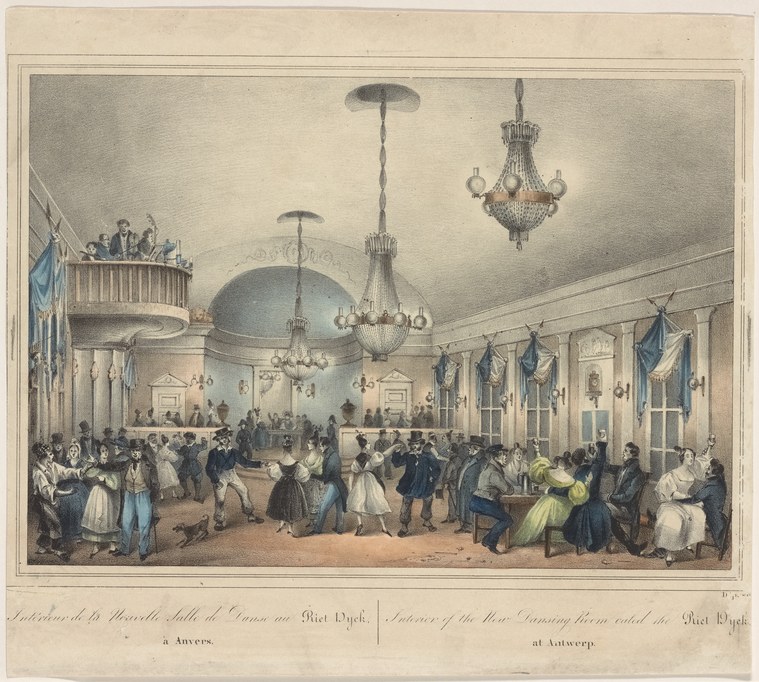
Interior of the new dancing room called the Riet Dyck at Antwerp
Unknown artist
- Collection:
- Prints depicting dance
- Source:
- New York Public Library
- Rights:
- Public domain — free to use, share and adapt.
- Recorded as:
- Public Domain
Few images survive that show Regency ballroom dancing in actual use within named public spaces; this print documents both the choreographic structure of early 19th-century set dances and the social architecture that housed them. For historians of ballroom dance and Regency social practice, it is a rare snapshot of how dancing was integrated into urban public life and built environment.
What you are looking at
A grand ballroom interior filled with elegantly dressed couples dancing and socializing. The space is dominated by a large domed ceiling with decorative plasterwork and three ornate chandeliers—two large multi-tiered fixtures suspended from the dome and ceiling, and one smaller hanging light. The architectural style suggests early 19th-century neoclassical design, with tall arched windows along the walls draped with blue fabric, white pilasters, and wainscoting. The floor appears to be polished wood in a reddish-brown tone. Dozens of figures in formal dress—men in dark coats and women in high-waisted white and pale-colored gowns characteristic of the Regency period—are distributed across the floor in small groups and dancing pairs. Some couples perform what appears to be a coordinated figure dance in the center, while others stand in conversation or promenade around the room. The composition suggests a moment of ordered social dancing rather than informal movement, with the crowd arranged to allow sight lines across the space.
The dancing
The dancers occupy upright postures consistent with early 19th-century ballroom etiquette. Couples appear to be in closed or semi-closed holds appropriate to Regency-era country dances and quadrilles, with arms positioned at mid-height and bodies oriented toward one another or in line with the set. The women's high-waisted Empire silhouette gowns hang vertically, permitting visible footwork. The male figures are consistently vertical and restrained in bearing. No pointe work, dramatic arm extensions, or theatrical gestures are evident; the movement appears social, regulated, and focused on geometric precision rather than expressive display.
The dance depicted
This depicts a Regency-era ballroom scene, most likely showing a quadrille, cotillion, or country dance—the dominant social dances of the 1810s–1830s. The title's reference to 'dancing room' and the formal arrangement of couples in floor patterns suggests a set dance requiring coordination among multiple pairs, consistent with historic-regency social practice. The presence of an orchestra or musicians (implied by the formal setting) would have provided music for such figures. The image documents the social and architectural context of Regency dancing rather than technical detail, emphasizing that these dances occurred in purpose-built public spaces as social events drawing mixed-gender crowds of the urban middle and upper classes.
How it was made
This is a hand-colored engraving or aquatint, as indicated by the fine linear hatching visible in the architectural details, the soft tonal gradations in the domed ceiling, and the selective application of watercolor tints to fabrics and skin tones. The technique allowed for wide distribution as a print, and the careful architectural rendering suggests the venue itself—the Riet Dyck in Antwerp—was of sufficient social note to warrant documentation. The coloring appears to be applied by hand after printing, as is evident from slight variations in pigment intensity. This object type indicates circulation among subscribers or purchasers interested in contemporary social venues and fashionable practice.
About this work
This is a documentary print of a fashionable public ballroom in Antwerp during the Regency era, capturing the architectural setting and social choreography of formal dancing in the early 19th century. The work functions as both architectural record and social document, showing how Regency ballroom dancing was structured, dressed, and spatially organized in a prosperous Continental city. It belongs in a dance history collection as evidence of ballroom culture, venue design, and the codified etiquette of social dancing in the period immediately preceding the dominance of the Romantic ballet.
How to look at it
Notice the architectural precision with which the space is rendered—the dome, the chandeliers, the proportioned fenestration—which frames the dancing as a designed social activity occurring within a designed structure. Observe how the figures are distributed: no single dramatic couple dominates; instead, multiple pairs perform in coordination, and many figures stand in conversation or promenade, emphasizing that dancing was one element within a broader social event. The formal dress and upright postures signal a completely different body culture from later theatrical forms; elegance here means restraint and geometric accuracy, not extension or display.
The artist
The artist is not recorded. The print was published as a commercial document of a contemporary venue, suggesting it was likely made by a professional printmaker or architectural illustrator active in Antwerp or the Low Countries during the Regency period. The quality of execution and hand-coloring indicates a modest but competent commercial operation.
The period
This image dates to the Regency era (approximately 1811–1820 in Britain, with parallel developments in Continental Europe), when ballroom dancing underwent significant formalization. The quadrille, imported from France, was establishing itself as the dominant set dance in fashionable society. Public ballrooms and assembly rooms had become standard features of urban social life in prosperous towns. The Romantic movement was beginning to reshape theatrical dance (Romantic ballet emerged in the 1830s–1840s), but social dancing remained conservative, geometric, and centered on partnership and precise figures. This print reflects the apex of Regency social-dance culture before the theatrical innovations that would follow.
Where it lives
The work is held in the New York Public Library's collection of prints depicting dance. It was made for commercial distribution as a commemorative or promotional print documenting the Riet Dyck, a public ballroom venue in Antwerp.
Dance in this work
Questions about this work
What were the Riet Dyck and why document it?
The Riet Dyck was a named public ballroom in Antwerp, one of many assembly rooms and dancing venues established in prosperous Continental cities during the Regency period. Such venues were documented in prints to promote them to potential subscribers and to commemorate their architectural and social significance. Public ballrooms were markers of urban refinement and social organization.
What dances are being performed here?
The formal arrangement and presence of multiple coordinated couples suggests a quadrille, cotillion, or English country dance—the standard set dances of the 1810s–1820s. These required several couples arranged in a square or line, performing memorized figures in synchronized patterns. The precise identification cannot be determined from the image alone, but the spatial organization and dress are consistent with these forms.
How does this compare to earlier ballroom images?
Regency ballroom scenes prioritize architectural grandeur and social order over dramatic gesture. Unlike Baroque court-dance imagery, which might emphasize individual virtuosity, this print shows dancing as a collective, regulated social practice embedded in public institutions. The rise of purpose-built public ballrooms reflects the expansion of dancing beyond the aristocratic court into the urban middle class.
Why are all the women wearing white?
High-waisted white and pale gowns in Empire silhouette were the fashion standard for ballroom dancing during the Regency period. White conveyed elegance, formality, and modernity (the style was influenced by neoclassical aesthetics). The uniformity of dress codes—men in dark formal coats, women in pale gowns—reinforced the formality and social cohesion of the event.
More dance artwork





