49 works in this view — arrow keys or swipe to move between them.
Dance in Art
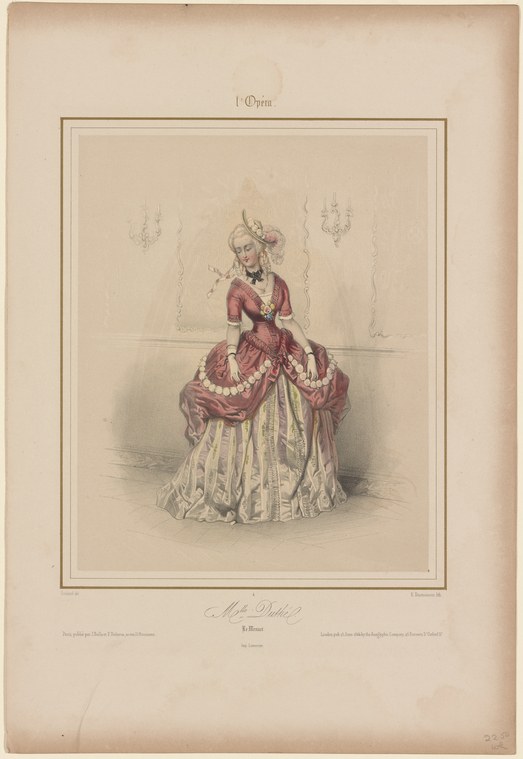
L'Opera. Mlle Duthé. Le menuet
Unknown artist
- Collection:
- Prints depicting dance
- Source:
- New York Public Library
- Rights:
- Public domain — free to use, share and adapt.
- Recorded as:
- Public Domain
This image is direct visual evidence of how a celebrated 18th-century dancer actually looked, how she dressed, and how she held her body in the minuet—the dance form that defined refined movement for a century. It shows that the minuet was not merely a country-dance but a theatrical art with celebrated soloists, professional technique, and a market for images of those performers. For historians of dance, deportment, and 18th-century celebrity, Duthé's portrait is invaluable documentation.
What you are looking at
A single female dancer stands in the center of an elegant interior, posed in a formal theatrical attitude. She wears an elaborate mid-18th-century court gown in deep rose or burgundy silk with a cream or pale yellow underskirt, the voluminous skirts gathered at the sides to reveal the lighter fabric beneath. The bodice is fitted and trimmed, the sleeves short and delicate. Her hair is styled high with ornamental decoration, and she wears what appears to be a small cap or headdress. The setting is a simple classical interior with a plain wall behind her, two elegant candelabra mounted on the wall at shoulder height on either side, and a horizontal dado line suggesting a paneled room. The figure is shown in three-quarter view, weight on one leg, the other extended or posed in an attitude of graceful repose. The engraving employs soft shading to model the figure and create depth, with the background left largely empty to focus attention entirely on the dancer's silhouette and costume.
The dancing
The dancer occupies a single, static pose rather than mid-movement. Her posture is upright and dignified, with the body weight settled and the spine extended. One leg appears to support her weight while the other is extended or held in a ballet attitude, though the exact foot position is not sharply defined in the print. The arms are positioned with apparent grace and control, one likely raised or extended to the side in a manner consistent with the formal vocabulary of courtly dance. The overall frame is symmetrical and composed, emphasizing display of the costume and deportment rather than dynamic motion.
The dance depicted
This is a theatrical portrait of Mademoiselle Duthé, a celebrated dancer of the 18th century, posed to display the menuet—the minuet—one of the most formal and codified dances of the period. The minuet was a courtly dance of French origin that dominated ballroom and theatrical stages throughout the 18th century. It was danced by a single couple or, for theatrical or court display, by a solo dancer as in this image. The minuet required controlled, turned-out movement, precise footwork, and an elegant carriage of the body. Duthé's pose here is not caught mid-figure but rather presents the ideal form of the dancer as refined by theatrical training—the epitome of grace and aristocratic bearing that the minuet demanded.
How it was made
This is a hand-colored engraving, printed from a metal plate and finished with watercolor or gouache to add the pinks, creams, and fleshtones visible in the image. The technique allowed for fine linear detail in the hair, facial features, and ornamental details of the costume, while the shading created dimension. The presence of a signature or artist attribution area at the bottom (partially legible) and the professional finish suggest this was a commercial print, likely sold as a theatrical portrait to patrons interested in the dance and in Duthé's performance. Such prints circulated widely among the French and European cognoscenti as both souvenirs and documentation of celebrated performers.
About this work
This is a theatrical portrait engraving of Mademoiselle Duthé, a major figure in 18th-century French dance, posed to exemplify the minuet in its refined, courtly form. The image documents not a moment of action but the ideal carriage and costume associated with one of Europe's most important dances. The minuet was the foundation of aristocratic dancing throughout the period and remained a touchstone of refinement long after its heyday. Duthé, active in the mid-to-late 18th century, was known for the elegance of her technique and her command of the courtly repertoire. This portrait preserves her name and the association between her body, her art, and the minuet—one of the most influential dances in Western history.
How to look at it
Observe the careful attention to the dancer's stance: the turned-out legs, the upright carriage, and the controlled placement of the arms are all expressions of the minuet's aesthetic. Look at the costume detail—the trim, the texture suggested by the engraver's line work, and the way the voluminous skirt is arranged to show both the outer and inner fabrics. The candelabra framing the figure suggest a theater or ballroom setting, emphasizing Duthé's status as a performer meant to be seen and admired. The absence of a partner and the static pose are conventions of the theatrical portrait, not deficiencies—they allow the viewer to study the dancer's form and bearing as one would study a statue.
The period
The minuet reached the height of its prestige in the 18th century, dominating European ballrooms, opera houses, and court ceremonies. By the mid-century, when this print was likely made, the minuet had become the standard by which a dancer's training and elegance were measured. Professional dancers like Duthé performed the minuet on stage as a solo or in theatrical contexts, and their fame—along with their portraits—circulated among the educated public through engravings. The costume shown here is characteristic of mid-to-late 18th-century theatrical dress: hoops or panniers have fallen out of favor in the most fashionable circles, but the full skirt, tight bodice, and exposed bosom remain markers of courtly femininity and aristocratic status. The print itself is a product of the age's appetite for celebrity portraiture and documentation of performance.
Where it lives
This engraving is part of the New York Public Library's collection of prints depicting dance. Such theatrical portraits were commercial products sold to the public and to patrons of the theater, circulated as souvenirs and documents of celebrated performers.
Dance in this work
Questions about this work
Who was Mademoiselle Duthé?
She was a celebrated dancer of the 18th century, known for her elegance and command of the courtly dance vocabulary, particularly the minuet. She performed in the leading theaters of her time and was famous enough to be the subject of multiple portrait engravings.
What is the minuet and why is it important?
The minuet was the dominant social and theatrical dance of the 18th century, a formal, courtly dance of French origin characterized by turned-out legs, precise footwork, and dignified carriage. It defined the standard of refinement in movement and was danced by aristocrats, professionals, and social dancers alike for over a century.
Why would a dancer be portrayed in a pose rather than in motion?
The theatrical portrait tradition valued the presentation of ideal form and elegance over the capture of movement. A static pose allowed the engraver to show the dancer's carriage, training, and costume with maximum clarity and precision, displaying her as a work of refined art rather than documenting a specific step or figure.
More dance artwork





