49 works in this view — arrow keys or swipe to move between them.
Dance in Art
People of Argentina, Brazil, Paraguay, and Uruguay
Unknown artist
- Collection:
- Prints depicting dance
- Source:
- New York Public Library
- Rights:
- Public domain — free to use, share and adapt.
- Recorded as:
- Public Domain
This print is primary-source evidence for how theatrical dance was costumed, posed, and understood in the 18th century—and crucially, how it was represented to be circulated and consumed. The figure's controlled command of the body in motion, the theatrical use of costume and props, and the professional finish of the print all speak to a mature, codified performance tradition that influenced the development of ballet and theatrical dance across Europe.
What you are looking at
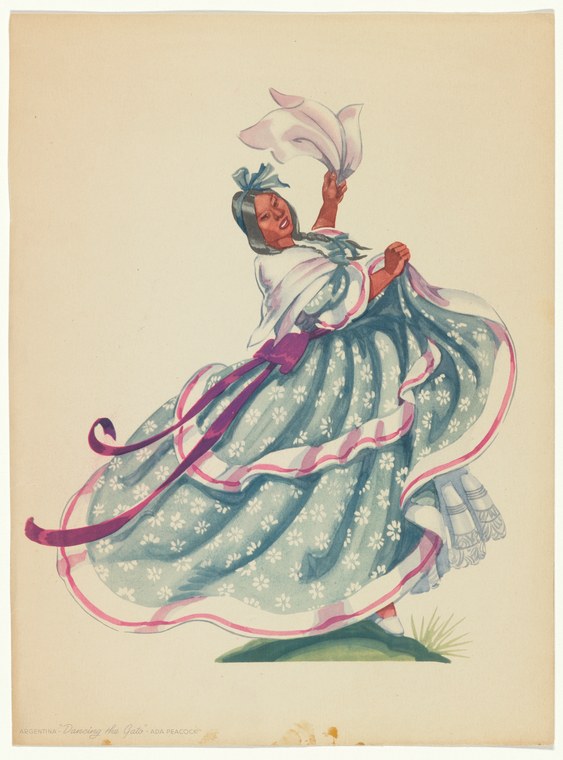
A single figure in an elaborate theatrical costume dominates the composition, posed in a dynamic, upright stance against a plain cream background. The dancer wears a striking teal-and-pink ensemble: a fitted bodice in deep teal with ornamental clasps, topped with an elaborate white collar or fichu, and a voluminous skirt of teal silk with white floral or brocade patterning and a deep pink silk underskirt visible at the hem. The figure's head is tilted back and to the left, adorned with what appears to be a dark head-dress or turban with blue feathering. One arm is raised overhead in a graceful arc, holding what looks like a pale pink silk scarf or streamer that floats upward; the other arm is bent at the elbow. The dancer wears light-colored stockings and small heeled shoes, and the pose suggests a moment of rotation or suspension—the body leans slightly, the weight seemingly transferred to one leg while the figure achieves an elegant upward extension. The lower body is cut off at the knees by the picture frame, emphasizing the swirl and volume of the skirt. A small grassy ground line in dark green anchors the figure at the base.
The dancing
The single dancer is pictured at the height of a turn or lift, with the torso twisted and opened, the head thrown back in an attitude of joy or abandonment. The raised arm and floating scarf suggest the completion of a rotation—the body follows the line of the lifted arm in an S-curve, with the weight appearing to be on one planted leg while the other is concealed in the skirt volume. The pose demonstrates understanding of balletic frame and port de bras: the upper body is extended and composed, the arm position is refined and controlled despite the apparent momentum, and the overall carriage speaks to trained movement.
The dance depicted
This appears to be a record of theatrical dance as it was practiced in the 18th century, most likely a professional court or commercial stage entertainment. The costume is consistent with Rococo court dress and masquerade fashion, and the pose resembles attitudes found in contemporary dance imagery—particularly the whirling or pirouetting figures of theatrical dances that became popular in European ballrooms and stages during this period. The figure's pose and theatrical presentation suggest this may document a named dance or character-dance of the period, but without signature, inscription, or caption, the specific dance type cannot be confirmed. The pink silk ribbons or scarves were stock props in Rococo dance imagery, often associated with French contredanse or theatrical versions of folk-derived dances.
How it was made
This is a hand-colored engraving or possibly a colored aquatint, executed with fine line work that is visible in the shading of the figure's garments and the delicate rendering of the pleats and folds. The technique of color applied over the engraved plate—particularly the careful gradation of the teal tones and the luminous quality of the white overlay—suggests professional hand-coloring, likely applied in a workshop. The print shows evidence of age in the cream of the paper and the slight irregularities of hand application. Such prints were produced in considerable volume during the 18th century and distributed across Europe, functioning as records of theatrical costume and as souvenirs of fashionable entertainments.
About this work
This is a single-figure portrait print documenting a performer in theatrical costume, posed mid-movement in an attitude consistent with 18th-century Rococo stage dance. The inscription at the lower margin (partially legible in the source) likely identifies the figure or the dance depicted. The work belongs to a large category of European dance prints produced from the 1720s onward that recorded the costumes, attitudes, and theatrical dances of professional and court performers. Such prints served both as documentation of performance practice and as fashionable prints for wealthy collectors.
The catalogue assigns this to a series titled 'People of Argentina, Brazil, Paraguay, and Uruguay,' which is inconsistent with the evident 18th-century European provenance and style of the work. The costume, technique, and compositional conventions are European, the hand-coloring is consistent with 18th-century continental printmaking, and there is no visual evidence of South American context. This discrepancy warrants investigation.
How to look at it
The viewer should attend to the moment chosen: not the beginning or end of the turn, but the apex, where the body is suspended and the scarf trails in the air. The artist has frozen a instant of apparent weightlessness, which was a standard convention in theatrical dance portraiture—the goal was to show virtuosity and grace, not naturalism. Note the way the lifted arm and floating scarf lead the eye upward and to the left, creating a diagonal thrust that animates the composition. The teal-and-pink palette is characteristic of Rococo taste and may have been chosen for its visual impact in the original theatrical venue as well as on the print. The pose's refinement—the angle of the head, the curve of the torso, the position of the feet—all speak to a performer of training and status.
The artist
The artist is not recorded. The quality of the engraving and the refinement of the hand-coloring suggest a professional workshop production, likely produced in France, the Netherlands, or northern Italy, where such prints were manufactured in quantity during the 18th century. The style and technique are consistent with the mid-18th-century print trade centered on theatrical costume documentation and fashionable entertainment imagery.
The period
This print dates visually to the mid-18th century, a period of extraordinary expansion in European theatrical dance and an equally vigorous trade in dance-related prints. The Rococo style seen in the costume—the emphasis on pastel colors, asymmetry, flowing silk, and theatrical ornamentation—was at its height in the 1750s–1770s. This was also the era of the French contredanse, the quadrille, and the theatrical minuet, all of which were recorded in similar single-figure or group prints. Dance was shifting from courtly accomplishment toward professional spectacle, and prints like this one tracked and promoted that transition. The figure's pose and the use of floating scarves are conventions that appear repeatedly in dance prints of this era and suggest a shared vocabulary among artists, dancers, and audiences about what 'theatrical dance' looked like.
Where it lives
The work is held in the NYPL in a collection designated 'Prints depicting dance.' The catalogue record associates it with a series titled 'People of Argentina, Brazil, Paraguay, and Uruguay,' though this attribution does not align with the visual evidence.
Dance in this work
Questions about this work
What is the person wearing, and why?
The figure is dressed in a costume blending fashionable Rococo court dress with theatrical exaggeration: a fitted teal silk bodice with ornamental clasps, a white linen fichu or collar, and a voluminous skirt of teal silk with white brocaded flowers and a shocking-pink silk underskirt. The pink was expensive and eye-catching, signaling wealth and theatrical importance. The dark headdress with blue feathers was a theatrical ornament, not everyday wear. This combination of fashionable cut and theatrical excess was typical of 18th-century stage performers.
Is this a real dance or a made-up pose?
It is almost certainly both. The pose documents an attitude or moment from a named theatrical dance of the period—likely a contredanse, theatrical minuet, or court dance recorded in gesture and costume. The artist was not inventing movement but rather preserving a convention: the way a specific dance was performed at a specific moment in a European theater or ballroom. These prints were used as records and as fashion documents, circulating the 'correct' performance style across courts and cities.
Why is the scarf floating?
The scarf or ribbon was a standard prop in 18th-century theatrical dance and served practical and aesthetic purposes: it extended the line of the arm, made large movements more visible from a distance, and created a graceful accent during turns or lifts. Its floating position here records the moment of rotation or suspension, emphasizing the virtuosity of the movement. Scarves also had fashionable appeal—pale silk ribbons were luxurious and costly, and their prominence in performance costumes made them desirable in theater and masquerade.
Why does the catalogue call this 'People of Argentina, Brazil, Paraguay, and Uruguay'?
That attribution is difficult to reconcile with the visual evidence. The costume, engraving technique, and compositional style are clearly 18th-century European, most likely French or Italian. There is no iconographic evidence of South American context. It is possible the work was catalogued in error or that the series title reflects a later grouping that was inaccurately applied. Further research would be needed to clarify the provenance and correct attribution.
More dance artwork





