49 works in this view — arrow keys or swipe to move between them.
Dance in Art
La pavane
Unknown artist
- Collection:
- Prints depicting dance
- Source:
- New York Public Library
- Rights:
- Public domain — free to use, share and adapt.
- Recorded as:
- Public Domain
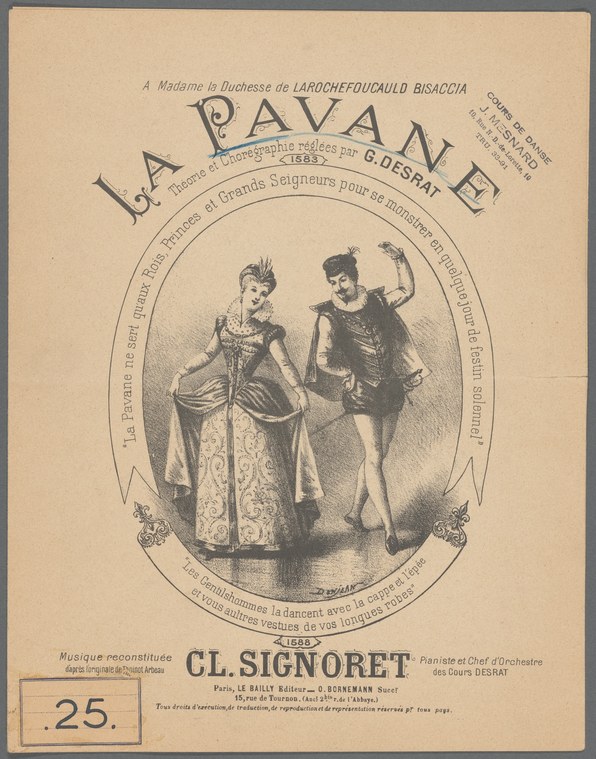
The pavane is a foundational courtly dance, and this image documents how it was presented to concert audiences and musicians in the era when historical reconstruction of early music was becoming systematic. The formality and distance between the figures—no contact, no visible footwork—teaches us what the pavane was thought to be by scholars of this period: a ceremonial, processional gesture rather than an athletic or intimate dance.
What you are looking at
A decorative title page or cover for a dance score, with the title *La Pavane* in large letters across the top. The central image shows two figures in Renaissance costume: a woman in an ornate patterned dress with a high waistline and full skirt, her posture formal and upright, and a man in dark hose and tunic beside her, gesturing toward her in a courtly manner. The woman's dress suggests the 16th century, with elaborate brocaded or embroidered fabric. The figures are contained within an oval frame, with decorative flourishes and small heraldic or ornamental devices at the base. Surrounding the oval is text in French describing the work, indicating this is a published musical composition. At the foot of the page are credits: the music is reconstituted after G. Gombosi, and the orchestration is by Cl. Signoret, with publication details for Paris (Le Bailly, Éditeur; Schoenemann). The overall design is typical of late 19th-century theatrical or musical publication, with fine line engraving or lithographic reproduction.
The dancing
The man stands to the right with his left arm extended toward the woman in a gesture of invitation or courtly presentation, his weight shifted slightly forward. The woman faces forward, her arms held at her sides or with hands visible but not engaged with her partner—a formal, poised stance. Both figures are upright and dignified, maintaining distance rather than contact. The gesture reads as a moment of courtly salutation or opening rather than active dance movement. The man's posture suggests deference and courtesy; the woman's suggests composed reception.
The dance depicted
The pavane (or pavan) was a slow, stately processional dance of the Renaissance and early Baroque, popular among the nobility of 16th and 17th century Europe. It was a couple dance typically performed in formal procession, with dignified, measured steps and minimal upper-body movement. The illustration captures the opening moment of the dance—the man's gesturing invitation to the woman—rather than the movement itself. The costumes are consistent with 16th-century Court dress, and the formal presentation aligns with the pavane's role as a ceremonial dance of courtship and social hierarchy. The reconstitution credited to G. Gombosi suggests this is a scholarly revival or arrangement of a historical dance score.
How it was made
This is a line engraving or lithograph, evident from the fine hatching and linear detail used to render the figures' costumes and the decorative frame. The reproductive technique allowed multiple copies to be distributed with printed music, making it a commercial publication object rather than a unique work. The oval format and decorative border are typical of 19th-century music-publishing design. The quality of the engraving—precise but not highly refined—suggests it was produced for a general educated audience rather than as a luxury edition.
About this work
This is a title-page illustration for a published piano or orchestral score of *La Pavane*, a Renaissance dance reconstituted from historical sources by the musicologist G. Gombosi and orchestrated by Cl. Signoret in Paris. The engraving shows two courtly figures at the moment of salutation that begins the dance, their formal costume and bearing evoking the 16th-century court milieu in which the pavane originated. As both a dance image and a document of musical publication and historical revival, it belongs in the gallery as evidence of how the pavane was remembered and reconstructed in the late 19th century, when interest in historical dance was linked to the broader Romantic recovery of Renaissance culture.
How to look at it
Attend to the distance and formal posture of the two figures: there is no embrace, no intertwined arms, and the woman is not leaning into the dance. The man's gesture is one of courtly invitation, not physical partnership. This tells us the pavane was conceived as a procession of dignity and decorum, a social rather than intimate dance. The elaborate dress of the woman—especially the wide, rigid skirt and high waist—also indicates that actual movement would be constrained and measured; big steps or vigorous action would be impossible in such costume.
The artist
The work credits G. Gombosi for the musical reconstitution and Cl. Signoret for orchestration. G. Gombosi (likely Ottó Gombosi, the Hungarian-born musicologist, 1902–1955, though dating would require verification) was known for historical research into Renaissance and early Baroque music. Signoret arranged and orchestrated the score for concert performance. The illustration itself is uncredited, typical of commercial music publishing of the period.
The period
The late 19th and early 20th centuries saw a widespread revival of Renaissance and Baroque music and dance, driven by musicologists and choreographers seeking to recover 'authentic' historical practice. The pavane, which had vanished from living court tradition, became an object of scholarly reconstruction and concert performance. This score represents that movement toward historical authenticity and the theatrical presentation of early dances to modern audiences. The aesthetic of the engraving itself—the formality of the design, the period costumes—was part of how publishers signaled cultural gravity and historical importance.
Where it lives
This is a page from a published musical score printed in Paris in the late 19th or early 20th century. It belongs to the NYPL's collection of prints depicting dance, and is classified as a reproductive print (engraving or lithograph) rather than a unique artwork. It serves as both a document of dance and a document of music publishing.
Dance in this work
Questions about this work
What is the pavane?
The pavane (or pavan) was a slow, processional dance of the Renaissance and early Baroque courts, popular in the 16th and 17th centuries. It was performed by couples in formal dress as part of court ceremony, with measured steps and an emphasis on dignity and courtly bearing rather than vigorous movement. It often preceded faster dances like the galliard.
Who danced the pavane?
The pavane was danced by the European nobility and courtiers, particularly in the royal courts of France, Spain, Italy, and England. It was a mark of social status and refinement, and was typically danced in formal procession before an assembled court. Kings and queens often led the pavane at state occasions.
How do we know what the pavane looked like?
We know the pavane from written descriptions in dance manuals of the period, from notation systems like Labanotation applied to historical sources, and from scholarly reconstruction by musicologists and dance historians. This illustration represents one such reconstruction, commissioned from a musical score. No video or photograph of the original dance exists.
Who was G. Gombosi?
G. Gombosi was likely the musicologist Ottó Gombosi (1902–1955), though the credit on this score requires verification. Gombosi was a respected scholar of Renaissance and early Baroque music who undertook historical research and reconstruction of early musical works.
More dance artwork





