49 works in this view — arrow keys or swipe to move between them.
Dance in Art
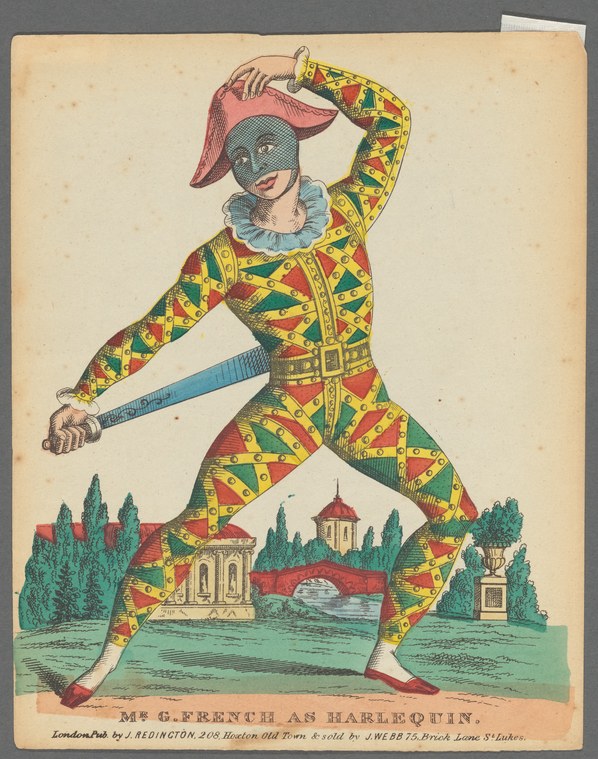
Mr. G. French as Harlequin
Unknown artist
- Collection:
- Prints depicting dance
- Source:
- New York Public Library
- Rights:
- Public domain — free to use, share and adapt.
- Recorded as:
- Public Domain
Harlequin was one of the most influential dance-theater characters in the Western tradition, and this print documents how a real performer embodied the role in early modern England, showing the acrobatic physicality and costume spectacle that defined the character. For anyone studying the history of theatrical dance, commedia dell'arte, or pantomime, this image is direct evidence of how the character was actually performed and presented to audiences.
What you are looking at
A figure in a vibrant harlequin costume strikes an exuberant pose, one leg extended in a wide lunge and one arm raised above the head holding a sword or staff. The figure wears a full-body suit of yellow, red, and green geometric patterns arranged in a diamond and cross design, with a ruffled white collar at the neck. The head is covered with a mask in grey or dark tone and topped with a pink or red three-cornered hat. The background depicts a pastoral landscape with cypress trees, a small chapel or church building with a domed roof, and a red-roofed structure on the right, all rendered in soft greens and muted colors that recede behind the figure. The harlequin dominates the composition, shown at nearly life scale against a much smaller architectural setting, emphasizing the theatrical nature of the costume and character.
The dancing
A single dancer fills the frame in a dynamic open position: the weight appears to be on one leg while the other extends into a full lunge, the torso lifted and twisted to open the chest toward the viewer. The raised arm extends upward at an angle, holding an implement that could be a sword, staff, or theatrical prop. The posture suggests arrested motion—a moment of stylized action rather than a naturalistic step. The body is fully extended through the limbs with an exaggerated elegance typical of pantomime and commedia dell'arte performance.
The dance depicted
This is a theatrical character portrait of Harlequin (Arlecchino), the iconic servant from Italian commedia dell'arte. The image documents performance style rather than a named dance, but the pose reflects the acrobatic, gestural vocabulary of commedia performers who combined pantomime, physical comedy, and dance in their improvisational comedies. The wide lunge, extended arm, and theatrical mask are consistent with the character's role as a nimble, witty servant—the stylized athleticism visible here was foundational to commedia performance, which influenced dance and theater throughout Europe. The inscription 'Mr G. French as Harlequin' indicates this is a portrait of a specific London performer in the role, documenting how the character was embodied on the English stage.
How it was made
This is a hand-colored engraving or woodcut, printed from a block or plate and then colored by hand—a technique typical of English theatrical prints from the late 18th and early 19th centuries. The inscription at the bottom identifies it as published by J. Redington in London. The medium allowed for mass circulation: multiple impressions could be made from the same plate and distributed to theaters, print shops, and collectors, making this form of theatrical documentation widely accessible. The combination of bold outline and bright hand coloring served promotional purposes, advertising the character and the performer to potential audiences.
About this work
This is a character portrait of a specific actor, Mr. G. French, performing as Harlequin in the commedia dell'arte tradition on the English stage. The print documents both a role and a performer, showing how the pantomimic acrobatics of commedia were translated into English theatrical practice. Harlequin remained a staple of English pantomime and popular theater well into the 19th century, and this image captures the exaggerated physicality and visual spectacle of the character—the impossible flexibility, the bright costume, the theatrical weaponry—that made him a crowd-pleasing figure. The work belongs in a dance collection because commedia dell'arte was foundational to Western theatrical dance, influencing everything from pantomime ballet to modern physical theater, and because this image documents the physical vocabulary and costume conventions of a living tradition of performance.
How to look at it
The viewer should attend to the arrested action: this is not a naturalistic moment of walking or standing, but a stylized pose held for theatrical effect. The extended limbs, the upturned face, the swagger of the costume—all are designed to be read from a distance by an audience in a theater. The figure fills the entire composition and dominates the landscape behind it, emphasizing that this is a portrait of a character and performer, not a scene of action. Notice how the geometric precision of the costume pattern, the bright colors, and the mask all work together to create visual impact: this is costume design as performance in itself, and the print documents that design with clarity and color.
The artist
The artist is not recorded in the catalogue. The print was published by J. Redington of Hoxton Old Town, London, a printer and publisher of theatrical imagery in the late 18th and early 19th centuries. The style is consistent with English theatrical prints of the period, which were typically produced for sale to playgoers and collectors interested in documenting performers and popular characters.
The period
This print dates to the era when Harlequin was enjoying enormous popularity on the English stage, particularly in pantomime productions and harlequinade afterpieces. Commedia dell'arte had arrived in England via Italian touring companies and French influence and had been thoroughly absorbed into English popular theater by the 17th century. By the 18th and 19th centuries, Harlequin and his companions (Columbine, Pantaloon, Clown) were stock characters in English pantomime, particularly at Christmastime. The acrobatic, mask-based physical comedy of commedia influenced early modern ballet, and the theatrical energy of characters like Harlequin remained a touchstone for dancers and choreographers seeking to break from classical ballet's strictness. Theatrical prints like this one were important mass-market documents of popular performance culture, sold in the foyers of theaters and print shops.
Where it lives
This print is held in the New York Public Library's collection of prints depicting dance. It is a hand-colored engraving or woodcut, published by J. Redington in London (the exact date is not recorded in the catalogue). Such prints were produced in quantity for theatrical audiences and collectors.
Dance in this work
Questions about this work
Who was Harlequin?
Harlequin (Arlecchino) was a stock character in Italian commedia dell'arte—a servant or fool known for acrobatic physical comedy, quick wit, and improvisation. The character was adopted across Europe and became a staple of English pantomime and popular theater from the 17th century onward. Harlequin was often paired with Columbine (a female lover) and Pantaloon (an old man), and the plots typically involved comic chases, magical transformations, and physical gags.
What is the connection to dance?
Commedia dell'arte combined mime, acrobatics, music, and stylized movement into a form of physical theater that was ancestral to many kinds of theatrical dance. The exaggerated gestures, the open body positions, and the emphasis on controlled athleticism visible in this print influenced the development of pantomime ballet and remain part of physical theater practice today. Early modern dancers and choreographers saw commedia not as quaint folk performance but as a living model for expressive movement.
How was Harlequin performed on the English stage?
In England, Harlequin appeared most famously in pantomimes, especially elaborate Christmas productions. These combined music, transformation scenes, slapstick comedy, and acrobatic movement. The character was known for quick changes of costume, the wielding of a sword (often used for comic business), and the ability to leap, tumble, and twist the body in surprising ways. The character's success depended on the physical virtuosity and comedic timing of the performer.
What does 'Mr. G. French' tell us?
The inscription indicates this is a portrait of a specific London actor who performed as Harlequin. Such character portraits were sold as souvenirs and advertisements, allowing theater-goers to own a colored print of their favorite performer in a beloved role. Theatrical prints were an important form of popular visual culture and celebrity documentation before photography.
More dance artwork





