49 works in this view — arrow keys or swipe to move between them.
Dance in Art
People of Argentina, Brazil, Paraguay, and Uruguay
Unknown artist
- Collection:
- Prints depicting dance
- Source:
- New York Public Library
- Rights:
- Public domain — free to use, share and adapt.
- Recorded as:
- Public Domain
For historians of Afro-Brazilian and South American carnival, this print is evidence of how early chromolithography circulated and aestheticized the visual culture of celebration. For dancers and costumers, it documents an early record of the silhouette, ornament, and scale of South American festive dress. The work sits at the intersection of dance history and the history of ethnographic representation—it tells us as much about how Europe saw South American bodies as it does about the dances themselves.
What you are looking at
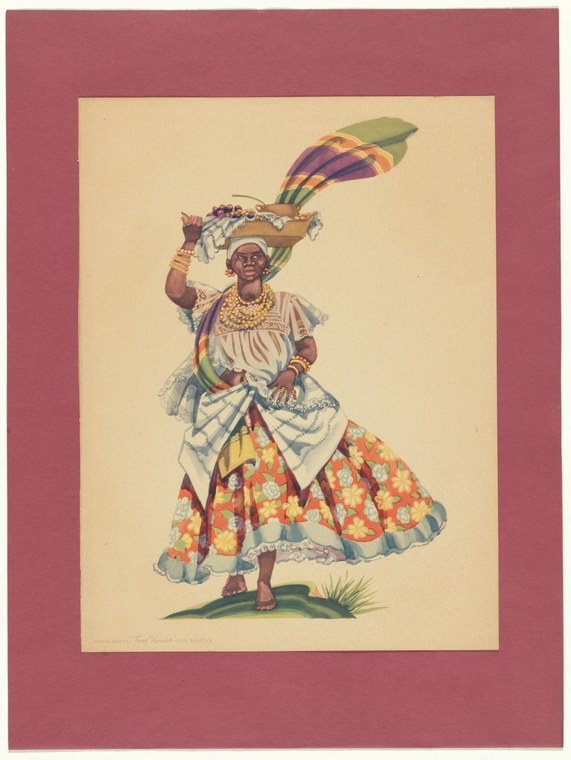
A woman stands in dynamic, celebratory pose against a cream background, her body angled in a moment of exuberant movement. She wears a vibrant patterned skirt in warm reds and yellows with geometric designs, layered with voluminous white underskirts that billow outward, creating a full silhouette. Her upper body is wrapped in a cream-colored draped cloth and embellished with gold beaded necklaces; a decorative headdress or crown sits atop her head. Her left arm is raised high, holding what appears to be a feathered object—possibly a fan or ceremonial object in purple, blue, and gold. Her right arm extends outward in an open gesture. The figure stands on a minimal grassy ground line, isolated against the pale background in a manner typical of early 20th-century ethnographic prints. The image employs hand-coloring techniques with flat, bright hues that emphasize the costume's richness rather than creating depth or shadow.
The dancing
A single female dancer is shown in a moment of upright, celebratory lift. Her weight appears centred and grounded, with both feet visible on the earth, while her upper body achieves buoyancy through the raised arm and open torso. The pose is frontal and declarative rather than balletic—the body does not display turned-out turnout or the compressed verticality of classical training. Instead, the gesture is open and expansive, the raised arm high and natural rather than held in a codified frame. The cloth wraps and jewelry suggest costume designed for visibility and ornamental display rather than movement efficiency.
The dance depicted
This print appears to document a celebratory or processional dance from South American carnival or festival tradition, most likely from Brazil, Argentina, Paraguay, or Uruguay as the title indicates. The exuberant pose, patterned skirt, and ornamental headdress are consistent with Afro-Brazilian carnival costume, though the specific dance form cannot be identified from the frozen moment alone. The artist has captured a moment of peak energy and display rather than a technical step sequence. The woman's stance suggests a vernacular celebratory dance tradition rather than any codified European or classical form.
How it was made
This is a hand-colored print, likely a lithograph or chromolithograph from the early 20th century, based on the technique's characteristic flat colour fields, crisp outlines, and the manner in which the figure is isolated against a plain ground. The hand-coloring adds specificity to costume details that a single-colour print could not convey—the geometric patterns of the skirt, the gold of the jewelry, the purple of the feathered object. The technique allowed for rapid production and wide circulation as an ethnographic or souvenir image, likely intended to document or exoticize the peoples and festivals of South America for a northern European or North American audience.
About this work
This hand-colored print documents a moment of carnival or festival celebration in early 20th-century South America, capturing a woman in the full regalia of celebration. The work belongs to a tradition of ethnographic printmaking that used the new chromolithographic techniques to circulate images of non-European cultures and festivals across collecting markets in Europe and North America. It is valuable not as a precise record of dance technique but as evidence of how South American vernacular celebration was visualized, commodified, and consumed through European print culture. The work shows interest in costume, ornament, and the body in celebratory display—the registers through which early 20th-century audiences encountered distant carnival traditions.
How to look at it
The viewer should attend to the moment the artist chose: a moment of peak expansion and lift, not a grounded step or technical sequence. Notice how the open arm and raised gesture create a sense of joy and declaration rather than virtuosity. The costume detail—the layered skirts, the specific density of pattern and ornament—was as important to the artist's purpose as the dance itself. The print records how the body moves through ornament and display, which is the language of carnival rather than the codified vocabularies of ballet or trained technique.
The period
Early 20th-century chromolithography made colour printing affordable and rapid, enabling the large-scale circulation of ethnographic and colonial imagery. South American carnival had become a subject of fascination in European visual culture; the technologies of colour printing allowed these distant festivals to be visualized and sold as novelties and souvenirs. At the same moment, South American carnival was undergoing its own transformation—the formalization of samba schools in Rio and the professionalization of carnival processions were beginning to codify what had been more diffuse festive practices. This print captures a moment in which vernacular South American dance was becoming a visual commodity in the print market.
Where it lives
This work is held in the New York Public Library's collection of prints depicting dance, catalogued within a broader series titled 'People of Argentina, Brazil, Paraguay, and Uruguay.' It is one of a set of chromolithographs documenting South American peoples and festivals, likely produced in the early 20th century as ethnographic or souvenir material.
Dance in this work
Questions about this work
What carnival is this from?
The title indicates South America generally—Argentina, Brazil, Paraguay, or Uruguay—but this print does not specify a location or festival. Based on the costume and pose, it most likely documents Brazilian carnival, but cannot be certain. The work is evidence of how ethnographic prints often generalized and homogenized the specific practices of distinct regions and communities.
Is this a real dance or a European fantasy?
The costume details and celebratory pose are consistent with documented South American carnival practice, particularly Afro-Brazilian festival dress. However, the print was created for a European or North American audience and reflects how those audiences wanted to see South American bodies and festivals. It is simultaneously documentary and constructed—a record filtered through the aesthetics and commercial interests of early 20th-century print culture.
Why is she holding that feathered object?
Feathered fans and ornamental objects were and remain part of South American carnival costume, used for gesture, visual impact, and the extension of the body in celebratory display. The specific function of this object cannot be determined from the image alone, but it is clearly meant to amplify the gesture and ornament of the moment.
What does the headdress indicate?
The ornamental crown or headdress is consistent with South American carnival royalty or queen regalia, indicating that this figure may represent a carnival queen or dignitary rather than a participant in a mass celebration. The ornament and frontal pose support this interpretation of display and status.
More dance artwork





