49 works in this view — arrow keys or swipe to move between them.
Dance in Art
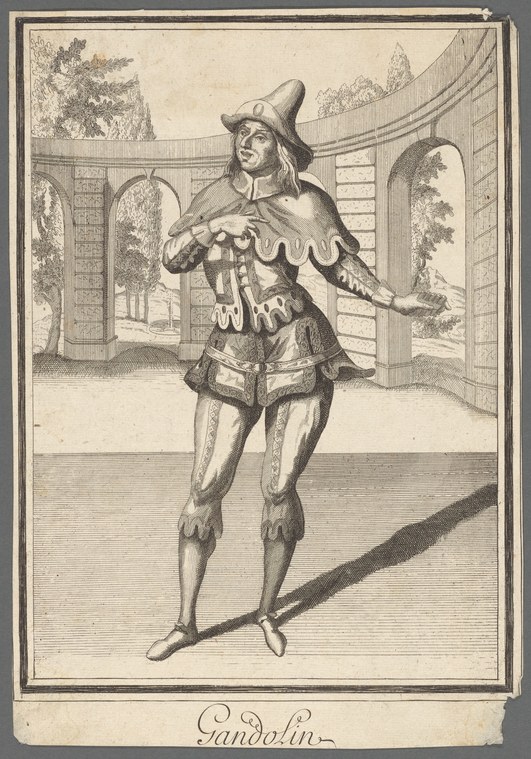
Gandolin
Unknown artist
- Collection:
- Prints depicting dance
- Source:
- New York Public Library
- Rights:
- Public domain — free to use, share and adapt.
- Recorded as:
- Public Domain
This image is a rare early document of theatrical performance practice and costume in the age before photography. For historians of dance and theatre, it provides concrete visual evidence of the deportment, gestural vocabulary, and dress codes of a named character type in the European stage tradition. For performers and choreographers, it reveals how theatrical character was communicated through static pose—a principle that persisted long after commedia dell'arte faded, and that remains relevant to contemporary practice.
What you are looking at
A single male figure dominates the composition, posed in a theatrical stance within a classical architectural setting. He wears early modern dress: a broad-brimmed hat, a scalloped doublet or jerkin with decorative edging, hose, and light shoes. His weight rests on one leg while the other is extended, and his arms are raised in an expressive gesture—one hand near his chest, the other extended outward. The setting is a colonnade or courtyard with rounded arches, cypress trees visible in the background, and carefully rendered stonework suggesting Renaissance or early Baroque architecture. The figure casts a strong shadow on the ground, emphasizing the bright, directional light. This is a formal engraving, likely a single-sheet print made for circulation, with the title 'Gandolin' inscribed at the foot.
The dancing
The dancer's stance is a single elevated pose rather than a captured moment of movement. Weight is unequally distributed between the legs, with one foot planted and one extended—a position familiar from court dance deportment. The arms frame the torso asymmetrically: one hand is positioned across or toward the chest in a gesture of address or display, while the other extends outward in a welcoming or presentational manner. The carriage of the upper body is upright and proud, the head held high beneath the hat. This is a static portrait pose rather than an action shot, consistent with the convention of displaying a character or role.
The dance depicted
This appears to be a character portrait or commedia dell'arte figure rather than a depiction of active dancing. The title 'Gandolin' suggests a named character—possibly 'Gandolino' or a variant, a character type that appears in early modern Italian comedy. The pose and dress align with the theatrical stock characters of the commedia dell'arte tradition, in which named figures (Pantalone, Arlecchino, Il Dottore, etc.) were embodied by travelling performers. The choreographic content is minimal: this is presentation rather than movement, a formal introduction of the character to the viewer. The engraving may have circulated as a reference image for performers, a pattern for costume, or a documentation of a famous portrayal.
How it was made
This is a finely executed engraving—established by the regular parallel hatching visible in the shadows, the precise line work, and the clarity of detail throughout. The technique of engraving required the artist to incise lines into a copper plate, a laborious process that produced prints of high tonal range and detail. The presence of a neat border frame and careful composition suggests this was a commercial print, likely from the late 16th or early 17th century. Such engravings circulated widely and inexpensively, making them an accessible form of visual documentation; they were pasted into collections, used as costume references, studied as models, and collected by performers and patrons. The print therefore likely reached an international audience and may have influenced theatrical practice across Europe.
About this work
This is a formal theatrical character portrait in engraving, showing a costumed male figure in the dress and pose conventions of early modern stage performance. The inscription 'Gandolin' identifies the character represented, and the architectural setting lends dignity and formality to what is likely a commedia dell'arte stock type. The work documents both the visual culture of Renaissance and early Baroque theatre and the performance conventions of a period in which character types, costumes, and gesture vocabularies were codified and circulated widely through prints. As a print, it is evidence of how theatrical knowledge and style spread across Europe before the era of photography: through engravings like this one, performers in distant cities could learn about costume, character, and the physical grammar of stage presence.
How to look at it
Attend to the precise positioning of the body: this is not a moment caught in motion, but a carefully composed introduction. The artist has chosen an asymmetrical stance that conveys both stability and character—weight favoring one leg, the torso erect, the gesture of the hands addressing the viewer directly. Notice how the shadow grounds the figure spatially, and how the architectural setting frames and ennobles him. This is the vocabulary of Renaissance court portraiture applied to theatrical character: the pose says 'this is who I am, this is the bearing and dress of my type.' The broad-brimmed hat, the scalloped doublet, the elegant hose—all are stage costume, rendered with the precision of a fashion or reference document.
The period
This engraving belongs to the period of the commedia dell'arte's flourishing in Italy and its rapid export across Europe (late 16th–early 17th century). During this era, theatrical performance was becoming codified into stock characters with recognizable costumes, masks, and movement vocabularies. Engravings of performers and characters served both as advertisements and as instructional documents, circulating among players and patrons. The formal architectural setting here reflects the dignity that was increasingly claimed for theatre as a form of art and learning. The print tradition was central to the dissemination of theatrical knowledge in an age before recorded media; Callot's famous engravings of commedia figures (from a slightly later period) built on a well-established convention.
Where it lives
The work is held in the New York Public Library's prints collection, catalogued as part of a broader collection of dance imagery. It is a single-sheet engraving, likely separated from an album or series of theatrical character portraits, and now survives as an isolated print.
Dance in this work
Questions about this work
Who is Gandolin?
The inscription suggests a character type or a named role in theatrical performance, most likely from the commedia dell'arte tradition. Without additional documentary evidence, we cannot confirm the exact identity or the specific performances in which this character appeared. However, the costume and pose indicate a stock character of the Renaissance or early Baroque theatre, circulated in print form so that performers across Europe could learn and imitate the role.
Is this person actually dancing?
No—this is a static portrait pose, not a depiction of active dance movement. However, the standing position and the carefully arranged gesture are part of the movement vocabulary and stage presence of early modern theatre. The pose communicates character, status, and deportment as effectively as any action scene might have done.
Why was this engraved and printed?
Theatrical character engravings served multiple purposes: they advertised famous performers and celebrated roles; they provided costume and gesture references for actors in other cities; and they were collected as documents of fashion, theatre, and cultural curiosity. As a widely circulated print, this image would have influenced how the character was performed elsewhere, making it an important tool for the international dissemination of theatrical style.
What can this tell us about how people danced in the Renaissance?
While this is not an active dance scene, it shows us the posture, dress, and gestural conventions of theatrical performance in the period. The upright carriage, the precise positioning of the limbs, and the formal use of space reflect broader ideals of movement and deportment that governed both court dance and theatrical performance.
More dance artwork





