49 works in this view — arrow keys or swipe to move between them.
Dance in Art
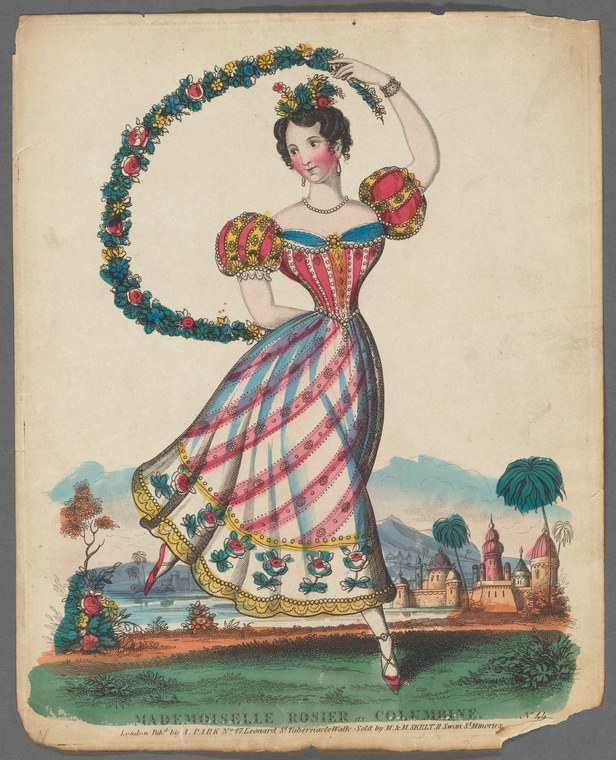
Mademoiselle Rosier as Columbine
Unknown artist
- Collection:
- Prints depicting dance
- Source:
- New York Public Library
- Rights:
- Public domain — free to use, share and adapt.
- Recorded as:
- Public Domain
This image documents the fusion of commedia dell'arte character with balletic movement vocabulary during the Romantic era—a crucial moment when theatre dancing in Britain was adopting the aesthetic and technique of classical ballet while maintaining the narrative and comic traditions of pantomime. It is also rare evidence of a named female performer in a named role, allowing us to trace how the character of Columbine was danced and visualized by a specific artist in a specific moment. The souvenir print itself is a primary document of how theatre was consumed, celebrated, and remembered by ordinary playgoers.
What you are looking at
A young woman in an elaborate theatrical costume dominates the composition, positioned as if mid-performance against a picturesque landscape backdrop. She wears a striking corseted bodice in pink and gold with enormous puffed sleeves decorated with ornate patterns, and a skirt with diagonal striped fabric in pink, blue, and gold, trimmed with a scalloped gold border embroidered with floral motifs. She holds a large wreath of green foliage studded with pink roses in an arc above her head, and her dark hair is styled in the fashion of the early 19th century with an ornamental comb or feather. Her pose is balletic and graceful, with one leg extended and her body angled to display the costume's silhouette. Behind her stretches a romanticized landscape with distant mountains, palm trees, a body of water, and an orientalist architectural fantasy of domed buildings and minarets—the kind of theatrical backdrop common to spectacular pantomimes. The entire image has been colored by hand, with delicate washes of watercolor or similar medium applied to the printed base.
The dancing
A single figure is portrayed in an extended, lightly balletic pose—the body lifted and elongated, one leg beneath her and the weight seemingly distributed to enable turning or stepping forward. Her arms are raised asymmetrically: one holds the heavy floral wreath aloft, the other extends upward in a graceful arc typical of early 19th-century theatrical gesture. The pose suggests lightness and buoyancy rather than strength, with the corseted torso held upright and the head tilted to create a line of elegant elongation from hip to crown. There is no partner; the dancer commands the entire visual field alone.
The dance depicted
This is Columbine, a principal character from the commedia dell'arte tradition adapted into pantomime and harlequinade—genres hugely popular in London theatres throughout the 19th century. The character of Columbine evolved from a witty, resourceful female servant into a romantic heroine who often danced in spectacular theatrical productions. The pose and costume suggest a moment of solo display or triumph, possibly from a transformation scene or finale. The exotic landscape setting (though entirely invented) and the emphasis on balletic posture indicate this belongs to the world of Romantic-era theatrical entertainment rather than authentic commedia dell'arte; the fusion of classical ballet vocabulary with pantomime character is characteristic of English pantomime as it developed after 1800. The wreath and uplifted arms suggest a moment of apotheosis or celebration—a visual peak in the narrative arc.
How it was made
This is a hand-colored lithographic or engraved print, established from the fine linear framework visible beneath the watercolor washes and the printed text at the base. The printing process allowed rapid, relatively inexpensive reproduction and circulation to a broad middle-class audience. The hand-coloring—applied selectively but with some care—indicates this was a higher-quality production intended for sale individually or as part of a theatrical souvenir series. The technique is typical of London theatrical prints from the 1820s–1840s, a period when such souvenir images of famous performers in famous roles flooded the market and became a form of theatrical publicity and fan merchandise.
About this work
This is a record of a specific theatrical performance: Mademoiselle Rosier dancing the role of Columbine, the witty heroine of commedia dell'arte tradition as it was reimagined in English pantomime. The print captures a moment of heightened theatrical display—the character poised in a balletic attitude within an orientalist fantasy landscape, her costume a riot of fashionable Regency color and silk. It belongs to a vast commercial genre of theatrical souvenir prints that documented famous performers and celebrated roles, serving as both keepsakes and advertisement. For dance historians, it is evidence of how classical ballet vocabulary (the lifted posture, the extended line) permeated theatrical character dance in the early 19th century, and how commedia dell'arte—originally improvisatory and physical—became increasingly codified into balletic spectacle.
How to look at it
Notice the tension between balletic refinement and theatrical spectacle. The artist has frozen the dancer at a moment of display—one leg extended, arms lifted asymmetrically—a pose drawn from the vocabulary of classical ballet rather than the improvised, grounded movements of traditional commedia dell'arte. Yet the setting and costume are pure fantasy pantomime: the invented oriental landscape, the exaggerated puffed sleeves, the wreath held aloft like a prop. This is where theatre dancing lived in 1820–1840: caught between two vocabularies. Watch the line created by the body—the elongation from toe to head—and notice how the weight appears distributed to create an impression of weightlessness and ease. This is neither folk dance nor court dance; it is theatrical character dance refracted through the prism of Romantic ballet aesthetics. The colors, applied by hand to the printed image, are theatrical and somewhat arbitrary; they tell us this was meant to evoke the spectacle and artifice of the stage, not fidelity to lived costume.
The period
This print dates to the early 19th century, an era of explosive popularity for English pantomime and harlequinade. Pantomime had evolved from its 18th-century roots into a spectacular, multi-act entertainment featuring elaborate scenery, transformation scenes, music, and dancing. The character of Columbine, originally the witty servant girl of commedia dell'arte, had been elevated to romantic heroine status and was now often danced en pointe or in a balletic style imported from the London stage's increasing engagement with continental ballet. Mademoiselle Rosier was one of many French and European dancers who performed in London theatres during this period, bringing refined technique to roles traditionally associated with pantomime. The hand-colored print was a mass-produced commodity, sold in theatre lobbies and print shops, serving as both souvenir and advertisement. This coincides with the period when lithography made theatrical prints suddenly affordable and ubiquitous—a crucial moment in the democratization of theatrical imagery.
Where it lives
This print is held in the New York Public Library's collection of prints depicting dance. It is a hand-colored lithograph or engraved print, a form of mass-produced theatrical merchandise typical of the early 19th-century London theatre trade. The text at the base confirms it was published in London by J. Fairbrother, suggesting it was one of a series of such souvenir prints circulating among theatregoers.
Dance in this work
Questions about this work
Who was Mademoiselle Rosier?
The catalogue record names her only as 'Mademoiselle Rosier' without additional biographical information. She was one of many European dancers performing in London theatres during the early 19th century. The fact that a souvenir print was made of her performance suggests she was a well-known or celebrated performer of the time, but further details are not available in the present record.
What is Columbine, and why does she have a wreath?
Columbine is a female character from commedia dell'arte, originally a clever servant girl. In English pantomime, she evolved into a romantic heroine and was often the focal point of spectacular final scenes or 'apotheosis' moments. The wreath held aloft here suggests a moment of triumph, celebration, or magical transformation—characteristic staging for a pantomime finale or transformation scene.
Is this actually a ballet or a pantomime?
It is pantomime—specifically English harlequinade—but one informed by the balletic aesthetics of the Romantic era. The dancer adopts balletic posture and uses ballet vocabulary, but within the context and costume of theatrical character dance. By the 1820s–1840s, these boundaries were increasingly fluid. Columbine could be danced in a balletic style even within a pantomime narrative.
What can we learn from a souvenir print like this?
These prints are invaluable records of how specific performers embodied famous roles at specific moments in theatrical history. They document costume, pose, and the visual ideology of performance—what the theatre chose to celebrate and sell. They also show us what playgoers valued enough to buy and keep: the glamour, the spectacle, the named performer in a named role. For dance historians, they provide rare evidence of movement vocabulary and aesthetic ideals in action.
More dance artwork





