49 works in this view — arrow keys or swipe to move between them.
Dance in Art
Il vero merito
Unknown artist
- Collection:
- Prints depicting dance
- Source:
- New York Public Library
- Rights:
- Public domain — free to use, share and adapt.
- Recorded as:
- Public Domain
Acro-dance and partner acrobatics have been largely written out of dance history, classified as circus or athletics rather than dance. This engraving is evidence that 19th-century audiences and artists recognized partner acrobatics as a legitimate dance form worthy of serious artistic representation. The title's explicit claim that this is *merit*—artistic achievement—offers a counterargument to the hierarchy that separated 'serious' dance (ballet) from 'popular' or 'spectacular' dance.
What you are looking at
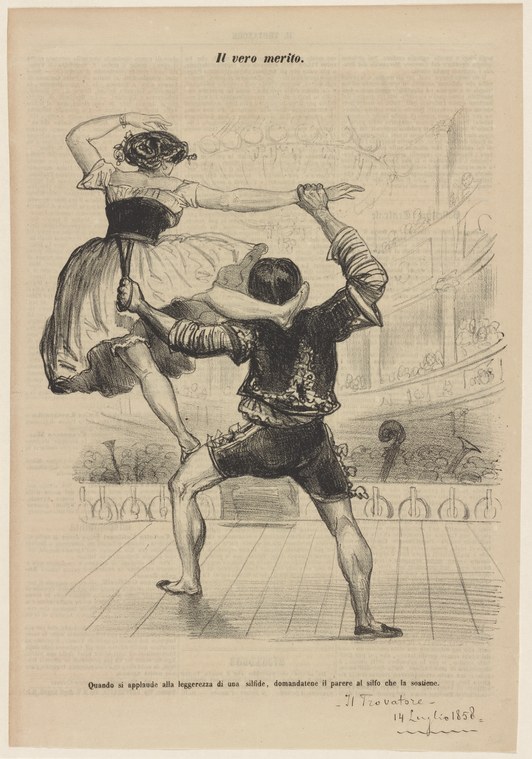
A young male acrobat in a black costume with decorative trim performs an acro-dance lift, holding a woman in a pale dress aloft with one arm while balancing on one leg. The woman's body is fully extended horizontally, her arm reaching toward the viewer, her elaborate hat with feathers tilted precariously. The acrobat's musculature and posture emphasize the extraordinary strength required; his free arm is raised for counterbalance, his supporting leg is locked and trembling with effort. The setting is a theatrical interior with a wooden floor marked with perspective lines, suggesting a stage or studio space. In the background, barely sketched architecture and another figure suggest an audience or witness. The Italian title *Il vero merito* (True Merit) appears at the top, suggesting the image celebrates the skill and dedication required for this feat.
The dancing
Two figures in a vertical acro-dance configuration: the male dancer (likely the protagonist) is in a deep single-leg stance with his torso upright and twisted, holding the woman's body parallel to the ground using only his raised arm and core strength. The woman is fully extended horizontally, her body a clean plank from head to toe, her head turned away from the support point and her far arm reaching outward in a graceful line that contradicts the brutal mechanics below. The asymmetry—his grounded effort against her weightless extension—creates a dramatic visual and kinetic contrast. The artist has captured the moment of maximum extension and maximum danger.
The dance depicted
This is acro-dance, or partner acrobatics (adagio), a performance practice in which one dancer (typically male) supports another (typically female) through extreme flexibility and strength feats. The image depicts what appears to be a classic adagio lift or balance—the woman's horizontal body position and the man's single-leg stance are hallmarks of early acro-dance vocabulary. Acro-dance as a codified theatrical form emerged in European circuses and music halls in the 19th century, though partner acrobatics have much older roots. The title's emphasis on *merito* (merit) suggests this work was made to celebrate the discipline and artistry behind what audiences might otherwise dismiss as mere showmanship.
How it was made
This is an engraving or etching, executed with fine cross-hatching and linear shading to model form and suggest movement. The medium allowed precise anatomical detail and dramatic tonal contrast between the figures and the lightly sketched background. The technique implies this is a reproductive print, likely made for circulation in European art journals, newspapers, or collected portfolios of caricature or social commentary. The style and subject matter suggest mid-to-late 19th-century origin, when such prints were common vehicles for documenting and satirizing popular entertainment.
About this work
A theatrical engraving depicting two performers in an acro-dance (partner acrobatics) configuration, with a male dancer supporting a fully extended female dancer on one arm while balancing on a single leg. The title *Il vero merito* claims this feat as an expression of genuine artistic merit rather than mere circus spectacle. The work sits at the intersection of popular entertainment, theatrical documentation, and fine-art printmaking—a common 19th-century practice of elevating dance and circus performance to the status of serious artistic study. The image celebrates the strength, control, and grace required for partner acrobatics at a moment when such work was gaining legitimacy as a theatrical art form rather than purely commercial attraction.
How to look at it
Attend to the moment of extreme extension the artist has chosen: the acrobat is at the limit of what a human body can do, and the woman's graceful horizontal line masks the enormous force required to hold her aloft. Notice how the artist uses the woman's outstretched arm and tilted hat to create a line of elegant instability—she appears weightless, yet the viewer knows that weightlessness is an illusion created by invisible muscular effort below. The contrast between the lightly sketched background and the intensely detailed figures emphasizes that the human body—stretched to its limit—is the true subject. The perspective lines on the floor ground the scene in a theater or studio, but the composition is almost sculptural: the two figures form a single, improbable structure.
The artist
The artist is not recorded. The style is consistent with mid-to-late 19th-century European satirical and theatrical printmaking, possibly French or Italian given the Italian title and the evident familiarity with music-hall and circus performance. The handling suggests a competent professional engraver accustomed to documenting contemporary entertainment.
The period
In the mid-to-late 19th century, acro-dance and partner acrobatics were flourishing in European music halls, circuses, and variety theaters. The same period saw a rigid stratification in dance discourse: ballet, performed by women in pointe shoes on raised stages, was deemed 'art'; circus and music-hall acrobatics were deemed 'spectacle.' Yet contemporaneous prints like this one show that audiences and artists did not always accept that boundary. The title's insistence on *merito* reflects an ongoing cultural negotiation about what counted as dance and art. Simultaneously, fine artists and printmakers were increasingly interested in documenting popular performance as a subject worthy of serious attention.
Where it lives
The work is held in the New York Public Library's collection of prints depicting dance. It is a reproductive print, suggesting it was made for wide circulation and would have appeared in journals, newspapers, or collected portfolios of contemporary entertainment imagery.
Dance in this work
Questions about this work
Is this acro-dance the same as modern gymnastics?
No. Acro-dance, or partner acrobatics, is a dance form that blends acrobatic feats with artistic movement, timing, and musicality. Modern gymnastics is a separate sport. However, in the 19th century, the boundary between circus acrobatics, dance, and athletic performance was much more fluid. This print documents a moment when partner acrobatics were recognized as dance.
Why does the title say 'True Merit'?
The title is a claim: it asserts that what looks like mere spectacular showmanship is actually a serious artistic achievement. In the 19th century, ballet was celebrated as high art while acrobatic performance was often dismissed as popular entertainment. This print pushes back against that hierarchy, insisting that acro-dance requires and deserves recognition as genuine artistic merit.
How do we know this is acro-dance and not something else?
The configuration is unmistakable: a male dancer in a single-leg balance supporting a female dancer's fully extended horizontal body. This is the classic pose of partner acrobatics or adagio. The anatomical knowledge shown by the artist—the precise positioning of the weight, the tension in the supporting leg, the graceful extension of the held figure—confirms that the artist understood the form.
More dance artwork





