49 works in this view — arrow keys or swipe to move between them.
Dance in Art
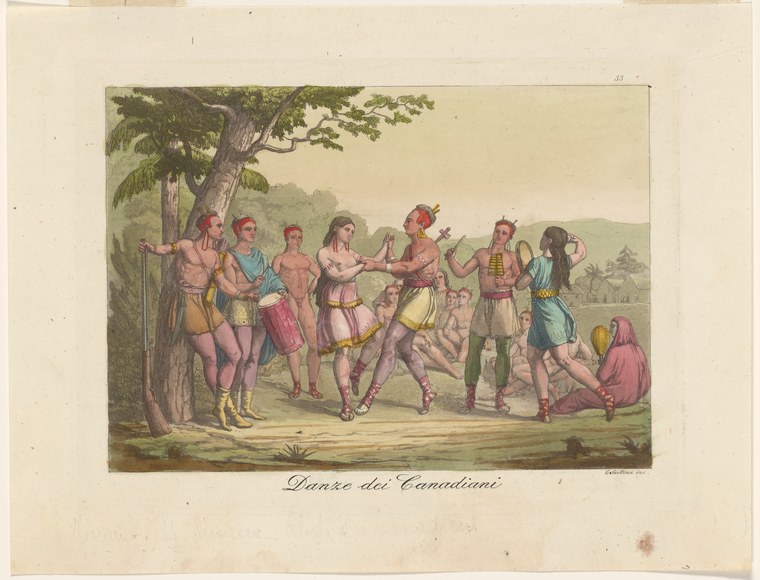
Danze dei Canadinani
Unknown artist
- Collection:
- Prints depicting dance
- Source:
- New York Public Library
- Rights:
- Public domain — free to use, share and adapt.
- Recorded as:
- Public Domain
This work illustrates how dance imagery participated in the colonial project: representing Indigenous bodies in motion served to confirm European ideas about cultural difference and 'savagery' versus 'civility.' For historians of dance, it demonstrates that choreography and movement have always been sites where power is exercised—where dominant cultures visualized and thus partially controlled how they imagined other peoples moved and expressed themselves. The image is a primary document of European attitudes toward Indigenous movement culture, not Indigenous dance itself.
What you are looking at
A group of figures stands beneath a large tree on open ground, engaged in animated dance or celebratory movement. The composition centers on eight to ten standing figures in various poses of exertion and joy—some with arms raised, others gesturing broadly—arranged in a loose circle or gathering. The figures wear minimal clothing typical of European depictions of Indigenous peoples of the period: loincloths, minimal upper-body covering, and ornamental accessories including feathered headdresses and bands. In the middle distance, two seated figures—one in red, one in blue—observe from the ground. The background shows a distant settlement or encampment with structures visible on the horizon, and the landscape is rendered in soft greens and browns suggesting a temperate or tropical setting. The engraving uses hand-coloring to distinguish individuals and the natural environment, with the large tree dominating the left side of the composition as a framing device and natural shelter for the gathering.
The dancing
The dancers stand in a relatively open formation without formal holds or partnering. Postures are emphatic and include raised arms, bent knees, and turned-out stances suggesting physical exertion and celebratory energy. One figure in the center-right appears to be in an elevated or jumping position. The bodies face varied directions rather than maintaining lines or ranks, suggesting spontaneous, joyful movement rather than choreographed formation. No visible instruments are held by the dancers themselves, though the gathering may have musicians outside the frame.
The dance depicted
This is titled *Danze dei Canadinani* (Dances of the Canadians)—a European term for Indigenous peoples of northeastern North America and the Great Lakes region, particularly Haudenosaunee (Iroquois) and Algonquian nations. The image documents celebratory or social dance as understood through a colonial European lens in the 17th or 18th century. The lack of codified steps, the absence of formal partnering, and the emphasis on joyful, full-bodied movement suggest social or celebratory dance rather than ceremonial practice. However, the image is an European engraving and reflects the artist's imagination and artistic conventions rather than direct observation; it should be read as a representation of how colonizing Europeans imagined Indigenous dance, not as ethnographic documentation.
How it was made
This is a hand-colored engraving or possibly a colored etching, executed with the fine linework characteristic of 18th-century European print culture. The engraved lines are precise and create the underlying composition, while watercolor or hand-applied pigment adds the visible color. This technique was common for travel narratives, natural history volumes, and accounts of European contact with distant peoples, allowing for relatively affordable mass production of illustrated texts while maintaining fine detail. The hand-coloring makes each print semi-unique and suggests circulation in a educated or wealthy audience—collectors of travel literature, natural philosophy, or cabinet curiosities.
About this work
This is a European engraving documenting—or more accurately, imagining—Indigenous North American dance in the colonial period. The title identifies the dancers as Canadians, a term applied broadly to diverse nations of the Northeast and Great Lakes region. The work belongs to a long tradition of European visual representation of Indigenous peoples and their practices, particularly the attempt to capture movement and social custom through the medium of the engraved print. It is valuable not as evidence of actual Indigenous dance practice, but as a window into European aesthetic conventions, colonial assumptions about 'otherness,' and the role of visual culture in shaping European understanding of the Americas. The emphasis on joyful, uninhibited movement reflects European Romantic-era interest in 'natural' or 'primitive' peoples, seen as free from the constraints of civilized society.
How to look at it
Attend to the composition's emphasis on full-bodied, uninhibited movement: the raised arms, varied postures, and absence of the rigid posture or symmetric formation that would characterize European court dance of the same period. Notice how the engraver has chosen to freeze a moment of apparent joy and physical freedom—note the jumping or elevated figure, the open stances, the turned-out legs. Observe also the framing device of the tree and the distant settlement: the tree anchors the 'natural' setting, while the settlement reminds us that this gathering takes place in a colonized landscape. The two seated observers introduce an ambiguous note—are they non-dancers, a rest between movements, or evidence of the artist's own position as an external witness? The hand-coloring, applied after engraving, adds a documentary quality meant to convince the viewer of the accuracy of what they are seeing, even though the image is fundamentally a colonial fantasy.
The period
This engraving dates to an era when illustrated travel narratives and natural history volumes were central to European knowledge-making about the wider world. The 17th and 18th centuries saw explosive growth in European publication of accounts of colonial contact, accompanied by engravings meant to make distant peoples and places visually comprehensible to a metropolitan audience. During this same period, European dance culture was undergoing transformation—from the formal court dances of the Baroque to the emergence of more 'natural' or 'expressive' movement ideals associated with emerging Romantic aesthetics. The colonial gaze applied to Indigenous dance was shaped by these European preoccupations: Indigenous movement was seen as unmediated, emotional, and 'natural' in contrast to the cultivated artifice of European court or theatre dance. The large tree and open landscape situate the dance in an Edenic or 'natural' setting, reinforcing the contrast.
Where it lives
The work is held in the New York Public Library's collection of prints depicting dance. It is catalogued with minimal metadata, reflecting the era when many such prints were acquired as miscellaneous curiosities rather than as a coherent documented collection.
Dance in this work
Questions about this work
Is this accurate representation of Indigenous North American dance?
No. This is a European artist's imaginative reconstruction, shaped by Baroque and Romantic-era aesthetic conventions and colonial attitudes. It reflects European ideas about Indigenous peoples more than Indigenous dance practice itself. Actual Indigenous dances of the Northeast and Great Lakes had complex choreography, often tied to ceremony, storytelling, and seasonal observance—none of which is visible or understood in this image.
What does 'Canadinani' mean?
It is a Latinized or Italianized form of 'Canadian,' a term Europeans applied loosely to Indigenous peoples of the northeastern interior of North America, particularly the Great Lakes and St. Lawrence River regions. The term conflated many distinct nations and obscured the diversity of peoples, languages, and practices it purported to describe.
Why would this image have circulated in Europe?
This engraving is likely part of a travel narrative, natural history, or cabinet-of-curiosities publication. Hand-colored engravings of distant places and peoples were highly desirable among educated European collectors and readers in the 17th and 18th centuries. They satisfied curiosity about the wider world while confirming European assumptions about the relationship between 'civilization' and 'nature.'
What does the tree signify?
The large tree frames the scene and anchors it in a 'natural' or 'wild' setting, contrasting with the cultivated spaces of European society. It is partly a compositional device (providing visual balance and a framing element) and partly an ideological statement—placing Indigenous dance in nature rather than culture.
More dance artwork





