49 works in this view — arrow keys or swipe to move between them.
Dance in Art
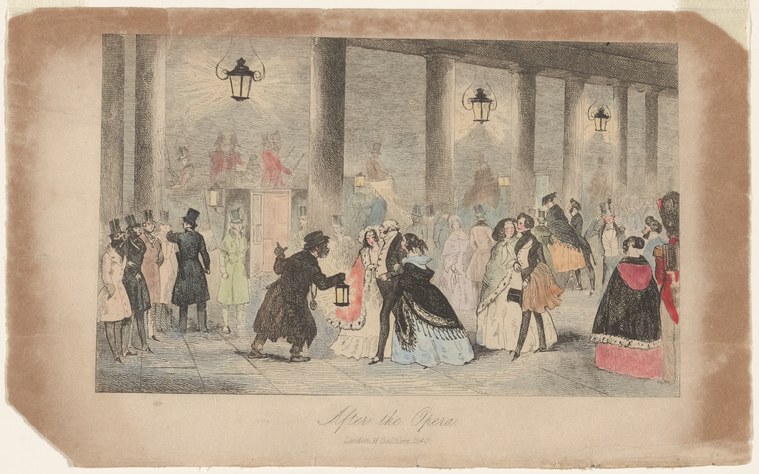
After the opera
Unknown artist
- Collection:
- Prints depicting dance
- Source:
- New York Public Library
- Rights:
- Public domain — free to use, share and adapt.
- Recorded as:
- Public Domain
For historians of ballroom dance and 19th-century society, this image is direct evidence of how the Viennese waltz and quadrille were held, framed, and practiced by the people who danced them. It shows the ballroom not as an abstract idea but as a real architectural space, crowded with real people, where dance was one element of a larger performance of social identity. For artists and printmakers, it exemplifies the skill with which 19th-century commercial print-makers could render architecture, costume, crowd psychology, and movement in a single composition.
What you are looking at
An elegant social gathering in a grand columned hall, evidently the foyer or vestibule of an opera house, captured in the moment after an evening's performance. The space is defined by classical architecture: tall columns support a coffered ceiling from which hanging lanterns cast light, and the floor stretches deep into the composition. The scene teems with fashionably dressed figures in 19th-century evening wear—men in dark tailcoats and top hats, women in full skirts and evening gowns, many holding wraps or fans. The crowd clusters and circulates, some standing in conversation, others moving through the space. In the foreground and middle distance, several pairs are engaged in what appears to be social dancing: a woman in a pale dress is held by a man in dark coat and hat in a closed ballroom hold; nearby another couple is similarly positioned. The lighting is warm and even, suggesting gaslight or early electric illumination. The artist has used subtle color—flesh tones, pale fabrics, the dark of the men's dress—against the pale architecture, creating an impression of fashionable society at leisure after the performance.
The dancing
The dancers visible in the foreground and middle ground are held in closed ballroom position: the man's right hand on the woman's back, their left hands joined at shoulder height, bodies angled in the three-quarter frame characteristic of 19th-century ballroom dance. The couples are upright and formal, with weight appearing to be centered and the frame held at a slight diagonal—the classic posture for the Viennese waltz or quadrille of the period. The women's full skirts extend to the floor and would have moved in the rotation and turn of such dances. Several figures stand passively observing, while others move through the crowd, creating a sense of flow and ongoing social interaction rather than a staged performance.
The dance depicted
The work depicts the social dances of the mid-to-late 19th-century ballroom, most likely the Viennese waltz or quadrille, which were the dominant couple dances of opera house society events. The closed hold, the formal dress, the mixed-gender pairs, and the setting after an evening's performance all point to the ballroom culture of the European elite. The artist has chosen to show not a single climactic moment but rather the social choreography of the evening—the dance as part of courtship and social hierarchy. The presence of observers standing at the margin suggests the semi-public nature of these dances and the importance of being seen dancing correctly.
How it was made
This is a hand-colored engraving or lithograph, executed in the manner typical of popular 19th-century theatrical prints. The line work is precise and controlled, defining the architecture and the figures with clarity; the color is applied in a thin, even wash that emphasizes the elegance of the scene without overwhelming the linear structure. This technique—engraving with hand-applied color—was the standard method for distributing images of fashionable society and theatrical scenes to a broad middle-class audience in the decades before photographic reproduction. The quality of the print and the care taken with the coloring suggest this was a commercial product meant for sale to the opera-going public, likely as a souvenir or record of a fashionable evening.
About this work
This is a record of ballroom society at the opera house, captured in the moment of social dancing after the performance. It shows the Viennese waltz or quadrille as it was danced by the 19th-century elite: formal, coupled, observed, and embedded in a ritually important social context. The work belongs in a gallery of dance in art because it documents not the spectacle of staged ballet (which would have been performed on stage during the opera) but the equally choreographed and meaningful dance of courtship and social display that followed. It is a snapshot of dance as a social technology, governed by strict conventions of hold, dress, and deportment.
How to look at it
Attend first to the architecture and the lighting—the artist has taken care to establish the setting as the interior of a grand public building, and the play of light from the hanging lanterns suggests the time of day and the quality of the event. Then trace the couples in the foreground: note the precision of the hold, the uprightness of the posture, and the way the man's body angles away from the woman's in the characteristic three-quarter frame. Observe the movement of the skirts and the positioning of the feet—the artist has frozen the dancers in a moment of rotation or turn, not in a static pose. Finally, step back and take in the crowd: the way the dancers occupy the center and the middle distance while observers cluster at the margins, and how the composition of the scene conveys the social meaning of the dance—it is not a private gesture but a public performance of elegance and refinement.
The period
This work was made during the height of the waltz craze in Europe, a period (roughly 1815–1900) when the closed-hold couple dance transformed social dancing and became the dominant form of fashionable entertainment. The opera house was not only a place to hear music and see drama but also a social arena—the foyer and vestibule were as important as the stage itself as spaces where the upper classes performed their status and refined their courtship. By the mid-19th century, the production and circulation of hand-colored prints depicting fashionable society had become a major commercial enterprise, serving the aspirations of the rising middle class to access and imitate the manners and pleasures of their social superiors. The title "After the Opera" signals the work's genre: a scene of social life rather than theatrical spectacle.
Where it lives
This work is held in the NYPL's collection of prints depicting dance. It is listed as having an unknown date and unknown artist, and without a recorded medium, though the hand-coloring and the style of the line work suggest a mid-19th-century commercial engraving or lithograph.
Dance in this work
Questions about this work
What dance is being performed?
The image shows couples in the closed ballroom hold characteristic of the Viennese waltz or quadrille, the dominant couple dances of 19th-century European society. The formal dress, the positioning of the bodies, and the setting after an evening at the opera all point to one of these two dances, though the image does not provide enough detail to distinguish between them with certainty.
Why would people dance after the opera?
The opera house was a major social venue, and the evening's program typically included a period between acts or after the final curtain when the audience would mingle, converse, and dance. This was a central feature of fashionable social life, especially for the upper classes, and the dance floor was as important a place for courtship and social display as the performance itself.
What does the print tell us about how these dances were taught and learned?
The precision of the hold, the formality of the frame, and the clear distinction between dancers and observers all suggest that ballroom dance was a highly codified practice, learned through instruction and governed by strict rules. The fact that this image was printed and sold suggests that it may have served as a visual instruction aid or aspiration for people learning to dance in this style.
Is this a theatrical performance or a social event?
This is a social event—a gathering of fashionable society in the foyer of the opera house after the evening's theatrical performance. The dancers are not actors on a stage but members of the audience performing their status and refinement for each other.
More dance artwork





