49 works in this view — arrow keys or swipe to move between them.
Dance in Art
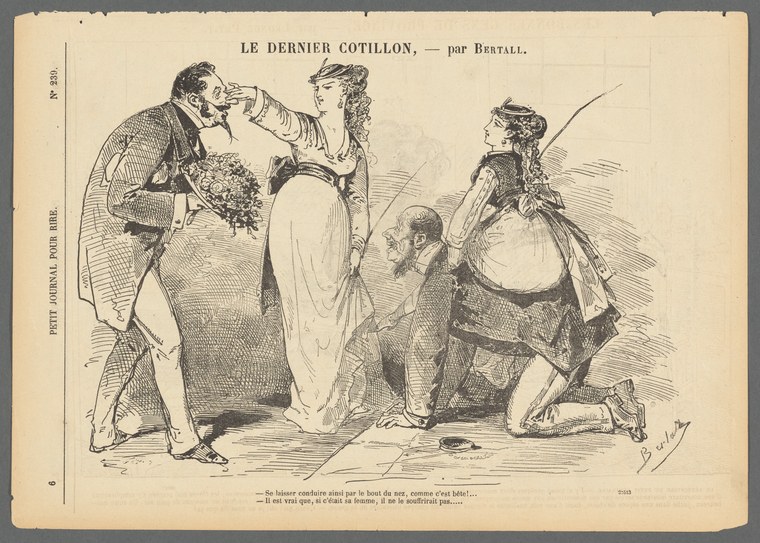
Le dernier cotillon
Unknown artist
- Collection:
- Prints depicting dance
- Source:
- New York Public Library
- Rights:
- Public domain — free to use, share and adapt.
- Recorded as:
- Public Domain
The cotillion was a foundational social dance of European high society, and this print shows how dance functioned as a language of courtship and social hierarchy—attraction, rejection, status, and emotion expressed through formal movement and gesture. For historians of dance and social practice, Bertall's work documents both the dance itself and the cultural meanings attached to it, revealing what audiences found funny about the rituals of the ballroom. The engraving is also a technical masterwork of its period—the rendering of fabric, posture, and emotion through line alone demonstrates what 19th-century printmakers could achieve.
What you are looking at
A satirical French engraving depicts the final cotillion of the social season, rendered with sharp wit and exaggerated gesture. The scene is crowded and lively: a fashionably dressed man on the left leans eagerly toward a woman in an elegant white gown, offering her flowers; she turns away with theatrical disdain. To their right, two smaller figures—likely servants or attendants—crouch or kneel, one gesturing frantically. The composition is cluttered and dynamic, the figures overlapping and turned at acute angles to one another. The engraving's fine cross-hatching creates depth and movement; the bare stage-like floor and simplified background keep focus on the human drama. This is social satire rendered as dance scene—the cotillion here is a pretext for mockery of courtship, vanity, and social pretension.
The dancing
The figures adopt poses of exaggerated politeness and rebuff rather than coordinated dance movement. The man bends forward in a deep bow or lean, flowers extended; the woman's posture is vertical and dismissive, her arm raised in refusal. The two smaller figures below them are caught in attitudes of supplication or distress—knees bent, arms raised or outstretched. There is no closed hold, no synchronized stepping, no ballroom frame; instead, each figure performs an individual emotional gesture toward the others, as if dancing were the language of courtship rather than its physical form.
The dance depicted
The cotillion was a fashionable group dance of the 18th and early 19th centuries, structured as a quadrille with set figures and partnering. This engraving satirizes the cotillion as a social arena for flirtation and rejection rather than celebrating its technical form. The title 'Le dernier cotillon'—the final cotillion—suggests this may be the last dance of an evening or season, invested with emotional weight. The artist uses the dance as a framework for social comedy, particularly the rituals of courtship: the man's advance, the woman's withdrawal, the attendants' anxious response. The dance itself is invisible; only its social meaning matters.
How it was made
This is a wood engraving or steel engraving, identifiable by the fine parallel lines (hatching) that model form and shadow, the crisp black lines against white paper, and the uniform density of tone across the image. The technique allows for sharp detail and wide reproduction—this work could be printed repeatedly for journals or collections. The signature 'Bertall' appears at top right, and the text block at the base suggests this was published in a periodical or satirical print series. Engraving's economy of means—line rather than tone—suits caricature and social satire perfectly; the technique enforces clarity and graphic punch.
About this work
This is a satirical engraving of a cotillion—the fashionable group dance of Regency and early Victorian society—rendered not as a technical demonstration but as a comedy of social manners. The artist, signing as Bertall, captures the moment of romantic rejection within the formal structure of a ballroom dance, using exaggerated gesture and theatrical composition to mock the pretensions of courtship. The work belongs in a dance gallery because it documents the cotillion as a social practice, shows how the dance functioned as theater of courtship, and demonstrates the engraver's eye for the body in motion—even when that motion is the body's refusal to move in concert with others. It is a print made for publication, circulating among French readers as satire; it tells us what people thought the cotillion meant.
How to look at it
Notice the moment Bertall has chosen: not the coordinated movement of the dance, but the instant of approach and refusal. The man is caught mid-gesture, the woman mid-turn; the attendants below react to the social failure unfolding above them. The composition is deliberately unbalanced and crowded, which is unusual for a dance scene—most prints of ballroom dances emphasize order and symmetry. Here, disorder and emotional turmoil dominate. Look at the quality of line: the engraver has used sharper, more insistent hatching around the woman's face and the man's posture of supplication, drawing your eye to the emotional content. The work is satirical, so the 'dance' is not beautiful or graceful—it is awkward, desperate, and funny.
The artist
Bertall (1820–1882) was a French caricaturist, illustrator, and printmaker known for his sharp social satire. He contributed to major French periodicals and published collections of satirical prints lampooning Parisian society, fashion, and manners. His style combined clear linear technique with exaggerated gesture and composition, making complex social situations readable at a glance. He was part of the tradition of French graphic satire that included Honoré Daumier and Gavarni, working in the mid-19th century when the illustrated periodical was at its height.
The period
The cotillion was at the height of fashion in European ballrooms from the 1780s through the 1850s, reaching peak popularity in the Regency and early Victorian periods. It had evolved from 18th-century quadrilles into a more elaborate group dance with set figures and opportunities for individual display. By the time Bertall was drawing in the 1840s–1860s, the cotillion was still central to high-society balls but had become a target for satire, especially regarding its role in courtship and marriage-making. French printmakers of the period frequently satirized ballroom culture, fashion, and the social rituals of the bourgeoisie and aristocracy; dance scenes were ideal vehicles for such satire because they combined spectacle, emotion, and ritual in a single frame. The illustration style and the subject matter place this work squarely in mid-19th-century Paris.
Where it lives
This engraving is held in the New York Public Library's collection of prints depicting dance. The print is housed as part of a broader collection of illustrated material related to social and theatrical practice. Based on the signature, publication style, and subject matter, it is likely from a French periodical or satirical print series of the mid-19th century.
Dance in this work
Questions about this work
What is a cotillion?
A cotillion was a fashionable group dance popular from the 1780s through the Victorian era. It evolved from French quadrilles and was structured around set figures performed by couples in a square formation. The cotillion was central to high-society balls and courtship rituals; it combined technical elements (coordinated stepping, figures, and turns) with opportunities for individual display and flirtation. By the 19th century, cotillions were often satirized as stuffy, pretentious affairs where social anxiety mattered more than dance skill.
Who was Bertall and why did he draw dance scenes?
Bertall (1820–1882) was a French printmaker and caricaturist who made sharp social satire the centerpiece of his practice. He drew dance scenes because ballrooms were ideal stages for observing—and mocking—social pretension, fashion, courtship, and class behavior. Dance prints circulated widely in 19th-century illustrated periodicals, where they entertained readers while documenting changing social customs. Bertall's style combined technical mastery of line engraving with an acute eye for human folly.
Is this a documentary record of how the cotillion was danced?
Not primarily. This is satire, not instruction. Bertall has exaggerated gesture and emotion for comic effect; the figures are not demonstrating cotillion technique but performing social anxiety. However, the print does tell us how the cotillion functioned in society—as a space for courtship, status display, and formal ritual. For a technical record of cotillion steps and figures, you would look to dance manuals of the period; for what people felt about the dance, Bertall's satire is invaluable.
What does the text at the bottom say?
The caption is in French and reads approximately: 'Je n'osais contempler que de loin du ciel / Il est vrai, c'is là le dernier, il me reconnaît pas' (roughly: 'I dared only contemplate from afar, it is true—this is the last one, he does not recognize me'). The caption reinforces the theme of unrequited longing and social rejection, adding a note of pathos to the visual satire.
More dance artwork





