49 works in this view — arrow keys or swipe to move between them.
Dance in Art
Dances of French Polynesia in prints
Unknown artist
- Collection:
- Prints depicting dance
- Source:
- New York Public Library
- Rights:
- Public domain — free to use, share and adapt.
- Recorded as:
- Public Domain
This engraving is one of the earliest visual records of Pacific Island dance to circulate widely in Europe, shaping how dance and Indigenous bodies were understood during the colonial period. It documents movement vocabulary, costume, and social context of a living tradition now studied through such historical images. For dancers and historians, it provides both evidence of historical practice and a case study in how dance is translated across cultural and visual media.
What you are looking at
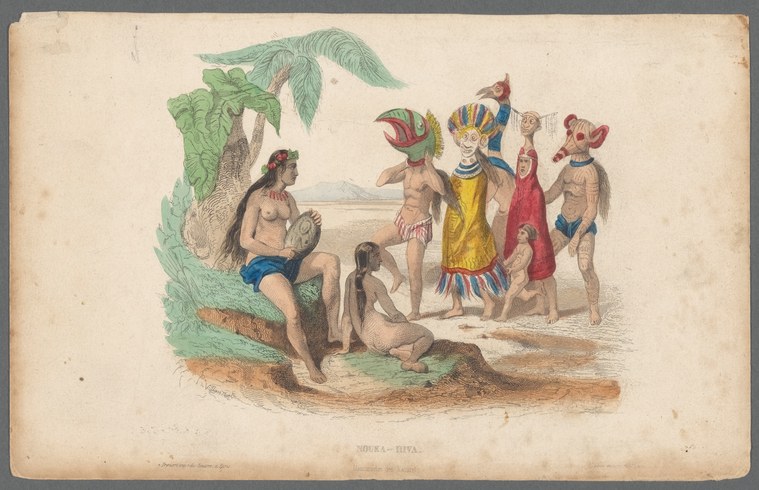
A hand-colored engraving depicts a gathering on a tropical shore, with a large leafy tree anchoring the left side of the composition. In the foreground, several figures in minimal dress—some bare-chested, wearing only loincloths or simple wraps—occupy the sand and shallow water. At center and right, a group of Indigenous people stand and gesture; one figure at center wears an elaborate feathered headdress and a yellow garment, standing in an animated pose with raised arms. The remaining figures gesture and interact with varied arm positions and body angles. The palette is muted—earth tones for the sand and bodies, green for the vegetation, subtle blues for the distant water and sky—typical of hand-coloring over engraved lines. The scene reads as a moment of social gathering or performance rather than stillness, with the posed central figure commanding attention.
The dancing
Eight to ten figures populate the scene, ranging from standing to seated positions. The central figure in the feathered headdress holds both arms raised at shoulder height or higher in an open, expansive gesture; the body is upright and the movement appears energetic. Surrounding figures display varied arm positions—some raised, some at sides—with torsos angled toward the central performer. None appear to be in formal partner holds. The weight distribution suggests standing and active posture rather than weighted balletic placement. The scale and spacing allow free movement of limbs rather than constrained, synchronized group formation.
The dance depicted
This appears to document a Polynesian or Pacific Islander social gathering, most likely Hawaiian, Samoan, or Tahitian based on the feathered headdress, minimal dress conventions, and tropical setting. The central figure's raised arms and open posture align with hula or related Pacific ceremonial-social dances. The surrounding figures' varied gestures and relative informality suggest a social context—greeting, celebration, or welcome ritual—rather than a formal staged performance. The image records movement vocabulary and dress conventions of early colonial-era Pacific dance as observed or documented by European artists, though the accuracy of the representation remains uncertain without provenance.
How it was made
This is a hand-colored engraving, a print medium common in the 18th and early 19th centuries. Engraving allowed wide circulation at lower cost than oil painting, making it the dominant medium for ethnographic and travel documentation of this period. The colored areas—applied by hand after printing—retain the crisp linear definition of the engraved line, visible especially in the tree's foliage and the figures' outlines. The technique implies this image was made for publication, likely in a travel account, natural history survey, or popular illustrated journal aimed at a European educated audience curious about colonial territories.
About this work
This engraving documents a moment of Pacific Islander dance or social ceremony, rendered in the ethnographic visual language of European colonial illustration. The work captures gestural and sartorial conventions of Hawaiian, Samoan, or Tahitian dance as recorded by a European artist, presenting both the movement itself and the colonial gaze that framed it. As an artifact of early modern dance documentation and cross-cultural representation, it belongs in a gallery exploring how dance was observed, recorded, and circulated during the age of exploration and colonial encounter. The work reveals what European audiences were shown about Pacific dance—energetic, open-bodied, tied to ceremony and social gathering—and how the medium of engraving made that image reproducible and portable.
How to look at it
Attend to the central figure's arm position and the energy it conveys—this is the movement the artist chose to freeze, and it communicates an open, gestural vocabulary quite different from the restrained ballroom or seated postures of contemporary European dance. Notice how the surrounding figures relate to the central performer: they form an informal group rather than a synchronized ensemble, suggesting social participation or witness rather than trained coordination. The feathered headdress and minimal dress are visual markers of cultural specificity, not decorative flourish; they anchor the scene to a particular place and practice.
The period
This print belongs to the tradition of ethnographic illustration that flourished in the late 18th and early 19th centuries, fed by European exploration and colonial expansion. Travel narratives, natural history surveys, and illustrated journals of voyages to the Pacific were wildly popular in Europe, and dance—exotic, visually compelling, and associated with 'otherness'—was a favored subject. Such images were rarely made by dancers or from sustained observation; instead, they filtered Indigenous movement through European aesthetic conventions and colonial fantasy. This particular work participates in that broader project of making the Pacific visible, legible, and consumable to European viewers.
Where it lives
The work is held in the NYPL Prints collection, catalogued as a hand-colored engraving depicting dances of French Polynesia. The catalogue record provides minimal detail, suggesting it is one of many such ethnographic prints in institutional holdings, valued as documentary evidence rather than as named or attributed artwork.
Dance in this work
Questions about this work
What is the feathered headdress the central figure wears?
This appears to be a lei hulu (feathered lei or similar regalia) typical of Hawaiian or broader Polynesian ceremonial dress. Such headdresses were worn in dances and formal social occasions and carried spiritual and hierarchical significance. The engraver likely recorded it as a visually striking and culturally distinctive element, though the accuracy of the detail cannot be verified.
Why are the figures so lightly dressed?
The minimal dress—loincloths and wraps—reflects the tropical climate and the actual practice of Hawaiian, Samoan, and Tahitian peoples. However, the engraver's choice to emphasize nudity or near-nudity also reflects European interest in exotic, sensationalized depictions of colonized bodies. The image thus documents practice and colonial fantasy simultaneously.
Is this a reliable record of how Polynesian people actually danced?
This engraving is useful evidence of movement, costume, and social context, but it is filtered through European aesthetic conventions and the artist's distance from the tradition. It records what a European observer chose to see and how they represented it. Modern hula and other Pacific dances are better understood through oral transmission, living practice, and Indigenous scholarship than through colonial-era prints alone.
Who created this image and when?
The catalogue record does not identify the artist or date. Based on style, the work likely dates to the late 18th or early 19th century, when ethnographic engravings of the Pacific proliferated. Such prints were often unsigned or credited only to the engraver rather than the original observer or artist.
More dance artwork





