49 works in this view — arrow keys or swipe to move between them.
Dance in Art
France XVIIIe siecle
Unknown artist
- Collection:
- Prints depicting dance
- Source:
- New York Public Library
- Rights:
- Public domain — free to use, share and adapt.
- Recorded as:
- Public Domain
For dancers and historians, this print illuminates the everyday physical culture from which formal dance grew—it shows us the baseline of aristocratic posture, arm carriage, and spatial negotiation that minuet dancers, contradance participants, and quadrille formations assumed as their foundation. The engraving suggests that what we call dance was only the heightened, musically timed version of a physical language that governed all elite movement; understanding this boundary helps us see why the period's actual dances were so codified and why the master's correction of an arm or inclination of the head was so consequential.
What you are looking at
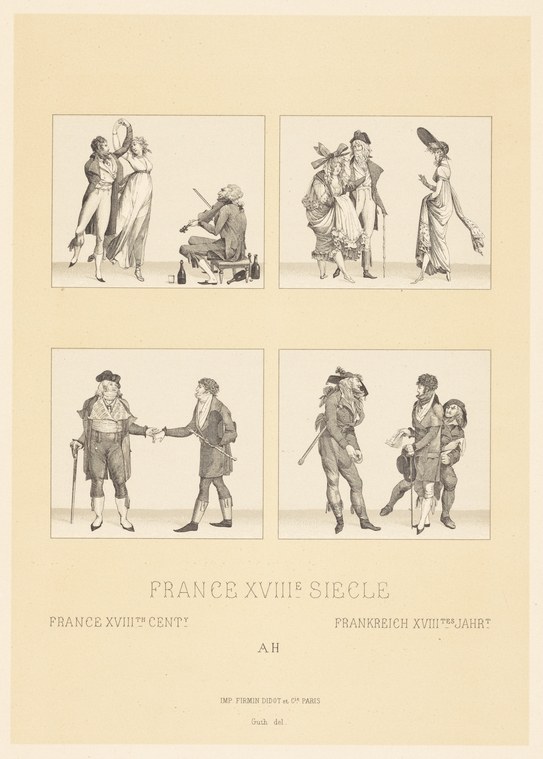
Four separate vignettes depict social dancing in eighteenth-century France, arranged in a grid on a cream background. The upper left shows a standing couple where the woman's elaborate gown dominates the composition; she wears a full-skirted dress with panniers, turned slightly away from her male partner who gestures toward her in courtship. Below them, a seated woman gestures upward while a standing man nearby works at some task, suggesting a narrative moment rather than synchronized dancing. The upper right presents two couples in social interaction—one pair at left with the woman reaching or gesturing, another at right with a woman in profile beside a standing man. The lower left shows two men in formal dress shaking hands or greeting, their posture upright and formal. The lower right depicts a man in profile with a young child, the man gesturing outward in a teaching or entertaining pose. All figures wear the knee breeches, stockings, coats, and elaborate headdresses typical of 1780s–1790s court fashion. The line work is fine, precise, and consistent throughout—a professional engraving technique rendering fabric folds, facial features, and gesture with clarity and wit.
The dancing
The bodies are posed rather than captured in motion; all weight is settled and vertical, with no indication of hop, turn, or traveling step. Arm gestures are theatrical and declarative—reaching, pointing, opening the palm—typical of courtly address rather than balletic port de bras. The male-female pairings show ritual distance maintained by extended arms rather than closed holds. In the lower-left handshake between two men, the contact is formal and frontal. Throughout all four scenes, the artist has emphasized stillness punctuated by expressive arm and hand gesture, and facial expression suggesting conversation or flirtation rather than musical response.
The dance depicted
These are not depictions of dance proper but rather of the social choreography of eighteenth-century court life—the formal greeting, the courtship approach, the teaching of a child, the professional courtesy between equals. The title *France XVIIIe siècle* (Eighteenth-Century France) and the bilingual German/French captions suggest this is a didactic or satirical print about manners and etiquette rather than a record of ballroom choreography. The vignettes may parody the exaggerated formality and gesture-language that governed noble interaction, or they may be instructional material on deportment. The absence of visible music, musicians, or the rapid weight-shift inherent to any actual dance—minuet, contradance, or courante—suggests these are social postures rather than dance steps.
How it was made
This is an engraving, identifiable from the fine parallel line work (hatching) used to model form and shadow, the precision of the line, and the tonal gradation achieved through density of mark-making. The medium allowed both the delicate rendering of fabric and the satirical exaggeration of pose and expression. Engravings of this type were produced in quantity and distributed as prints for a literate, educated public—they were far cheaper and more portable than paintings and circulated widely in homes, studios, and salons. The dual German and French inscriptions suggest a market in both the Germanic territories and France, implying this was a commercially distributed work meant for international consumption among the educated middle and upper classes.
About this work
This is a multi-panel engraving depicting the formal social interactions and manners of eighteenth-century French aristocracy, rendered as four distinct scenes of greeting, courtship, instruction, and professional courtesy. While titled as a representation of French eighteenth-century life, the work documents gesture, posture, and spatial relationship rather than dance per se—it belongs in a gallery of dance in art because it freezes and codifies the non-musical movement vocabulary that framed courtly interaction. The precision and wit of the engraving, combined with its apparent didactic intent, suggests the artist was recording or gently mocking the elaborate physical courtesy that governed elite social life, where every gesture carried meaning and prescribed distance and angle mattered. This is a document of dance's closest neighbor: the formalized body in social space.
How to look at it
Attend to the artist's choices about moment: in each vignette, the gesture is caught at its peak—the reaching arm at full extension, the inclination of the head at its most marked, the distance between bodies at its most eloquent. This is not dance photography but rhetorical drawing, where every line serves interpretation. Notice the contrast between the formality of the scene (knee breeches, heeled shoes, elaborate coats) and the apparent casualness or intimacy of the interaction (the child, the handshake, the woman's gesture skyward)—this tension is likely intentional, whether the artist meant to mock or instruct. The consistency of the line and the precision of the rendering create an almost mechanical quality to the figures, which may be part of the satire: bodies regulated, predictable, following an invisible score.
The period
By the 1780s–1790s, when this print was likely made, the codes of aristocratic behavior in ancien régime France were both deeply entrenched and—for many observers—ripe for satire. The exaggerated posture and gesture in these vignettes may reflect genuine court practice or a contemporary caricature of it; the engraving's tone remains ambiguous. This was the final generation of the French aristocracy before revolution; the elaborate physical courtesy depicted here would vanish within a decade. In the context of eighteenth-century dance, this is the world from which the minuet emerged and in which the quadrille and contradance flourished—dances that codified and musicalized the spatial and gestural relationships visible here. The print's distribution across French and German-speaking territories places it in a market of educated consumers curious about foreign manners and fashion.
Where it lives
This engraving is held in the New York Public Library's collection of prints depicting dance, catalogued as part of their broader holdings on dance imagery. The object is a single-sheet print, likely one of many impressions struck from the same plate, indicating it was a commercially circulated work rather than a unique or expensive object.
Dance in this work
Questions about this work
Is this actually a dance?
Not in the strict sense—these are scenes of courtly social interaction and etiquette rather than choreographed dance steps set to music. However, they document the physical foundation on which eighteenth-century formal dance rested. Aristocratic dancers were trained to move with exactly this kind of controlled, gestural, upright carriage in all contexts, and the spatial relationships and arm positions visible here are the grammar from which minuets and quadrilles were composed.
Why are there four different scenes?
The print appears to be a survey of the social situations in which formal gesture and deportment mattered: greeting a peer, courting a woman, instructing youth, and professional courtesy. Together they suggest that the codified movement of the aristocracy extended across all social interaction, not just formal dances. The vignettes may also carry satirical intent, exaggerating the formality or artificiality of these interactions.
What does the dual-language caption tell us?
The inscription in both French and German indicates this print was made for a market spanning France and the Germanic territories. This was common for popular prints on fashion, manners, and social observation—both regions shared aristocratic culture and were curious about each other's codes of behavior. The bilingual approach also suggests the work was intended as an educational or satirical commentary on European courtly life rather than a purely French document.
How does this connect to ballroom dancing?
The minuet, quadrille, and contradance of the eighteenth century all took place in the formal clothes, with the upright posture and controlled gesture visible here. These prints show us the default position of the aristocratic body—the 'frame' from which all dance movements departed. A minuet dancer's elegance depended on maintaining this vertical carriage while stepping in triple time; a contradance figure depended on this formal distance and angle. This print is a record of the physical baseline that made those dances possible.
More dance artwork





