49 works in this view — arrow keys or swipe to move between them.
Dance in Art
Shiki no tsuki
Unknown artist
- Collection:
- Prints depicting dance
- Source:
- New York Public Library
- Rights:
- Public domain — free to use, share and adapt.
- Recorded as:
- Public Domain
This work preserves visual evidence of how formal ceremonial procession was structured and performed in Edo Japan, including the specific constraints and aesthetics of movement in court dress. For dance historians, it documents a tradition of ordered, ritualized feminine movement that differs fundamentally from the gestural vocabulary of entertainment or religious dance, yet was central to the expression of rank, seasonality, and state authority.
What you are looking at
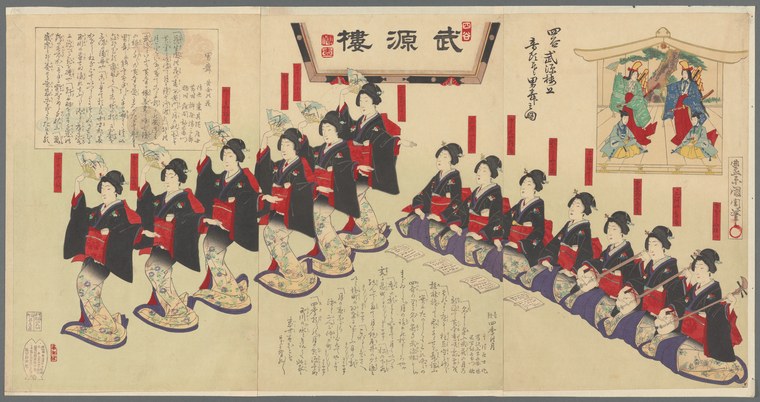
This is a Japanese woodblock print depicting an indoor formal ceremony or celebration. A procession of elegantly dressed women in layers of kimono and trailing hakama skirts processes through an interior space marked by hanging red lanterns. The women are arranged in a line formation, their bodies angled and turned as they move through the space. The composition spans two pages, with additional figures visible on the right side, suggesting continuation of the procession. The women wear formal dress with bold red outer garments and ornate patterned fabrics visible at the hem and neckline. Above the scene floats a canopied viewing platform with additional figures watching the proceedings. The print includes substantial text panels to the left and center, indicating this documents a specific named event.
The dancing
The dancers move in a structured procession with bodies held upright and slightly forward. Their feet are positioned in the characteristic small steps of formal Japanese court movement, with the voluminous trailing hakama skirts constraining leg movement significantly. The women's arms hang at their sides or are positioned forward with hands visible, showing restraint and formality rather than expansive gesture. The turning of torsos and heads as they process suggests a stately, deliberate pace rather than quick or energetic movement. The regular spacing and alignment indicate choreographed formation dancing rather than free improvisation.
The dance depicted
This appears to document a formal court or ceremonial procession from the Edo period, most likely a seasonal celebration or court festival. The stiffness of posture, the processional formation, the red court dress, and the watching officials all point to a structured ceremonial display that falls within the realm of court dance or formal movement ritual rather than entertainment dance. The title 'Shiki no tsuki' (Seasons' Moon) suggests this marks a specific seasonal observance. Such processions were fundamental to Edo period court ritual and would have been performed by women of rank or performers trained in court etiquette. The orderly formation and the documentary style of the print suggest the artist aimed to record a significant ceremonial event.
How it was made
This is a Japanese woodblock print (likely a triptych or multi-block composition given the span and detail). The technique employs clear lines and color separation typical of ukiyo-e printing, with red and blue pigments prominent. The precision of line work in the textile patterns and the careful gradation of color blocks indicate skilled carving and printing. Woodblock printing allowed wide circulation of documentary images of court events among merchants and urban viewers who would not have access to the actual ceremonies, making this a form of visual news or cultural record for literate urban audiences.
About this work
This woodblock print documents a formal court procession or seasonal ceremony from Edo-period Japan, showing a line of noblewomen or court performers moving in stately formation through an interior hung with ceremonial lanterns. The scene is rich in the visual language of Edo ritual—the formal red dress, the processional structure, the watching officials—and represents a form of ordered ceremonial movement that was foundational to court culture. As a woodblock print, it made this exclusive court spectacle visible to a wider urban audience, functioning as both a record of a significant event and a document of contemporary performance practice.
How to look at it
Observe the constraint imposed by the clothing: the movement is minimal, the steps small, the arms controlled. The artist has captured not a moment of high energy but the formal pace of ceremonial procession—what matters is the line formation, the order, the visual harmony of repeated figures. Notice how the lanterns frame the scene and draw the eye along the procession, emphasizing the linear, directional nature of the movement. The presence of observers in the canopy above signals that this is a display meant to be watched, not a functional passage but a choreographed presentation of rank and seasonality.
The period
This print dates to the Edo period (1603–1868), when woodblock printing became the dominant medium for recording and circulating images of contemporary life, theatre, and ceremony. Court ceremonial processions were highly formalized affairs tied to the calendar and seasonal rhythms; the title 'Shiki no tsuki' ('Seasons' Moon') indicates this prints commemorates one such festival. Edo-period court culture was increasingly documented in print for urban audiences, reflecting both the commercial expansion of publishing and the fascination of the merchant class with the aesthetics and rituals of the aristocracy they could observe only through such images.
Where it lives
Held in the New York Public Library's collection of prints depicting dance. This is part of a broader documentary tradition within Edo woodblock printing that recorded court life, theatrical performances, and ceremonial occasions for urban consumption.
Dance in this work
Questions about this work
What is the 'Shiki no tsuki' this print depicts?
The title refers to a seasonal celebration or court festival (literally 'Seasons' Moon'). Japanese court culture marked the calendar through seasonal ceremonies and processions. This print appears to document one such formal observance, likely a significant enough event to warrant recording in woodblock form for circulation among urban audiences.
Why do the women move so stiffly?
The rigid posture and minimal footwork reflect the constraints and aesthetics of Edo court dress and court etiquette. The heavy, trailing hakama skirts and layered kimono physically restrict leg movement; additionally, formal court ceremony demanded an upright, restrained carriage that signaled dignity and rank. This is not limitation but aesthetic ideal.
Is this dance?
This is formal ceremonial procession or court ritual movement—a structured, choreographed display that shares the ordered, rule-governed character of dance even if it does not match modern definitions. The procession is clearly composed and directed; it is a visual display meant to be observed. Court ceremony and dance overlap considerably in premodern East Asian traditions.
Who performed these processions?
Most likely noblewomen of rank or performers trained in court etiquette and movement. The formal dress, the watching officials, and the ceremonial framing suggest this was a court-sponsored ritual rather than a public performance, though the woodblock print made the image of the event available to the wider urban audience.
More dance artwork





