49 works in this view — arrow keys or swipe to move between them.
Dance in Art
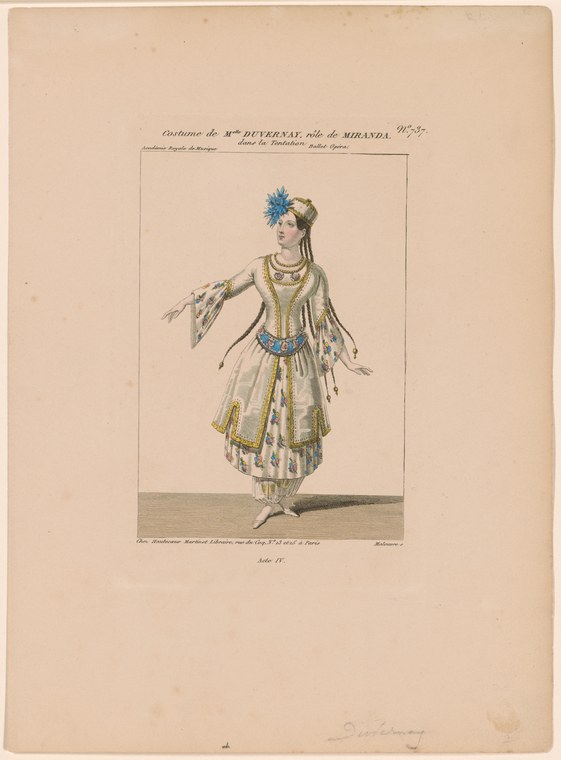
Costume de Melle. Duvernay, rôle de Miranda, dans La tentation, acte IV
Unknown artist
- Collection:
- Prints depicting dance
- Source:
- New York Public Library
- Rights:
- Public domain — free to use, share and adapt.
- Recorded as:
- Public Domain
This image documents the performance identity and costume practice of a specific dancer in a specific role, preserving evidence of how theatrical character was constructed through dress, jewels, and theatrical presentation in 19th-century French dance. It is a primary source for understanding the visual culture of theatrical performance before photography, showing how audiences encountered and remembered dancers not through dynamic action but through the display of elaborate character costume.
What you are looking at
A single female dancer stands in a frontal pose against a neutral background, wearing an elaborate theatrical costume in pale gold and cream tones with decorative patterns. Her dress features a fitted bodice with gold embroidery and a full skirt with scalloped hem edges and dangling ornamental tassels or fringe. She wears a high, jeweled headdress in blue and gold, and multiple strands of beaded necklaces across her chest. Her left arm is extended outward with the hand gracefully turned, palm facing downward in a gesture of aristocratic poise, while her right arm hangs naturally. Her posture is upright and composed, with weight evenly distributed on both feet. The costume and pose suggest a character role from romantic theatrical pantomime or ballet rather than abstract dance, and the figure's direct gaze and stationary stance convey the theatrical presentation typical of mid-19th-century dance imagery.
The dancing
The dancer stands in a frontal, nearly symmetrical pose characteristic of costume documentation or role portraiture rather than caught mid-movement. Her extended left arm—the only limb in active gesture—traces a gentle outward line with the hand softly extended and palm down, a refined classical position. Her torso remains upright and still, her weight neutral, and her feet appear to be in a simple standing position without evidence of turned-out legs or balletic fifth position. The overall frame is stately and presentational, designed to display the costume from front view rather than to convey dynamic movement or technical footwork.
The dance depicted
This is a costume study of Mlle. Duvernay in the role of Miranda from *La Tentation* (The Temptation), Act IV. The title and formal presentation suggest this is documentation of a specific theatrical character rather than a representation of dance movement itself. The costume—with its exotic headdress, jeweled ornaments, and elaborately decorated dress—indicates a romantic-era theatrical or ballet character, likely from a French opéra comique, vaudeville, or pantomime production of the mid-19th century. Without additional archival evidence, the specific dance styles employed in this role cannot be determined from the image alone, though the theatrical costume and character designation point toward the romantic ballet or theatrical dance traditions of that period.
How it was made
This is a hand-colored engraving or aquatint, as evidenced by the fine linear detail visible in the costume patterns, the precise delineation of fabric textures, and the delicate watercolor wash applied over the printed base. The technique allowed for mass production of theatre costume documentation for circulation to audiences, fellow performers, and archives. The colored finish—gold, blue, cream, and flesh tones applied with restraint—was typical of theatrical prints meant to inform potential viewers or preserve a performer's celebrated roles. The image was likely printed in Paris and distributed through theatrical print merchants, making it a record of professional performance rather than fine art.
About this work
This is a costume portrait of dancer Mlle. Duvernay as the character Miranda in a mid-19th-century French theatrical production, rendered as a hand-colored engraving. It serves as documentary evidence of theatrical dress and character design in romantic-era dance-theatre rather than as a representation of choreographed movement. The work belongs in a gallery of dance in art because it captures the visual spectacle, theatrical convention, and professional identity of performance in an era when dance was inseparable from pantomime, opera, and baroque-derived theatrical spectacle. Such costume prints were essential to how theatrical dance was promoted, remembered, and transmitted between performances and across geography.
How to look at it
The image is best read as a formal costume portrait designed for frontal viewing and archival preservation rather than as a captured moment of dance. The single extended gesture—the outward-turned arm—is posed for display and clarity of form rather than as part of a sequence of movement. Pay attention to the richness and specificity of the costume detail: the scalloped hem with tassels, the jeweled headdress, the beaded necklaces—these are the primary content of the image, telling us how theatrical spectacle and visual luxury were deployed to create character identity in this period. The stationary, frontal pose was the convention for theatrical costume documentation and should not be mistaken for a representation of actual performance movement.
The artist
The artist is not recorded in the catalogue. The work is identified as belonging to a print collection and was likely produced in Paris by one of the commercial theatrical print publishers or illustrators active in the 1830s–1860s, a period when such costume documentation was a standard commercial product.
The period
The mid-19th century saw the height of romantic ballet and French theatrical dance, a period when dancers like Marie Taglioni and Fanny Elssler achieved international fame partly through the circulation of their costume prints and theatrical portraits. Theatrical prints—hand-colored engravings showing performers in celebrated roles—were popular souvenirs and advertisements, circulated by theatres and print merchants. The costume visible here reflects the romantic aesthetic: the exotic headdress and jeweled ornaments suggest an orientalist or fantasy character, consistent with the taste for spectacular pantomime and ballet-pantomime that characterized French popular theatre of this era.
Where it lives
This work is held in the New York Public Library's print collection dedicated to dance-related imagery. It is part of a corpus of theatrical costume prints, likely 19th-century French commercial prints, that document performers and their celebrated roles.
Dance in this work
Questions about this work
Who was Mlle. Duvernay?
Duvernay was a professional dancer active in mid-19th-century Paris, celebrated enough to have her costume roles documented and circulated in print form. Beyond this theatrical record and similar prints, biographical information about her career is not readily available in standard dance histories, a reminder that many performers of the period are known to us now primarily through such ephemeral visual documentation.
What is *La Tentation* and what role did Miranda play?
Without access to the full script or original production records, the nature of the work and the specific character of Miranda cannot be determined from this image alone. The title and costume suggest a French theatrical work—possibly a pantomime, opéra comique, or vaudeville piece—popular in 19th-century Paris. The exotic costume hints that Miranda may have been an oriental, supernatural, or fantastic character typical of such entertainment.
Is this a ballet or another form of theatrical dance?
The image alone does not provide enough evidence to determine the specific dance form. The theatrical costume, character designation, and formal presentation suggest it could be ballet, pantomime-ballet, or theatrical vaudeville dance—all genres that mixed dance, gesture, and narrative in 19th-century French theatre. The absence of pointe shoes or visible turned-out positions suggests this may not be classical ballet technique, but costume and pose alone are insufficient evidence.
More dance artwork





