49 works in this view — arrow keys or swipe to move between them.
Dance in Art
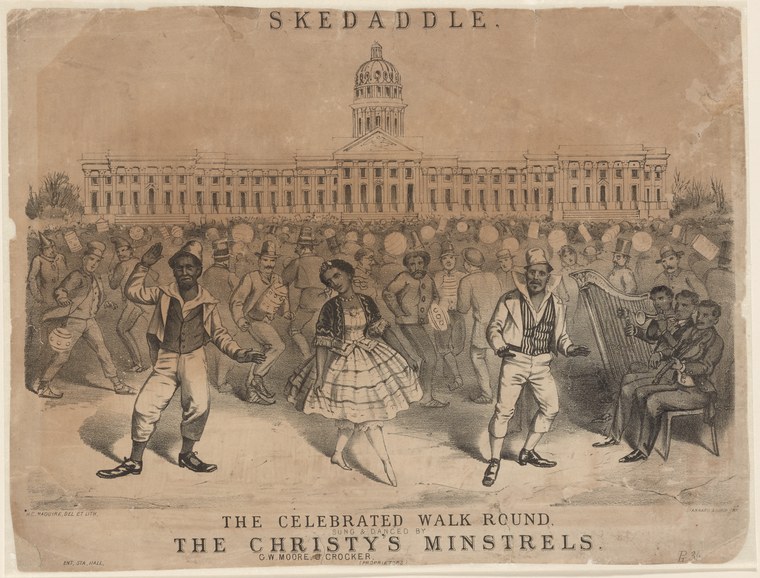
Skedaddle: the celebrated walk round sung & danced by the Christy Minstrels
Unknown artist
- Collection:
- Prints depicting dance
- Source:
- New York Public Library
- Rights:
- Public domain — free to use, share and adapt.
- Recorded as:
- Public Domain
Minstrelsy was arguably the dominant commercial dance entertainment in mid-19th-century America, yet it is often omitted from dance history or treated only as a negative example. This image documents an actual choreographic form—the walk-around—that influenced later theatrical dance, while also showing how racist caricature was embedded in movement itself. For historians and dancers, confronting such images is essential to understanding both the technical and social history of American dance, and to recognizing how aesthetic categories like 'style' and 'entertainment value' were weaponized in service of racial dehumanization.
What you are looking at
A crowded street scene before a large classical government building, probably a city hall or courthouse, with a domed central pavilion and symmetrical wing facades. In the foreground, a group of African American performers in period costume occupy the center of the composition—a woman in a wide skirt with horizontal stripes, and men in tightly fitted striped or patterned trousers and vests. They are mid-performance, with exaggerated body positions and energetic stances. The woman's skirt is caught mid-motion, and the men display grotesquely contorted postures typical of minstrel caricature. The surrounding crowd—dozens of onlookers in 19th-century dress—watches from all sides, some seated, others standing. The technique is a hand-colored engraving or lithograph, with the performers rendered in darker tones and the crowd in lighter washes, creating depth and focus on the central spectacle.
The dancing
Four central performers occupy separate positions in the composition, each isolated rather than partnered. The woman stands in an S-curve posture with skirt deployed sideways, weight on one leg, torso twisted. Two men flank her in exaggerated wide-legged stances with bent knees and contorted spines, arms extended in splayed positions—one with arm raised and cape flared, one with both arms akimbo. A fourth seated figure occupies the right margin. The postures are designed for maximum visual distortion and entertainment, with no formal ballroom hold or partnership evident. The bodies are pushed into elongation and compression rather than centered or aligned.
The dance depicted
This depicts a performance by the Christy Minstrels, one of the most prominent blackface minstrel troupes of the mid-19th century. The 'skedaddle' was a minstrel walk-around—a comedic procession or promenade performed during the interlocution portion of a minstrel show, typically featuring exaggerated gaits, contorted body positions, and satirical mimicry. The song was likely danced as a structured comic number with repeated figures designed for maximum visual absurdity. The performers' grotesque posturing reflects the racist caricature central to minstrelsy, though the format suggests genuine choreography with specific steps and movement patterns that audiences had come to expect and enjoy.
How it was made
This is a hand-colored engraving or lithographic print, a mass-produced medium that circulated widely in the 19th century. The technique allowed rapid printing and distribution to audiences hungry for images of popular entertainments; the careful hand-coloring of each print suggests both commercial value and the technical labor required. The composition is designed for legibility from a distance—bold outlines, clear figure separation, and high contrast between performers and crowd. Such prints served as souvenirs and publicity, extending the reach of live minstrel performances into homes and public spaces far beyond the theater.
About this work
This 19th-century engraving documents a performance by the Christy Minstrels—the most commercially successful blackface minstrel troupe of the era—during a public 'skedaddle' number in front of an urban government building. The 'Celebrated Walk Round' was a signature minstrel turn, a comedic parade featuring exaggerated gaits and contorted body positions that reduced African American movement to grotesque parody. The print circulated as a souvenir and promotion for the live spectacle, documenting both a specific choreographed entertainment and the racist visual culture that sustained American popular theater in the mid-1800s. It belongs in a gallery devoted to dance history precisely because minstrelsy was one of the most visible and economically significant dance entertainments of its time, and because understanding the history of racist performance is essential to understanding how American theatrical dance developed.
How to look at it
Notice the isolation of each performer—they are not dancing together but rather presented as discrete objects of visual spectacle, each more grotesquely contorted than would be possible in actual ballroom or partner dance. The artist has frozen a moment of maximum distortion: the woman's impossible spine curve, the men's splayed limbs and bent knees. The crowd's placement matters: they are the frame and the point—these performers exist to be looked at and laughed at by the assembled masses. The setting (a government building) is itself a statement, suggesting public legitimacy for this entertainment. A viewer should ask what this image shows about the relationship between spectacle, caricature, and movement in American popular culture.
The period
Minstrelsy emerged in the 1840s and dominated American popular entertainment through the Civil War and beyond. The Christy Minstrels, founded by Edwin P. Christy in 1844, were the template for the form: a staged spectacle featuring blackface performers in a three-part show with songs, dances, comic sketches, and an interlocution (dialogue) section featuring walk-arounds and other processional numbers. The 1850s and 1860s saw the peak of minstrelsy's commercial success and cultural saturation; prints like this one documented performances and extended their reach. The genre drew on earlier African American vernacular dance while systematically distorting and caricaturing it for white audiences. This particular performance likely took place in a northern city, given the architecture and the public performance space, and dates to the height of minstrelsy's popularity.
Where it lives
This print is held in the New York Public Library's collection of prints depicting dance. Such collections often gathered theatrical ephemera, promotional materials, and satirical prints that documented entertainment and social life. The print's survival and institutional preservation reflects its circulation value in its own time and later historical interest in documenting popular entertainments.
Dance in this work
Questions about this work
What is a 'skedaddle' in minstrelsy?
A skedaddle was a walk-around or promenade performed during the interlocution (middle section) of a minstrel show. Performers would process across the stage in an exaggerated, comedic manner, often with grotesque postures and specific choreographed steps. The term itself suggests both hastiness and humor, fitting the genre's emphasis on comic spectacle over virtuosity.
Who were the Christy Minstrels?
The Christy Minstrels, founded by Edwin P. Christy in 1844, were the most commercially successful blackface minstrel troupe of the 19th century. They established the template for the three-part minstrel show and toured extensively throughout the United States and Europe. They were influential in standardizing minstrel performance practices and in creating the cultural demand for this form of entertainment.
Was this an actual choreographed dance or just random movement?
The walk-around was a specific choreographic form with established conventions and repeated figures. Audiences expected particular steps and gaits; minstrel troupes rehearsed and standardized their numbers. However, the 'choreography' was designed to maximize caricature and distortion rather than to display technical skill or aesthetic grace, so it operated under radically different principles than ballet or ballroom dance.
Why should I care about racist entertainment?
Understanding minstrelsy's formal properties as dance is essential to understanding American theatrical history. Minstrelsy was wildly popular, enormously profitable, and deeply influential on later theatrical forms. Ignoring it leaves a huge gap in dance history; confronting it honestly means recognizing how movement itself can be weaponized in service of racism, and how 'entertainment' and 'art' are never neutral categories.
More dance artwork





