49 works in this view — arrow keys or swipe to move between them.
Dance in Art
Bal Mabille
Unknown artist
- Collection:
- Prints depicting dance
- Source:
- New York Public Library
- Rights:
- Public domain — free to use, share and adapt.
- Recorded as:
- Public Domain
For dance historians, this image provides rare visual evidence of how popular social ballroom dancing actually looked in the mid-19th century—the dress, the density of dancers, the mix of couples, spectators, and promenaders, and the outdoor public context. For art historians, it exemplifies the lithographic print tradition documenting modern leisure and the commodification of Parisian spectacle.
What you are looking at
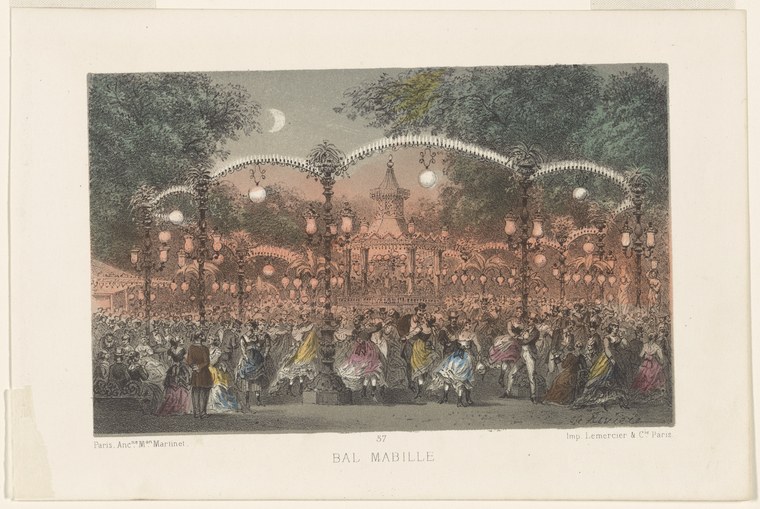
A nighttime outdoor dance venue in 19th-century Paris, likely the famous Bal Mabille in the Allées des Veuves (now Avenue Montaigne). Hundreds of figures crowd the illuminated garden beneath a crescent moon and hanging globe lights strung between trees. The architectural backdrop shows a grand pavilion or dance hall with ornate decorative elements and spires. The crowd is densely packed, mixing couples dancing, spectators standing and observing, and promenaders. The women wear the voluminous skirts and bright colors typical of the 1850s–1860s, with pale cream, rose, yellow, and purple dominant. The foreground shows figures in sharper detail: women in full-skirted dresses, men in dark coats and hats. The hand-coloring technique brings warmth to the scene, with the lit venue glowing warmly against the dark foliage and night sky.
The dancing
The dancers visible in the foreground are in closed ballroom holds—couples facing one another, the man's arm around the woman's waist, her hand on his shoulder. The women's skirts are dramatically distended, suggesting vigorous turning and movement. Many figures stand rather than dance, positioned as observers or as part of the promenade culture of such venues. The postures are upright and formal rather than energetic; this is social dancing in a public spectacle, not theatrical performance. The sheer number of bodies—perhaps 200–300 figures—establishes this as a mass social event rather than intimate partner dancing.
The dance depicted
This is a document of the *bal musette* or public dance garden, specifically the notorious Bal Mabille, which operated in Paris from 1840 to 1870 as a destination for working-class and bohemian dancers and onlookers. The dancing was primarily *quadrilles*, *polkas*, *waltzes*, and *galops*—popular social forms of the mid-19th century performed by paying visitors. The Bal Mabille was famous as a place where respectability was suspended, attracting both genuine dancers and spectators attracted to the transgressive nature of the venue. The image captures not the dance itself but the *culture of dancing*—the gathering, the fashion display, the mix of participation and spectatorship that defined such public ballrooms.
How it was made
This is a hand-colored lithograph, a commercial print technique of the 19th century that allowed rapid color reproduction and wide distribution. The composition was likely drawn from sketches or memory rather than direct observation, given the complexity of the scene and the generic quality of individual figures. The hand-coloring process—applied after lithographic printing—produces the warm, somewhat uneven tonality visible here. Such prints were affordable commodities sold to middle-class and working-class audiences as souvenirs or illustrations of fashionable Parisian life. The artist's signature appears at the lower left, though it is not clearly legible in this image.
About this work
The Bal Mabille was the most famous public dance venue in mid-19th-century Paris, and this print records its appearance and atmosphere. It was a place where social ballroom dances—waltzes, quadrilles, polkas—were performed by the general public in an atmosphere of relative freedom and transgression. The work is significant as a documentary image: it shows not professional dancers or theatrical spectacle, but the actual practice and environment of popular dancing in the era, including the gendered dynamics of public dance (spectacle, display, observation, participation), the role of fashion, and the democratization of ballroom dancing beyond aristocratic salons.
This lithograph belongs to a tradition of commercial prints documenting Parisian social life and leisure. Such prints were consumed eagerly by middle-class audiences and travelers and served as both souvenirs and moral documents—the Bal Mabille had a slightly scandalous reputation, and images of it carried frisson for the respectable viewer.
How to look at it
Notice the structure of the scene: the dancing is concentrated in the central illuminated pavilion, but the crowd extends far beyond the dancers themselves. This is a reminder that public dancing in this period was as much about being seen, seeing others, and participating in a social spectacle as it was about the dancing itself. Observe the women's skirts: the enormous bulk of fabric suggests the vigor of the polka and galop, the turning dances that dominated the venue. Look at the faces and postures of the spectators—many are watching, not dancing. The image captures a moment of relaxation and pleasure that was transgressive for its era: public women dancing with strangers in a setting without strict moral governance.
The artist
The artist is not recorded in the catalogue. The composition and hand-coloring are consistent with commercial Parisian lithography of the 1850s–1860s, possibly by an artist working for a print publisher such as Martial or Lemercier. Such artists rarely received attribution; the prints were produced rapidly for mass consumption and valued for their documentary and entertaining content rather than artistic individuality.
The period
The Bal Mabille operated during a period of explosive growth in commercial leisure culture in Paris. The July Monarchy and Second Empire saw the emergence of public dance venues—the *guinguettes*, *bals publics*, and *salons de danse*—as destinations for pleasure-seeking crowds. The waltz, quadrille, and polka were the dominant social dances, having displaced the contredanse. This was also the era in which lithography became the dominant medium for illustrated journalism and commercial prints, allowing artists to capture contemporary scenes for mass audiences. The image reflects anxieties about gender, class mixing, and public morality; the Bal Mabille was notorious partly because it allowed women to dance without the strict supervision of family, and because it mixed classes and reputations.
Where it lives
This print is held in the New York Public Library's collection of prints depicting dance, a collection focused on documentary and commercial images of dance practices across centuries and cultures. Such prints were originally ephemeral commercial objects, sold as souvenirs or illustrations of fashionable life; their survival in institutional collections reflects their later recognition as historical documents.
Dance in this work
Questions about this work
Was the Bal Mabille a respectable place?
No—it had a reputation for transgression. It was a place where working-class and bohemian dancers mixed, where women could dance with strangers without family supervision, and where conventional social rules were relaxed. For respectable society, this made it fascinating and slightly scandalous. It was also famous as a site of solicitation and loose morals, though it was not exclusively a place of vice.
What dances are being performed here?
Primarily waltzes, quadrilles, polkas, and galops—the popular social ballroom dances of the mid-19th century. The print does not capture these with enough detail to identify individual steps, but the closed holds and the women's full skirts are consistent with these forms. The Bal Mabille was famous for the vigor and speed of its polkas and galops in particular.
Who attended the Bal Mabille?
A broad cross-section of Parisian society: working-class dancers, bohemians, tourists, curious bourgeois visitors, and people seeking pleasure and transgression. The venue was neither exclusively elite nor exclusively working-class, but mixed these groups in ways that were novel and slightly unsettling for the era.
How does this lithograph compare to photographs of the era?
Lithographs allowed for color, composition, and a sense of the overall scene that photographs of the period could not easily capture. The artist has chosen a high vantage point and a wide view to convey the scale and atmosphere of the venue. The hand-coloring adds warmth and visual interest that a black-and-white photograph would lack.
More dance artwork





