49 works in this view — arrow keys or swipe to move between them.
Dance in Art
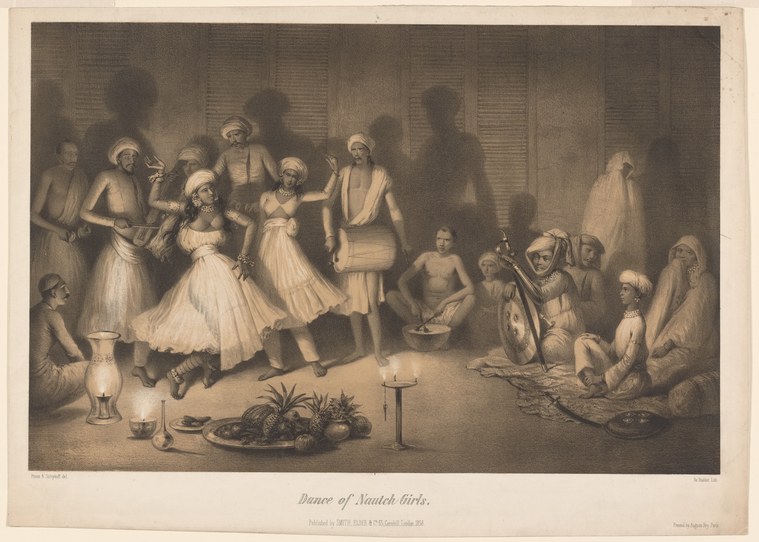
Dance of nautch girls
Unknown artist
- Collection:
- Prints depicting dance
- Source:
- New York Public Library
- Rights:
- Public domain — free to use, share and adapt.
- Recorded as:
- Public Domain
This work documents the intersection of Indian classical and courtly dance traditions with European visual culture during the 19th century, at a moment when Nautch was being simultaneously celebrated in elite circles and increasingly stigmatized by missionary and reform movements. It preserves a visual record of costume, ensemble structure, and the relationship between dancers and musicians in a form that would undergo radical transformation in the 20th century. For dancers and historians, it offers a dated snapshot of how this living tradition appeared to outsider eyes.
What you are looking at
A choreographed entertainment unfolds in an interior space with columned architecture, rendered in sepia tones characteristic of 19th-century printmaking. Central to the composition are three women in pale, diaphanous skirts—likely cotton or muslin—posed mid-movement with raised arms and tilted torsos. They are surrounded by a larger ensemble: musicians sit cross-legged on the ground holding stringed instruments (possibly sitars or similar long-necked lutes); other performers crouch or recline at the periphery; attendants and observers line the walls. The floor is scattered with vessels, plates of fruit and food, and a central incense burner or lamp, suggesting a formal performance context with hospitality elements. The lighting is even and diffused, with shadows defining the architectural recession and the muscularity of the male torsos of musicians and onlookers. The overall mood is one of staged spectacle: the dancers occupy the visual and spatial centre, while servants and musicians create a framing audience within the frame.
The dancing
The three central dancers display a remarkably consistent arm vocabulary: both upper arms are raised to shoulder or ear height, elbows bent, with forearms and hands extended upward or to the side in a gesture that balances lift and restraint. The torsos show a pronounced backward inclination or lateral sway, with hips appearing to shift in counter-motion to the upper body. Their legs are not clearly visible beneath the layered skirts, but the feet appear to be weighted and stationary or moving in small steps rather than traveling steps. The pose suggests a held moment within a continuous undulation rather than a turn or leap. The musicians and attendants are entirely static, their role being to frame and contextualize the dancers' bodies.
The dance depicted
This is almost certainly a depiction of Nautch dancing, the term used by British observers in the 19th century for the performance traditions of professional female dancers (and sometimes male performers) in India, particularly in courts and elite domestic settings. The title confirms this attribution. Nautch encompassed various regional forms, but typically featured rhythmic hip and torso movement, hand gestures drawn from classical Indian dance vocabularies (mudras), and close coordination with live musicians. The image captures the characteristic upright carriage, the isolation of the upper body from the lower, and the integration of performers and musicians in a single ceremonial space. The costume—gauze or thin cotton drapery with minimal jewelry visible—aligns with 19th-century documentation of Nautch dress. The backward torso inclination visible here is a recognizable element of certain Nautch styles. However, this is an outsider's record: a European artist's interpretation of an Indian performance tradition, made for a European audience unfamiliar with the form.
How it was made
This is a hand-colored or tinted engraving or aquatint, executed in the refined style characteristic of British travel and ethnographic publishing in the early-to-mid 19th century. The light sepia tone, the fine hatching visible in the architectural and shadow areas, and the even application of color suggest either a professionally tinted engraving or a hand-colored print. The technique allowed for wide circulation—engravings could be reproduced in multiple impressions and hand-colored to order, making this both a commodity and a document. The delicate line work and careful attention to anatomical proportion indicate a trained European artist, likely working from a sketch or description rather than direct observation. The medium itself signals the intended audience: educated British collectors and readers of travel literature and periodicals.
About this work
This is a 19th-century European engraving depicting Nautch dancing, a professional performance tradition of India observed and recorded by British travelers and artists during the period of colonial presence. The work captures a formal indoor performance: three dancers in diaphanous cotton perform rhythmic body movement in the center of a columned hall, accompanied by seated musicians with stringed instruments and watched by male attendants. The composition and rendering technique are those of British ethnographic printmaking—careful, descriptive, and framed for a European viewer unfamiliar with the form. The image is valuable not as an accurate record of Nautch technique (it remains filtered through European aesthetic conventions) but as evidence of how the practice was understood and aestheticized in the colonial moment.
How to look at it
Attend to the stillness at the center of this image: the dancers are not captured in a climactic leap or turn, but in a sustained, held moment of rhythmic undulation. The artist has chosen a pose of equilibrium rather than explosive energy—the backward tilt of the torso, the raised arms, the apparent weight in the feet. This reflects the actual technique of Nautch, which prioritizes isolable movement of the hips and torso over traveling steps or lifts. Notice also the formal architecture and the presence of musicians and attendants: the dancer is not isolated, but embedded in a ritual or ceremonial context. The composition emphasizes the dancer's centrality to an organized social space, not her individual brilliance.
The artist
The artist is unrecorded, which is typical for commercial ethnographic engravings of the period. The work bears the mark of competent professional production—it was likely engraved by a London-based printhouse working from a sketch, possibly by a traveling artist or from a published lithograph or earlier engraving. The style and execution are consistent with the output of firms like Ackermann or Day & Son, which dominated the market for hand-colored travel prints. The anonymity reflects the industrial nature of 19th-century printmaking: the engraver was a skilled laborer rather than an attributed artist, and prints were sold as informational commodities rather than singular artworks.
The period
The early 19th century saw intense European curiosity about Indian dance and performance, driven by British presence in India and by the Romantic movement's fascination with 'exotic' and 'oriental' cultures. Nautch performances were witnessed by British officers, merchants, and travelers, and were frequently described in travel narratives and periodicals. However, this was also the period in which missionary and reform movements began to pathologize Nautch as immoral or debased—a trajectory that would lead to significant marginalization of the form under colonial rule. Simultaneously, European academic art was moving toward more naturalistic representation and away from the ornamental, decorative traditions that had dominated the 18th century. This print sits at the intersection of these currents: it documents a non-European dance form through the lens of European realism and anthropological interest, even as it aestheticizes and domesticates the subject for British consumption.
Where it lives
The print is held in the New York Public Library's collection of prints depicting dance. The work is catalogued with minimal descriptive information, and no artist attribution. It is one of many ethnographic and travel prints produced in 19th-century Britain for an audience of educated collectors and readers.
Dance in this work
Questions about this work
What is Nautch?
Nautch is the term used by British observers to describe professional female and male performers in Indian dance and music traditions, particularly in courts and elite domestic settings from the 18th century onward. The term derives from the Hindi word 'naach' (नाच), meaning dance. Nautch encompassed multiple regional styles and incorporated rhythm, hand gestures (mudras) drawn from classical Indian vocabularies, and live instrumental accompaniment. The tradition predates colonialism but was significantly transformed during the British period.
Is this an accurate depiction of Nautch?
This is a European artist's interpretation rather than an authoritative record. The engraver has rendered the costume, general posture, and ensemble structure recognizably, but the image is filtered through European artistic conventions—the even lighting, the architectural framing, and the overall composition reflect what a British viewer in the 19th century might expect to see in a 'scene' rather than documentary detail. It is most valuable as evidence of how Nautch was perceived and aestheticized by outsiders.
Why were there no artist credits on this print?
Commercial engravings of the 19th century were typically produced by urban printhouse studios where the labor was divided among designers, engravers, and colorists. Credit was often given to the publisher or printhouse rather than individual makers. This print's anonymity reflects the industrial and commodity-driven nature of travel and ethnographic publishing in the period.
What happened to Nautch after the 19th century?
Nautch was increasingly stigmatized during the colonial period and fell out of elite patronage, though it persisted in folk and informal contexts. In the early 20th century, Indian classical dance traditions were revived and codified by nationalist and anti-colonial reformers, who reframed 'Bharatanatyam' and other classical forms as repositories of authentic Indian culture distinct from the colonial-era 'Nautch.' The distinction between 'classical' and 'Nautch' remains contested among scholars and practitioners.
More dance artwork





