49 works in this view — arrow keys or swipe to move between them.
Dance in Art
[Contredanses] L'anglaise
Unknown artist
- Collection:
- Prints depicting dance
- Source:
- New York Public Library
- Rights:
- Public domain — free to use, share and adapt.
- Recorded as:
- Public Domain
For historians of early-19th-century social dance, this print is invaluable evidence of how the contredanse was actually dressed and arranged in the moment of performance. It documents not just the dance itself but the social composition of the ballroom—the gendered division of garments, the formality of posture, and the scale and spacing of group formations. The specificity of the title and the care taken in hand-coloring suggest this was part of a documented series, making it a window into how dance knowledge was transmitted and consumed in the Regency period.
What you are looking at
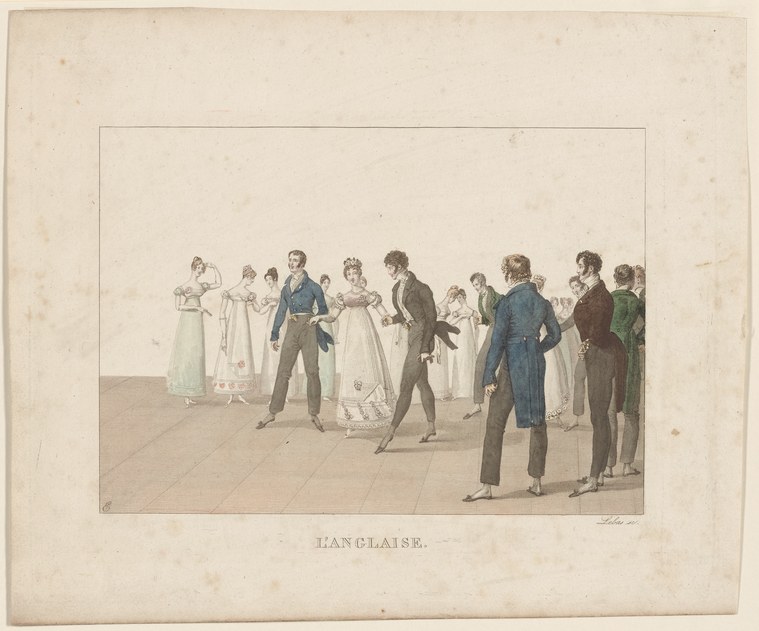
A formal group of approximately twelve figures arranged in a shallow interior space, dressed in early 19th-century clothing. The composition is strikingly linear: four women in white muslin gowns stand to the left; a male figure in a blue coat stands center-left; several men in dark coats occupy the middle ground; and additional figures in colored coats—blue, brown, green—stand to the right. The floor is rendered in pale wash, suggesting a ballroom or assembly room. The figures are posed in readiness rather than motion, their bodies upright and formal, suggesting the moment before or during the establishment of a dance formation. The print employs soft hand-coloring on an engraved or lithographed base, with delicate line work defining silhouettes and a restrained palette of ochres, blues, browns, and greens typical of early-19th-century fashion prints.
The dancing
The bodies are held in the upright, formally composed posture characteristic of regency-era ballroom etiquette. The women's arms hang naturally at their sides or are lightly positioned; the men stand with weight distributed evenly, some with hands at their sides, others gesturing subtly. There is no obvious physical contact between figures—they are not in closed hold or even loosely connected. The composition suggests a group formation where partners have not yet engaged, or are preparing to do so. The arrangement suggests dancers orienting themselves within a large-group figure rather than couple-based movement.
The dance depicted
This is almost certainly a contredanse (or contradance), specifically *l'Anglaise* as the caption states—the English country dance form that dominated continental European ballrooms in the late 18th and early 19th centuries. Contredanses were typically performed by groups of couples arranged in lines or square formations, with figures that emphasized processional movement, weaving, and turning. The linear arrangement of figures and the formal readiness of their poses are consistent with the moment just before or at the opening of such a figure. The term 'l'Anglaise' specifically denotes one of many named contredanse variants; this image documents the social ballroom context of the dance, where mixed groups of fashionable people participated in formally choreographed sequences.
How it was made
This is a hand-colored engraving or lithograph, executed in the style typical of European dance and fashion prints of the 1820s–1830s. The base print employs fine line work to define figures and drapery, with hand-applied watercolor or gouache adding the soft palette. This technique was the standard method for circulating fashionable imagery in the early 19th century, allowing multiple copies and broad distribution among the literate and affluent classes. The deliberate coloring of fabrics and coats—not merely tinting—suggests this was a semi-commercial print, possibly from a series documenting fashionable assemblies or dance manuals.
About this work
L'anglaise (The English Dance) is a hand-colored engraving documenting a contredanse, the dominant ballroom form of Regency Europe. The image captures the formal social ritual of the ballroom rather than a moment of active movement: a group of elegantly dressed men and women stand ready to begin or within the opening moments of a choreographed sequence. The work belongs to a rich tradition of dance documentation through fashion and ballroom prints, which served as both social records and practical guides for the aspiring dancer. It testifies to the enormous popularity of the contredanse across all levels of society and to the precise social conventions that governed the ballroom.
How to look at it
Notice the careful positioning of each figure within a shallow, frieze-like space—this is not a moment of dynamic movement but rather the establishment of formation. The painter has chosen the moment of assembly, when dancers have found their positions but have not yet begun the active phrases of the figure. Pay attention to the stark gender differentiation in dress: the women in plain white muslin, the men in colored coats and breeches. This sartorial hierarchy was not incidental to the dance; it was central to how the contredanse was understood and performed as a social marker of respectability.
The artist
Unknown. The signature or attribution is not clearly legible in reproduction. Dance and ballroom prints of this period were often produced collaboratively by engravers and colorists, sometimes attributed only to the print publisher rather than to an individual hand. The style and execution are consistent with the output of Parisian and London print workshops of the 1820s–1830s.
The period
The contredanse dominated European ballroom culture from roughly 1780 to 1850, gradually ceding ground to the waltz, polka, and quadrille. The Regency period (1811–1820 in Britain, concurrent with the Bourbon Restoration in France) saw the height of the contredanse's prestige, particularly *l'Anglaise*, which had aristocratic English origins and retained fashionable cachet on the continent. Dance prints flourished during this period as a new form of commercial leisure documentation; publishers catered to the growing middle class of affluent merchants and professionals who participated in public and private balls. The precise, linear arrangement of dancers and the emphasis on correct dress reflect the period's investment in regulated, genteel social behavior.
Where it lives
Held in the New York Public Library's collection of prints depicting dance. The work is catalogued as part of a broader assemblage of ballroom and social dance prints, primarily European, dating from the late 18th through mid-19th centuries.
Dance in this work
Questions about this work
What is a contredanse?
A contredanse (French, from English 'country dance') is a group ballroom dance in which couples or groups face each other and execute choreographed sequences of figures—lines, weaving, turns—typically to music in 2/4 or 6/8 time. Originating in England, it became the dominant social dance form in continental Europe from the 1780s onward. Unlike the waltz, which emphasizes couple contact and continuous rotation, the contredanse is predominantly an ensemble form with formal structure.
What does 'l'Anglaise' mean?
L'Anglaise literally means 'the English (dance).' It is the name of a specific contredanse variant, one of many named figures that gave structure to what might otherwise seem like a generic group dance. Different named contredanses had different sequences of steps and configurations; a musician or dance master would announce which contredanse was to be performed, and the dancers would execute the known figure.
Why are all the women in white and the men in bright colors?
The gendered dress code of the Regency ballroom reflected both aesthetic fashion and social convention. Women wore high-waisted white or pale muslin gowns that were considered elegant and virginal; men wore embroidered coats, waistcoats, and breeches in jewel tones or pastels, allowing them to display wealth and status through fabric and tailoring. This distinction made couples easily identifiable in formation and reinforced the social roles each gender performed.
Is this image from a dance manual?
It may be, or it may be from a series of fashionable prints intended for drawing-room display or collection. The precision of the grouping and the title suggest it was created as documentation—either to teach the dance or to record how it was performed in fashionable society. Many such prints were sold both to active dancers (as guides) and to non-dancers (as records of elite leisure).
More dance artwork





