49 works in this view — arrow keys or swipe to move between them.
Dance in Art
La walse
Unknown artist
- Collection:
- Prints depicting dance
- Source:
- New York Public Library
- Rights:
- Public domain — free to use, share and adapt.
- Recorded as:
- Public Domain
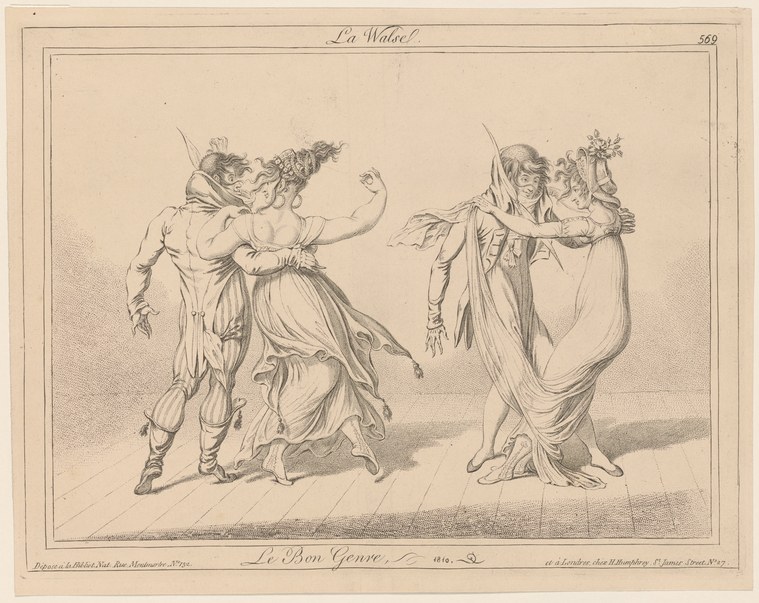
This print provides direct visual evidence of how the waltz was performed and understood in the early years of its adoption into European ballroom and theatrical contexts. The work is also historically significant as an example of the period's investment in dance imagery as a vehicle for neoclassical aesthetics and social commentary, showing that the waltz was deemed important enough to receive allegorical and artistic treatment rather than simple documentary illustration.
What you are looking at
Two allegorical female figures dominate this engraving, set against a plain background with minimal shading. Both wear classical drapery and are crowned with flowering garlands. The figure on the left stands in a contrapposto pose, one arm raised in an expansive gesture while the other extends downward; her body twists dynamically, suggesting movement. The figure on the right leans backward slightly, her weight shifted, one arm extended toward her companion. Both figures' draperies billow and flow, emphasizing their motion. The composition is symmetrical and theatrical, with the two figures responding to each other across the shallow picture plane. The refined line work and lack of color are consistent with a French engraving of the late 18th or early 19th century.
The dancing
The left figure executes what appears to be a waltz turn or pivot, her torso rotated with one arm raised high and the other at her side, her weight clearly on one leg while the other extends. The right figure's posture suggests she is following or responding—her body leans back, arms at mid-level, in a position consistent with a partner position in a waltz. Both figures maintain the upright carriage and the lifted, turned-out frame typical of Romantic-era ballroom dance. The distance between them and their orientation suggest this is not a closed-hold dance but rather a moment of interaction between two characters or two aspects of the same idea.
The dance depicted
The title 'La Walse' (The Waltz) identifies this explicitly as depicting the waltz, the dominant ballroom dance of the early 19th century. The classical dress and allegorical treatment suggest this may be a design for theatrical dance—possibly for a ballet or court entertainment—rather than a depiction of ballroom social dancing. The poses show the characteristic rotational movement and rise-and-fall frame of the waltz, though the theatrical costume and the figure's gesture vocabulary suggest a stylized, performative version rather than a documentary of social practice. The allegorical format (the crowned and garlanded figures) may indicate this is representing the Waltz as a personified idea or cultural force, common in theatrical and propagandistic prints of the period.
How it was made
This is a finely executed line engraving, likely French, using controlled parallel hatching to create volume and shadow. The technique allows for precise delineation of the figures' anatomy and the delicate folds of their draperies, and the shallow linear shading gives the scene a refined, classical character. The engraving process made such works reproducible and economical to distribute, placing them within the reach of educated middle-class viewers and dance enthusiasts. The elegant, finished appearance and the absence of any artist signature suggest this may be a commercial print from a dance instruction manual, a theatrical design, or a commemorative image celebrating the waltz's status as a fashionable dance.
About this work
This engraving celebrates the waltz through allegorical and neoclassical imagery, rendering it as a pair of classical-draped figures in motion. The explicit title and the careful rendering of the rotational, lifted posture and frame establish this as a document of early 19th-century waltz practice, but the theatrical costume and composition suggest it belongs to the world of artistic and theatrical representation of dance rather than to its social practice. The work combines documentary intent—showing how the waltz was executed—with symbolic and promotional purpose, treating the dance as a subject worthy of fine-art treatment and cultural celebration.
How to look at it
Observe the rotational axis of each figure's body and the way the drapery trails behind the motion, capturing the moment of a waltz turn. Notice how the artist has frozen not a static position but a transitional moment—the left figure is mid-pivot, the right figure responding in kind. The raised arm of the left figure shows the extended frame of the waltz, while both figures' upright carriage and the space between them reflect the lifted, elegant style of Romantic-era ballroom dance. The allegorical treatment should not obscure the anatomical precision: the artist understood the mechanics of the waltz and rendered them with clarity.
The period
The waltz, originating in Vienna in the late 18th century, was viewed by conservative moralists as shockingly intimate and improper due to its closed hold and rapid turning. By the early 19th century, however, it had become fashionable in elite ballrooms and in theatrical performances across Europe. The classical drapery and allegorical treatment of this engraving reflect the period's tendency to legitimize the waltz by associating it with Greco-Roman virtue and artistic refinement. Engravings of fashionable dances were common commercial products in this era, distributed through dance instruction books, periodicals, and prints sold to enthusiasts. The refined execution suggests this was aimed at an educated audience and may have served as both a record of correct technique and a cultural endorsement of the dance.
Where it lives
This work is held in the NYPL's collection of dance-related prints. It appears to be a commercial engraving, likely from a French dance instruction manual, theatrical publication, or commemorative series of fashionable dances. The collection index title 'La Walsel' may be a variant or archival reading of the inscription visible in the print.
Dance in this work
Questions about this work
Is this an engraving or an etching?
This is an engraving, identifiable by the clean, controlled line work and the use of parallel hatching for shadow, characteristic of burin engraving rather than etching's more fluid line. Engravings could achieve very fine detail and were the preferred technique for high-quality reproductive prints in the early 19th century.
Who are these two figures?
They are allegorical personifications of the Waltz itself, dressed in classical drapery and crowned with flowers in the style of Romantic-era prints. They are not depicting specific individuals but rather embodying the dance as an ideal or cultural concept.
What does the waltz look like in this image?
The rotational frame and the lifted, turned-out posture of both figures show the characteristic waltz technique. The left figure is captured mid-turn with an extended arm and raised frame; the right figure's backward-leaning posture and arm position reflect the follower's role in a waltz partnership, though the theatrical distance between them suggests a staged rather than ballroom interpretation.
When was this print made?
The catalogue record does not provide a date, but the style of the engraving, the classical drapery, and the subject matter are consistent with French dance prints of the 1810s–1830s, the period when the waltz was being promoted as a fashionable and artistically legitimate dance.
More dance artwork





