49 works in this view — arrow keys or swipe to move between them.
Dance in Art
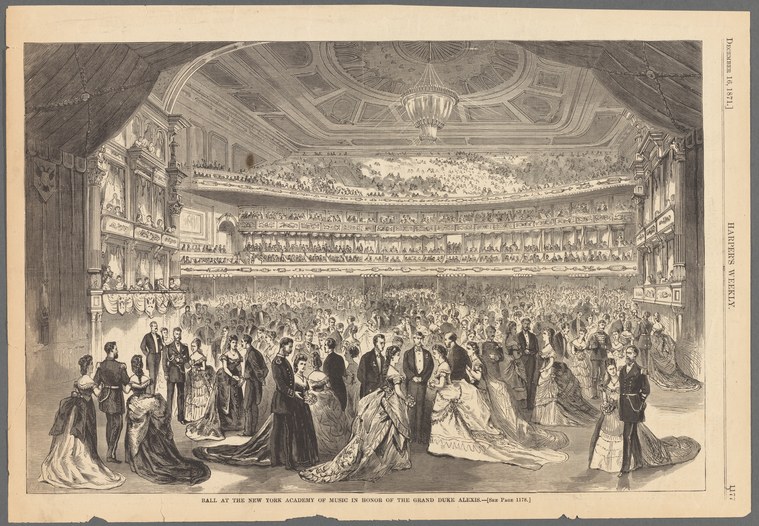
Ball at the New York Academy of Music in honor of the Grand Duke Alexis
Unknown artist
- Collection:
- Prints depicting dance
- Source:
- New York Public Library
- Rights:
- Public domain — free to use, share and adapt.
- Recorded as:
- Public Domain
The image is valuable evidence of how ballroom dance functioned as state ritual in late-19th-century America, not merely as social recreation but as diplomatic ceremony. It shows the scale of formal assembly required for such occasions, the strict gender and military hierarchies encoded in dress and positioning, and the role of the theater as the appropriate venue for the most prestigious social dancing.
What you are looking at
A grand ball fills an ornate theater with hundreds of figures in formal evening dress. The composition centers on the stage floor, where couples and groups stand in conversation and preparation for dancing, while the auditorium rises steeply behind them with multiple tiers of balconies packed with spectators. The ceiling is elaborately decorated with coffers and ornamental molding. The foreground shows women in full-skirted gowns with long trains, many in white or pale silks with dark bodices or cloaks; men wear military dress uniforms with medals and formal tailcoats. The lighting, created through the engraver's use of cross-hatching and parallel lines, falls most brightly on the stage and figures nearest the viewer, fading toward the back. This is a state occasion of considerable ceremony—the gathering of an aristocratic or royal society for a formal ball rather than a performance of dance for an audience.
The dancing
The dancers and attendees stand in upright, formal postures typical of 19th-century ballroom protocol. Several figures in the foreground hold pairs of hands in closed position or stand at arm's length awaiting engagement; the positioning suggests the opening formations of a quadrille or cotillion rather than active turning. The women's enormous skirts and trains dominate the visual field, rendered with careful parallel hatching to suggest volume and fabric weight. Military uniforms on the men are shown with precise insignia and decoration. Most figures are stationary or in standing conversation; no one is captured mid-leap or in vigorous motion. The overall frame shows constraint and ceremony rather than energetic movement.
The dance depicted
This depicts a formal state ball, most likely a quadrille or cotillion—the ceremonial court dances of the 19th-century aristocracy. The title's mention of the Grand Duke Alexis (a Russian royal visitor to America in 1871–1872) anchors the event historically. The gathering is not a performance but a participatory social dance of the kind that required precise formation, formal dress, and careful attention to rank and precedent. The sheer scale of the assembly, the theatrical venue, and the mixed presentation of dancers on the floor and spectators in the balconies indicates this was a state reception in which the ball itself was part of diplomatic ceremony. The dress and decorum suggest a waltz or quadrille was the principal dance.
How it was made
This is a wood engraving or steel engraving, established from the fine parallel hatching, the precise linework, and the tonal modeling achieved entirely through line density—all characteristic of 19th-century engraving technique. The image was likely created for reproduction in a newspaper or illustrated periodical, which was the standard means of documenting and circulating images of major social events. The technique required great skill in rendering architectural space, fabric, and human groupings at small scale, and was well suited to the simultaneous recording of many figures and the illusion of crowd and spectacle. The image would have been distributed to the American press to commemorate the royal visit.
About this work
This engraving documents a state ball held at the Academy of Music in New York in honor of Grand Duke Alexis of Russia, a ceremonial event at the apex of 19th-century American high society. Rather than depicting an active performance or a technical display of dance, it captures the formal assembly and conversational gathering that preceded and framed the dancing—the moment of ceremony and protocol rather than motion. The work is a historical record of court dance culture in Gilded Age America, showing the scale of such occasions, the precision of dress and rank, and the mixture of participation and spectatorship that characterized ballroom events of the period.
How to look at it
Trace the layering of the composition: the stage floor in the immediate foreground, the rising tiers of spectators, and the ornamental theater architecture framing everything. Note how the engraver uses line density and hatching to create the illusion of crowd and depth—fewer, finer lines in the distance, heavier hatching in the foreground. Observe the careful distinction between the dancers on the floor (fewer, more precisely rendered) and the dense crowd of spectators in the balconies (rendered almost as texture). The moment captured is one of assembly and anticipation rather than action—a formal photograph of society in its ceremonial dress.
The artist
The artist is not recorded. The work was produced as news illustration for a major metropolitan newspaper or illustrated periodical, in the anonymous collaborative tradition of wood and steel engraving for print. Such works were typically unsigned or credited only to the publication.
The period
The years 1871–1872 saw the height of Gilded Age society in New York and the emergence of the ball as a form of conspicuous display and international diplomacy. The quadrille, cotillion, and waltz dominated ballroom dancing at this period, performed in strict formation according to the rules of deportment and etiquette codified in dance manuals. The visit of Russian royalty was a major social event, and such occasions were extensively documented in the illustrated press as a means of spreading images of American wealth and refinement. Wood and steel engraving was at the peak of its use for news and event documentation, before photographic reproduction became standard in the 1890s.
Where it lives
The work is held in the New York Public Library's collection of prints depicting dance. It is a newspaper or periodical engraving, produced and circulated for immediate news documentation rather than preserved as a unique artwork.
Dance in this work
Questions about this work
Who was the Grand Duke Alexis and why was he honored with a ball?
Grand Duke Alexis was a son of Tsar Alexander II of Russia. His visit to the United States in 1871–1872 was a major diplomatic event, and elaborate state balls were given in his honor in the principal American cities as a gesture of international goodwill and to display American society and wealth.
What dance would have been performed at a ball like this?
The principal dances at such a formal state ball would have been the quadrille and the cotillion, both highly structured figure dances performed in formation by couples, and the waltz. All three required formal dress, careful attention to etiquette, and knowledge of the prescribed steps and formations.
Why are there so many people in the balconies if they are not dancing?
In the 19th century, the most prestigious balls were semi-public events where society members not dancing watched from the balconies. This created a hierarchy of participation: those on the floor were the principal dancers and the most honored guests, while those in the balconies were members of society, press, and spectators. The presence of spectators was itself part of the ceremonial nature of the occasion.
How do I know this is an engraving and not a drawing or painting?
The image is composed entirely of parallel lines and cross-hatching—the characteristic technique of wood or steel engraving. There is no continuous tone, shading, or wash; all gradation of light and dark is achieved by varying the density and direction of parallel lines. This technique was standard for press reproduction in the 19th century because engraved plates could be printed at high speed alongside type.
More dance artwork





