49 works in this view — arrow keys or swipe to move between them.
Dance in Art
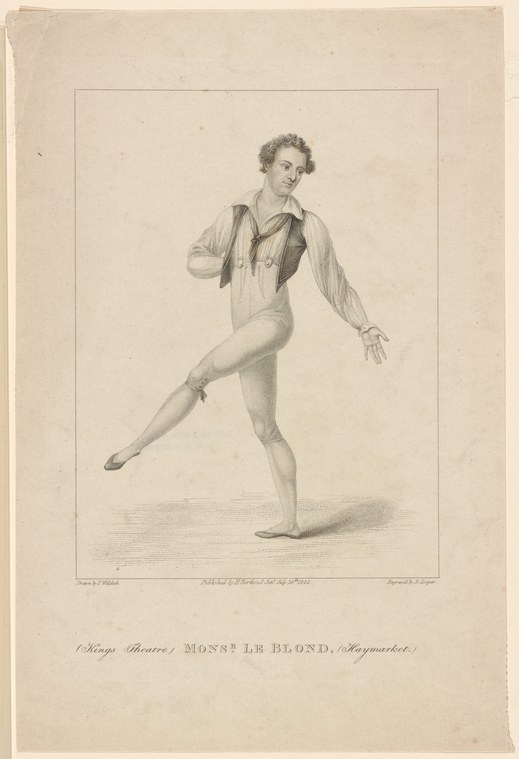
Monsr. Le Blond (Kings Theatre Haymarket)
Unknown artist
- Collection:
- Prints depicting dance
- Source:
- New York Public Library
- Rights:
- Public domain — free to use, share and adapt.
- Recorded as:
- Public Domain
As a named portrait of a professional dancer, this print is documentary evidence of who danced at the Kings Theatre Haymarket and what technical skill was prized in 18th-century theatrical performance. The engraved format means it circulated beyond the theatre itself, shaping audiences' understanding of what male dancers looked like and what their bodies could do.
What you are looking at
A male dancer in theatrical dress stands alone against a plain background, captured mid-performance in a pose of considerable virtuosity. He wears a pale tunic or shirt with short sleeves, dark breeches, and appears barefoot. His pose is one of arrested motion: the torso inclines forward while one leg extends behind him in a controlled line, the other knee bent in support, and his arms are held in open positions—the near arm extended outward, the far arm relaxed—suggesting either preparation for or recovery from a vigorous step. The figure is rendered in fine detail through engraving, with careful attention to musculature and the precise articulation of the limbs, against a light ground that isolates the dancer completely. The inscription below names him as Monsr. Le Blond of the Kings Theatre Haymarket, identifying this as a portrait of a celebrated performer.
The dancing
A single male dancer occupies the frame in a moment of controlled elevation or balletic suspension. His weight is concentrated on one bent leg while the opposite leg extends into a near-horizontal line behind the body, creating a line of considerable extension from hip to heel. The torso is pitched forward from the hips in a posture characteristic of male classical dance technique—neither fully upright nor collapsed, suggesting active control. The arms are held in open positions rather than classical closed frames, with one arm extended laterally and the other more relaxed, indicating either the male dancer's characteristic open port de bras or the moment between steps.
The dance depicted
This is a portrait of a professional male dancer from the 18th-century London theatre, most likely engaged in theatrical dance of the period—either classical ballet or the mixed theatrical dance performed at Haymarket theatres. The pose itself, with its emphasis on elevation, extension, and controlled balance on one leg, is consistent with male classical ballet technique as performed in the mid-to-late 1700s. Le Blond's costume and barefoot performance align with the conventions of theatrical dance of the era, when male dancers in Britain were increasingly trained in the Continental manner. The image appears to celebrate technical virtuosity rather than narrative content, presenting the dancer as a skilled performer of elevation and line control.
How it was made
This is a copper-plate engraving, a reproductive print technology that allowed wide circulation of theatrical portraits. The technique demands precise parallel lines to create tone and volume, which is visible in the careful hatching that models the musculature of the legs and the fall of fabric. Engraving was the standard method for publishing theatrical imagery in 18th-century London, making such prints accessible to theatre-goers and collectors of theatrical memorabilia. The print's fine detail and careful composition suggest a skilled engraver working from a drawing or painting, designed to celebrate and market a celebrated performer.
About this work
This is an 18th-century engraved portrait of a professional male dancer of the London stage, identified by inscription as Monsr. Le Blond of the Kings Theatre Haymarket. The image documents both a performer and a moment in the history of dance: when male classical technique was becoming established in British theatre, and when the theatre's star performers were celebrated through reproductive prints. The isolated figure against plain ground is characteristic of theatrical portraiture of the period, presenting the dancer as a virtuoso of controlled elevation and extension rather than as a character in narrative. The image is a historical record of professional male ballet as it was performed and understood in Georgian London.
How to look at it
The viewer should attend to the precision of the dancer's posture: note how the extended leg is held nearly parallel to the ground in a line of pure geometry, and how the supporting leg is bent to maintain control and balance. The moment chosen is one of arrest—not the explosive moment of takeoff, but the sustained hold that demonstrates both strength and control. The artist has frozen a moment that showcases the dancer's ability to command space and sustain a difficult position, which is the point: this is a portrait of virtuosity, not narrative. The plain background and frontal-yet-dynamic pose are conventions of theatrical portraiture designed to focus all attention on the dancer's technical achievement.
The artist
The engraver is not recorded in the available catalogue information. The style and technique are consistent with mid-to-late 18th-century London engraving practice, and the print's quality suggests work by a skilled reproductive engraver of the period, but identification would require archival research beyond the current record.
The period
This print dates to a period when British theatre was increasingly importing and training dancers in the Continental (French and Italian) classical manner. The Kings Theatre Haymarket was one of London's principal theatres, and male dancers were celebrated performers drawing audiences as featured attractions. The 1750s–1770s saw the establishment of classical ballet vocabulary and technique in British theatrical practice, though male dancers in Britain remained less emphasized than in Continental Europe. Theatrical prints of named performers were a popular form of entertainment memorabilia, comparable to modern celebrity photography.
Where it lives
This engraved print is held in the New York Public Library's collection of prints depicting dance. It is a reproductive print, likely published for commercial sale to theatre-goers and collectors, and exists in likely multiple impressions.
Dance in this work
Questions about this work
Who was Monsr. Le Blond?
Le Blond was a professional male dancer performing at the Kings Theatre Haymarket in London in the 18th century. Beyond the inscription on this print, further details of his career and background would require research in theatrical records and archival sources. The honorific 'Monsr.' (Monsieur) suggests French training or Continental style, which was prestigious in London at this period.
What is he doing in this pose?
The pose demonstrates elevation and extension—two core technical accomplishments of classical male dance. He is holding a position with one leg extended behind him nearly horizontal while supported on the other leg, showing strength, control, and the ability to maintain a difficult line. This is a moment of sustained technical display rather than a transitional movement, designed to show off his virtuosity.
What was theatrical dance like in 18th-century London?
Theatrical dance in this period was a mixture of classical ballet vocabulary (increasingly imported from France and Italy), pantomime, and entertainment. Male and female dancers were featured separately in diverse theatrical contexts—opera, drama, and dance-focused performances. Le Blond's costume and barefoot technique align with Continental practice. Professional dancers were celebrated as star attractions and were marketed through prints like this one.
More dance artwork





