49 works in this view — arrow keys or swipe to move between them.
Dance in Art
Virginia Zucchi
Unknown artist
- Collection:
- Prints depicting dance
- Source:
- New York Public Library
- Rights:
- Public domain — free to use, share and adapt.
- Recorded as:
- Public Domain
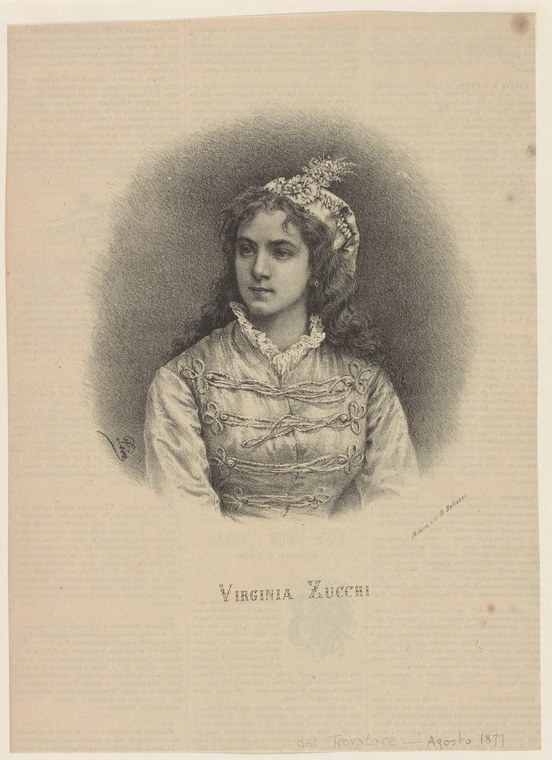
Virginia Zucchi was transformative in the history of ballet, particularly in her role in bringing Italian Classical technique to Russia and in her influence on the development of academic ballet in the late 19th century. This portrait serves as historical documentation of how a celebrated dancer of the highest rank was visually presented to the public, offering insight into the costume, styling, and cultural status of the prima ballerina assoluta during a pivotal era in ballet history.
What you are looking at
A three-quarter-length portrait of a young woman in an elegant indoor setting, rendered in fine-line engraving with subtle tonal shading. She wears a richly decorated dress of pale silk or satin with ornate braiding or embroidery across the bodice in a military or theatrical style, suggesting formal stage costume. Her long hair is styled in ringlets and crowned with a delicate floral wreath or tiara. The background is dark and atmospheric, with soft light modeling her face and upper body against the shadows. The composition is tightly focused on the subject, with her gaze directed away to the left, lending a pensive or poised quality to the portrait. The overall effect is one of refined elegance and considerable technical skill in the medium.
The dancing
The woman stands at ease with an upright, dignified posture characteristic of stage presentation. Her shoulders are relaxed and aligned, and her arms rest naturally at her sides in a pose suggesting quiet readiness or composure. The face is delicately modeled with fine hatching; the expression is serene and composed. There is no active movement or dance gesture visible; this is a formal portrait study rather than a representation of motion or performance action.
The dance depicted
This is a portrait of Virginia Zucchi, the Italian prima ballerina assoluta who became one of the most influential dancers of the late 19th century. The ornate military-style bodice, floral headdress, and formal presentation are consistent with the theatrical costume and styling of Romantic-era and late-Classical ballet as performed in the 1870s–1890s. The image does not show Zucchi in performance or mid-movement, but rather as a celebrated artist presented in formal dress. Her renown was tied to her mastery of Classical ballet technique and her dramatic stage presence, which would have been known to audiences of this print through her celebrated performances.
How it was made
This is a fine-line engraving or possibly a steel engraving, a technique that allowed for delicate tonal modeling and subtle gradations through careful hatching and cross-hatching. The inscription at the base identifies the subject as Virginia Zucchi. The medium was well suited to portrait circulation in the 19th century, when such prints were widely distributed and collected as documentation of celebrated performers. The quality of execution suggests a commercially produced print for a substantial audience of dance enthusiasts, theater patrons, and collectors of theatrical ephemera.
About this work
This is a formal portrait engraving of Virginia Zucchi, the celebrated Italian prima ballerina of the late 19th century. It presents her in elegant stage costume and formal pose, capturing her as a figure of artistic prestige and refined classical training. The print is a document of how one of the era's most influential dancers was publicly presented and remembered—not in the moment of performance, but as a composed and dignified artist. The work belongs in a gallery of dance imagery because it represents the veneration of the female ballet dancer as a cultural icon and the visual conventions by which great performers were documented and circulated among their audiences.
How to look at it
Attend to the formal presentation of the body and the deliberate styling of costume and hair—elements chosen to convey both elegance and authority. The portrait is static, not captured in movement, which was the conventional way of honoring a major artist of the period. The ornate military-style bodice is typical of late-Romantic and Classical ballet costume and would have been instantly recognizable to contemporary viewers as theatrical formal dress. The calm, poised expression and refined execution of the engraving convey the cultural status and refined artistry associated with the highest rank of ballet dancer.
The artist
The engraver is not identified in the catalogue record. The print bears a signature or inscription in the lower right corner, but it is not clearly legible in the reproduction. The quality of line and tonal control suggests a skilled theatrical portrait engraver of the mid-to-late 19th century, likely working in Italy or Europe during the height of Zucchi's fame.
The period
Virginia Zucchi (1847–1930) was at the height of her fame in the 1870s and 1880s. She trained in the rigorous Italian school and became famous for her technical brilliance, particularly in the Classical repertoire. Her career coincided with a moment when ballet was consolidating its academic vocabulary and the figure of the prima ballerina was becoming a celebrated cultural symbol. In the visual arts, theatrical portraiture flourished during this period, with prints and engravings serving as the primary medium for disseminating images of celebrated performers to a wide public. This print belongs to that tradition of theatrical documentation.
Where it lives
The print is held in the New York Public Library's collection of prints depicting dance. The date is not recorded in the catalogue, but based on Zucchi's career and the style of the engraving, it likely dates to the 1870s–1890s. Such prints were typically sold individually or in series as theatrical souvenirs and collector's items.
Dance in this work
Questions about this work
Who was Virginia Zucchi?
Virginia Zucchi (1847–1930) was an Italian prima ballerina and one of the most influential dancers of the late 19th century. She was celebrated for her technical mastery of Classical ballet and her dramatic presence on stage. She was particularly important in bringing Italian Classical technique to Russia, where she performed and taught, profoundly shaping the development of Russian Imperial Ballet.
What does the ornate costume tell us?
The elaborate braided or embroidered bodice and the floral headdress are typical of formal stage costume for a prima ballerina in the Classical and late-Romantic repertoire. The military-style decoration suggests either a specific theatrical role or the formal presentation costume that celebrated dancers wore for portraits. These details communicate theatrical status and refined elegance.
Why is this a portrait rather than a performance image?
Portrait engravings of celebrated performers were the standard way to document and circulate images of major artists in the 19th century. This formal presentation honored the dancer's status and allowed audiences to own an image of a performer they admired. Performance imagery was rarer; formal portraiture was the primary visual medium for celebrating artists.
What is the technique of this print?
This is an engraving, a technique in which an image is incised into a metal plate (usually steel or copper) and then printed. Fine-line engraving allowed for subtle tonal modeling through careful hatching, as seen in the soft modeling of the face and the delicate rendering of the fabric. This technique was ideal for theatrical portraiture and allowed for many high-quality impressions to be distributed.
More dance artwork





