49 works in this view — arrow keys or swipe to move between them.
Dance in Art
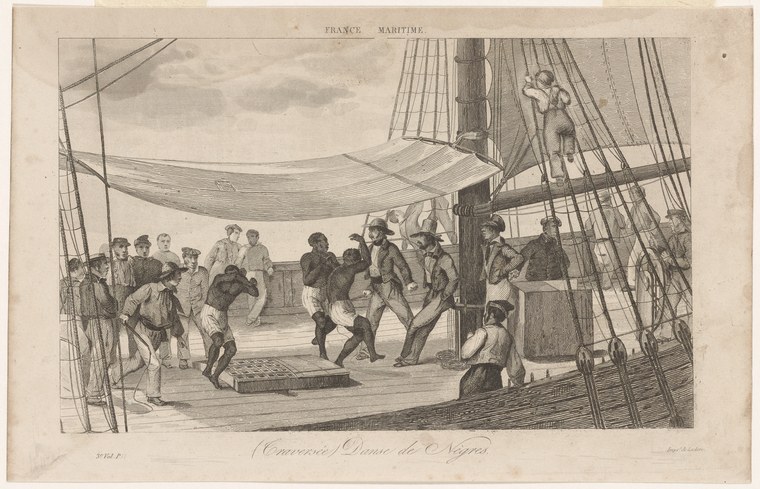
Traversée: danse de nègres
Unknown artist
- Collection:
- Prints depicting dance
- Source:
- New York Public Library
- Rights:
- Public domain — free to use, share and adapt.
- Recorded as:
- Public Domain
This print is crucial evidence of how European artists and audiences consumed and represented Black dance during the period of the slave trade and colonial expansion. It shows that African and diaspora dance forms were visible, documented, and circulated through European print culture — a visibility that served to exoticize and dehumanize the dancers themselves. The image raises essential questions about spectatorship, exploitation, and the ethics of representing Black bodies in motion in historical art.
What you are looking at
A crowded deck scene aboard a sailing vessel, rendered in fine line engraving. The ship's rigging and canvas fill the upper portion of the composition; below, roughly twenty figures occupy the main deck around a central open space. The figures wear early 19th-century dress — long coats, breeches, and hats for the men; long dresses for the women. At the center, several figures are in active motion: a man and woman appear to be dancing or demonstrating dance steps, while others form a loose circle or crowd around them, watching intently. The lighting is even and the scene is rendered with meticulous attention to the ship's structural detail, suggesting this is a specific, documented event rather than a generic maritime scene.
The dancing
The central dancers occupy an open circle of deck space, roughly 8–10 feet in diameter, with spectators pressed close around them. The male dancer (left-center) wears a dark coat and appears to be in an active, sprung posture — weight forward, knees bent, suggesting vigorous or acrobatic movement. The female dancer beside him wears a white or light dress and is also in active motion. Both figures have limbs extended in ways that suggest high energy and physical display. The surrounding figures stand upright, many with arms at their sides or gesturing, clearly engaged as onlookers rather than participants.
The dance depicted
The title *Traversée: danse de nègres* (Crossing: dance of Black people) and the shipboard setting suggest this depicts enslaved or free Black people dancing during the Middle Passage or a transatlantic voyage, a subject that appears in European maritime and popular prints of the 18th and early 19th centuries. The vigorous posture and acrobatic quality of the central figures' movement, combined with the spectatorial arrangement, suggests a display dance — possibly a recreation or performance of African dance forms or a syncretic style that emerged in the context of forced maritime confinement. The crowded deck and the emphasis on watching mark this as a social or entertainment event within the ship's hierarchy, not a ceremonial or religious practice. Without clearer detail of the footwork or musical instruments, the specific African or diasporic dance tradition cannot be identified with certainty, but the image appears to document a moment of embodied cultural practice under conditions of profound constraint.
How it was made
This is a finely executed line engraving, likely produced for a popular print or book illustration in the early 19th century. The technique allows for precise rendering of architectural detail — the ship's rigging, timber, and fittings are delineated with the exactness characteristic of maritime documentation prints. The human figures are rendered with less detail than the ship itself, particularly in the faces and hands, which were often left somewhat schematic in popular prints to speed production and reduce cost. The quality of the engraving and the subject suggest this was intended for a narrative or travel account aimed at a literate European audience curious about maritime life and colonial encounters.
About this work
This engraving documents a moment of dance aboard ship, placed at the intersection of maritime history, the transatlantic slave trade, and European visual culture. The title explicitly identifies the dancers as Black, and the shipboard setting places the image within a long tradition of European prints depicting encounters between European sailors and non-European peoples during voyages of trade and conquest. The dance itself — vigorous, acrobatic, and organized around spectatorial watching — suggests both cultural continuity and the constrained circumstances under which African diaspora performance took place. For a gallery of dance in art, this image is significant not as an aesthetic celebration of movement but as evidence of how European artists recorded and commodified Black bodies and Black cultural practice during the colonial period.
How to look at it
Attend first to the composition: the viewer's eye is drawn into the ship's interior by the perspective lines of the rigging, then settles on the open circle where the dancers perform. The artist has chosen to freeze a moment of high activity — the dancers are mid-movement, their bodies extended — which conveys energy and physicality. Note how the surrounding figures function as a frame: their stillness and their gaze direct attention to the dancers, reproducing the shipboard hierarchy and the European observer's perspective. The engraving technique itself is worth observing: the fine hatching that creates shadow and form in the ship's timber contrasts with the flatter rendering of the human figures, which may reflect both the artist's priorities and the conventions of popular maritime print-making.
The period
Early 19th-century European maritime prints often depicted scenes of shipboard life, including encounters with non-European peoples. The 'crossing' referenced in the title likely refers to the transatlantic voyage, and prints of this kind were produced as curiosities and ethnographic documents for European audiences who had little direct contact with African or diaspora cultures. The engraving technique allowed for rapid, inexpensive reproduction and wide circulation in the popular print market. At the same time, European dance aesthetics were undergoing significant change: Romantic ballet was emerging as a dominant theatrical form, and the contrast between the ordered, ethereal movement of European ballet and the vigorous, grounded, acrobatic movement depicted here reflects the racial and aesthetic hierarchies embedded in European artistic practice.
Where it lives
This print is held in the New York Public Library's collection of prints depicting dance. It is one of a significant body of European maritime and ethnographic prints from the 18th and 19th centuries that documented encounters between European sailors and non-European peoples.
Dance in this work
Questions about this work
Is this image from the slave trade?
The title and composition suggest this depicts a shipboard voyage, likely transatlantic. The explicit identification of the dancers as 'nègres' and the context of early 19th-century maritime print culture make it probable that this documented enslaved or constrained people. However, the catalogue record does not specify provenance or historical context, so the exact circumstances cannot be confirmed from the image alone. What is clear is that this is a European representation of Black people dancing under maritime conditions, and the image circulated as a curiosity within European visual culture.
What dance style is this?
The vigorous, acrobatic posture of the central figures suggests African or diaspora movement forms, but the engraving does not provide enough detail of footwork, hand position, or musical accompaniment to identify a specific dance tradition. The dancing appears energetic and grounded, in contrast to contemporary European ballet aesthetics. It may represent a syncretic style that emerged in the context of the diaspora, or a recreation of African forms remembered by the dancers themselves.
Who is the artist?
The artist is not recorded in the catalogue. The quality and style of the engraving suggest it was produced by a professional maritime print maker, likely working in the early 19th century for a European publisher, but no signature or attribution is visible in the image or catalogue record.
Why is this in a collection of dance prints?
This print documents a moment of embodied cultural practice — people dancing — and circulated as part of European visual culture. It belongs in a dance collection both as evidence of how dance was practiced under extreme constraint and as a historical artifact of how European artists and audiences consumed representations of Black bodies in motion.
More dance artwork





