49 works in this view — arrow keys or swipe to move between them.
Dance in Art
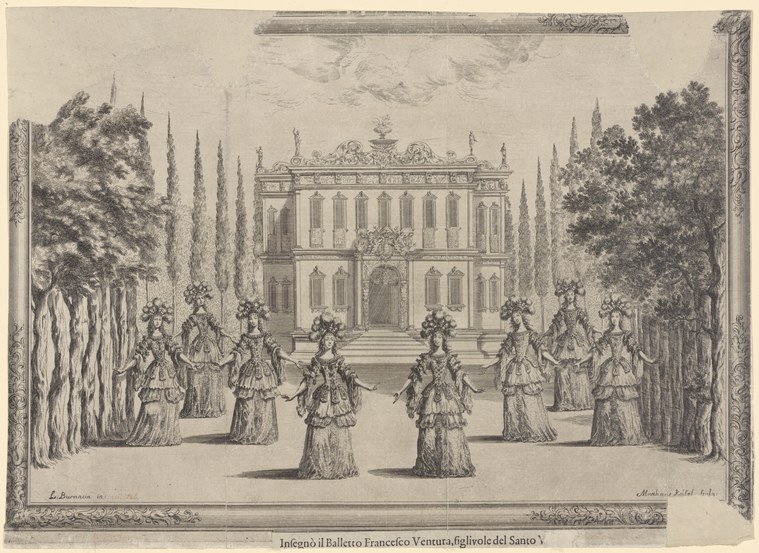
Insegnò Balletto Francesco Ventura, figlivole del Santo Ventura
Unknown artist
- Collection:
- Prints depicting dance
- Source:
- New York Public Library
- Rights:
- Public domain — free to use, share and adapt.
- Recorded as:
- Public Domain
This is one of the few surviving visual documents of Italian court dance choreography from the early modern period. Named attribution to a dance master (Ventura) is rare in engraved dance records and suggests this was a celebrated or innovative composition worth recording. The work shows that court dance was documented, circulated, and valued as authored intellectual property rather than anonymous social practice.
What you are looking at
An engraved scene of formal court dance set in a neoclassical palace courtyard. Two dozen figures in elaborate 18th-century dress stand in an open plaza framed by tall cypress trees and colonnaded architecture. The building behind them is a two-story structure with classical proportions, columns, and a balustrade crowning the roof. The figures are arranged in loose groupings across the space rather than in tight formation—some stand facing forward, others turned in profile, a few pairs appear to be dancing or in conversational contact. All wear formal court dress: the women in full-skirted gowns with tight bodices and elaborate headdresses, the men in breeches, coats, and tricorn hats. The composition uses the palace and formal garden setting to emphasize the ritualized, aristocratic character of the event.
The dancing
The dancers maintain upright, composed posture throughout. Several pairs stand close together in what appears to be a promenade or conversational stance rather than a closed ballroom hold. The spacing is generous and deliberate—figures are distributed across the courtyard floor rather than packed densely. Where bodies overlap, it is to show couples turning or walking together. The women's skirts, rendered with careful attention to volume and fall, show the kind of stiffened construction that would limit hip and leg movement. The men stand with weight forward, arms at ease or gesturing in social address.
The dance depicted
This depicts a court dance in the Italian or French neoclassical tradition, most likely from the late 17th or early 18th century. The title attributes the dance to Francesco Ventura (named as the son of Santo Ventura), a professional dance master. The format—an engraved record of a named choreographer's composition, set in an aristocratic courtyard, with figures shown in posed attitudes rather than mid-movement—was a common way to document and publicize court dances in this era. The women's heeled shoes, the men's formal court dress, and the open-air palatial setting all confirm this is a spectacle event for elite audiences rather than popular social dancing. The specific dance form cannot be determined from the poses alone, but the stately, processional arrangement suggests a pavane, passacaille, or formal court minuet rather than a faster galliard or branle.
How it was made
This is an engraving on paper, a medium that allows fine detail and mechanical reproducibility. The artist has used line work to render both form and shadow, with cross-hatching to suggest fabric texture and architectural depth. The precision of the palace architecture and the clarity of individual costume details indicate professional execution. As an engraved print, this work was designed for circulation among the educated elite and would have served as a record of the choreography, a souvenir of an actual court event, or a teaching document for other dance masters. The careful rendering of costume and setting gives this the character of a documentary rather than an imaginative illustration.
About this work
This is a record engraving of a court dance attributed to the dance master Francesco Ventura, likely made in Italy in the late 17th or early 18th century. It belongs to a now-lost tradition of printed dance notation in which choreographers recorded their compositions through engraved representations of dancers in costume and setting. The work documents not just a dance but an entire social ceremony—the dress, the architecture, the formal groupings—that constituted court spectacle. For historians of dance and theater, such prints are among the few visual records we have of how court dances were actually performed and arranged in space.
How to look at it
Read the composition from the palace outward: the building establishes hierarchy and formality, while the cypress trees frame the space as a designed, theatrical setting rather than a casual garden. Note the distribution of figures across the open floor—no couple is centered or prominent, suggesting that the overall pattern or procession was the point rather than virtuosity by individuals. Look at the costume details: the rigid bodices and heeled shoes tell you this is not everyday movement but highly constrained, upright, and measured. The women's faces are small and idealized, the men's poses formal and symmetrical—this is a representation of an ideal court event, not a documentary photograph.
The artist
The engraver is not recorded. The composition is attributed to Francesco Ventura, about whom little is known beyond this record. Dance masters of the period were often Italian professionals who traveled to courts across Europe; some, like Fabritio Caroso and Cesare Negri, published instructional manuals. Ventura's name suggests an Italian master, and the engraving's style and the classical architectural setting suggest a northern Italian or central European court commission. The notation that he was the son of Santo Ventura may indicate a family dynasty of dance masters, as was common in the profession.
The period
This print belongs to the era of high court dance spectacle in Europe, roughly 1650–1750. Court dances were not entertainment alone but instruments of political order and social ranking. The formal, processional character shown here reflects the influence of French court culture under Louis XIV, whose elaborate court ballets and dances set the standard for European aristocracy. The neoclassical architecture and the formal grouping of figures suggest influence from late-17th-century or early-18th-century aesthetic values. By this period, the galliard and other athletic dances had given way to the minuet and slower, more stately forms. The publication of such prints was part of a broader effort by dancing masters to establish dance as a teachable, recordable art form worthy of transmission and study.
Where it lives
This print is held in the New York Public Library's collection of prints depicting dance. It is catalogued as an engraving with a title in Italian, suggesting an Italian origin or at least an Italian-language cultural context.
Dance in this work
Questions about this work
Who was Francesco Ventura?
Little is known. He was a dance master active in the late 17th or early 18th century, likely Italian, and is recorded here as the choreographer of this court dance. That his father was named Santo Ventura suggests a family profession in dance. The fact that his work was engraved and circulated suggests he was celebrated or employed by a major court.
Is this a painting or a print?
This is an engraving—a print made by incising lines into a metal plate (usually copper), inking the plate, and pressing it onto paper. Engravings allowed designs to be reproduced many times and distributed widely. The fine linear detail and the clarity of architectural elements are characteristic of professional engraving work.
What dance is this?
The title gives only the name of the choreographer and the dance master's lineage. The formal, processional arrangement and the costume suggest a pavane, passacaille, or minuet—stately court dances of the period—rather than a fast or athletic dance. The exact form cannot be determined from the poses alone.
Why were dances engraved and printed?
Engraved records served multiple purposes: they documented prestigious court events, provided models for other dance masters to learn from, enhanced a choreographer's reputation, and allowed a dance to be performed by other courts. In an era before video or notation as we know it, these prints were a way to preserve and circulate choreographic knowledge.
More dance artwork





