49 works in this view — arrow keys or swipe to move between them.
Dance in Art
Le dernier cotillon
Unknown artist
- Collection:
- Prints depicting dance
- Source:
- New York Public Library
- Rights:
- Public domain — free to use, share and adapt.
- Recorded as:
- Public Domain
The cotillion was central to Regency social life and marriage markets, making it a constant subject of satire and commentary. This engraving captures a specific moment in the history of English ballroom dance—the height of the Regency period—and reveals how contemporaries saw both the dance itself and the social anxieties it embodied. For dance historians, it is rare evidence of the cotillion in action, albeit through the distorting lens of satire.
What you are looking at
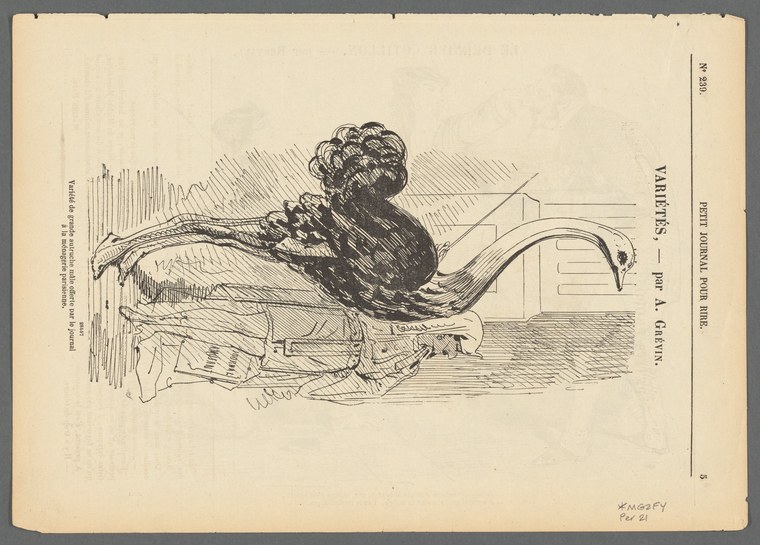
A satirical engraving depicts a final cotillion, the fashionable closing dance of Regency-era balls. The composition shows three figures in a moment of exaggerated social chaos. At center, a portly man in formal dress has lost his footing, his body splayed horizontally in mid-fall, his legs and arms akimbo in undignified abandon. A woman in an elaborate high-waisted gown and plumed headdress recoils in alarm, her posture rigid with shock. A second woman, partially visible at left, gestures with consternation. The setting is sparse—a few architectural lines suggest an interior, and scattered on the ground are the detritus of the ball: a dropped fan, a shoe, perhaps a glove. The engraving's sharp, precise linework captures the comedy of the moment through exaggerated gesture and the contrast between the dancers' formal attire and their undignified positions. The title inscribed at the base confirms the subject as the cotillion's finale—a deliberate choice of the most solemn moment for this indecorous spectacle.
The dancing
The central male figure is captured mid-collapse, his body nearly horizontal and entirely out of control—legs splayed, arms outstretched, his formal coat and breeches unable to maintain any dignity. The woman nearest him springs back with arms raised, her frame rigid with alarm and her face turned away, her elaborate dress (including a striking plumed headdress typical of Regency fashion) rendering her apparent helplessness more comic. A third figure at left adds to the sense of social disruption. None of these figures maintain any standard dance hold or frame; the composition is built on the complete breakdown of ballroom deportment.
The dance depicted
This is a cotillion, the grand closing dance of English Regency-era balls, typically performed in sets with intricate figures and considerable formality. The image satirizes the moment when this most stately of dances has descended into chaos—a tumble rather than a turn, loss of balance rather than controlled movement. The cotillion was a French import that became essential to English high society from the late 18th century onward, and its strict conventions made it a perfect target for caricaturists. The engraving mocks not only the dance itself but the social pretensions of those who performed it, reducing aristocratic ceremony to physical comedy. The date and artist remain unknown, but the style and subject place it firmly in the tradition of Regency social satire.
How it was made
This is a hand-engraved print, executed in the linear cross-hatching and fine line work characteristic of late 18th- or early 19th-century satirical prints. The technique allowed for rapid reproduction and wide circulation among the literate and leisure classes who attended balls. Engraving's precision makes the exaggerated poses and comic distortion more cutting—the very clarity of line emphasizes the indignity. The print format suggests it was published in a series or as a standalone broadside, typical of the popular satirical print trade that thrived on social mockery during the Regency period.
About this work
This is a satirical engraving of a cotillion, the formal closing dance of English Regency balls, captured at the moment of its catastrophic collapse. The work belongs to a long tradition of prints mocking ballroom culture and the pretensions of its participants—a tradition that includes Gillray and Rowlandson, though the artist here is unidentified. The print's power lies in its use of the cotillion, most rigid and ceremonious of dances, as the vehicle for social satire: the very formality of the dress and the setting makes the tumble more absurd. It is a document of how the Regency elite danced, what they wore, and how they were perceived—and mocked—by contemporary observers.
How to look at it
Pay attention to the moment the artist has chosen: not the graceful execution of a cotillion figure, but the instant of disaster. Notice how the formal dress—the man's coat and breeches, the woman's high waist and elaborate headdress—makes the loss of control more absurd. The scattered objects on the floor (fan, shoe) are deliberate details that emphasize the breakdown of order. The sharp, precise linework of the engraving technique makes the exaggeration of gesture—the splayed legs, the rigid recoil—all the more cutting. This is not a straightforward record of how the cotillion was danced; it is a commentary on the gap between the aspiration to grace and the reality of the body in motion.
The period
The cotillion was at the peak of its fashionable dominance during the Regency period (1811–1820), when it was the essential closing dance of the London season and country-house balls. It had arrived from France in the 1760s and became increasingly elaborate and rule-bound as the 19th century progressed. The same period saw an explosion of satirical prints mocking Regency society—its dress, manners, and social rituals. Artists like James Gillray and Thomas Rowlandson made fortunes caricaturing the follies of the ton, and the ballroom was a favorite subject. Satirical prints of dancing couples, of failed courtships on the dance floor, and of the physical comedy of formal dress in motion were widely circulated and consumed as entertainment. This engraving sits squarely in that tradition, using the pretensions of the cotillion to mock the entire social apparatus of the aristocracy.
Where it lives
The print is held in the New York Public Library's collection of prints depicting dance. It is an example of the popular satirical print trade of the Regency era, likely produced for wide circulation among London's reading public.
Dance in this work
Questions about this work
What is a cotillion?
A cotillion (or cotillon) was a French-derived ballroom dance that became the standard closing dance of English balls from the late 18th century onward. It was typically performed in sets and involved complex figures with considerable formality and precision. By the Regency period, it was an essential part of the social season and a marker of gentility and correct deportment.
Why is this dance being mocked?
The satire works precisely because the cotillion was so formal and so central to social status. By showing it collapsing into physical chaos, the engraver mocks not only the dance but the social pretensions of those who danced it. The contrast between the elaborate costume and the undignified tumble amplifies the comedy.
When was this engraved?
The style, costume, and subject matter place it in the Regency period or shortly after (roughly 1810–1825), but the exact date is unknown. The fashion of the woman's dress and headdress, and the style of the engraving, support this attribution.
Who was the artist?
The artist is not recorded. The print was not signed (or the signature has been lost), and it survives in the NYPL collection without attribution. It is likely the work of a professional print-maker working in the satirical tradition of the period, possibly published anonymously or as part of a series.
More dance artwork





