49 works in this view — arrow keys or swipe to move between them.
Dance in Art
Le Cancan
Unknown artist
- Collection:
- Prints depicting dance
- Source:
- New York Public Library
- Rights:
- Public domain — free to use, share and adapt.
- Recorded as:
- Public Domain
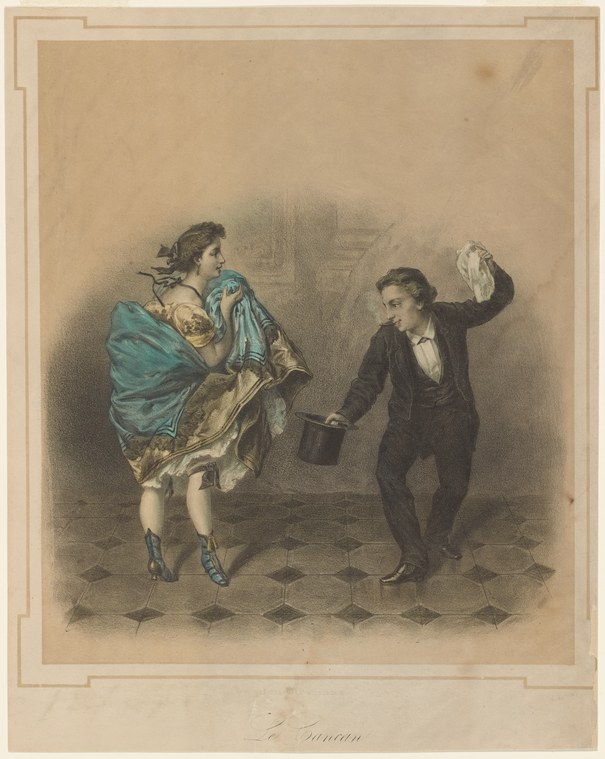
The cancan was one of the most visually and socially disruptive dances of the 19th century, and this image preserves the precise physical form that made it transgressive: the extended leg, the kicked-up skirt, the woman's active agency and physical boldness. For historians of dance, fashion, and social performance, such prints are primary evidence of how the dance was executed, what it looked like in action, and what viewers expected to see—which often differed sharply from the reality.
What you are looking at
A young woman in an elaborate costume—teal-blue wrap, gold-embroidered dress, and heeled shoes—executes a high kick or leap while a man in dark formal dress (jacket, waistcoat, and light trousers) watches or participates. The woman's body is angled dynamically, her free leg extended upward and her torso pitched forward with the wrap flying behind her. The man stands in a casual pose, one arm raised, suggesting either encouragement or participation in the dance. The setting is a simple interior with a geometric tiled floor and neutral background, drawn in muted tones that throw the couple into sharp relief. The composition captures a moment of exuberance and physical abandon—the woman's body at full extension, the man's posture relaxed and approving.
The dancing
Two figures in close spatial relationship but not in ballroom hold. The woman is the active dancer: her weight is on one leg, the other extended high in a vigorous kick or extension, her torso bent forward in a dramatic line that emphasizes the lift and energy of the movement. The man is stationary and tertiary to the action—standing upright, one arm raised to shoulder height in a gesture of encouragement or mild participation. Their body language suggests a performance or demonstration rather than a mutual partnership; the woman is the spectacle and the man is witness or facilitator.
The dance depicted
This is identified as the cancan (also spelled can-can), the high-kicking social dance of the Paris music halls and cabarets, particularly associated with the Moulin Rouge and the 1890s. The image captures the dance's defining gesture: the sharp, uninhibited kick, executed with leg extended high and straight, often with deliberate exaggeration of the femur and dramatic use of the skirt. The cancan was danced by women in groups or with male partners, and its reputation for scandal—the visible leg, the apparent impropriety—made it a subject of intense artistic attention throughout Europe. The informal setting and the woman's costume (richly decorated but not ballroom-formal) align with the dance hall and cabaret context in which the cancan was performed.
How it was made
This is a hand-colored engraving or lithograph, evident from the fine linear work in the background geometry, the controlled tonal gradations achieved through careful cross-hatching and wash, and the crisp definition of the figures against the softer background. The coloring—the teal wrap, the gold tones of the dress, the subtle modeling of skin—is applied by hand, suggesting a print made for popular distribution and then individually colored, a common practice for mid-to-late 19th-century satirical and theatrical imagery. The technique allowed rapid reproduction for a mass audience interested in music hall life, social commentary, and fashion.
About this work
This is a satirical or documentary print of cancan dancing, rendered in the hand-colored engraving or lithograph technique popular for theatrical and social subjects in the 19th century. It captures the defining physical gesture of the cancan—the high kick—and the informal, performative relationship between dancer and male observer. The work belongs to a large body of European imagery documenting and often mocking the music hall and cabaret cultures of Paris, Berlin, and other cities in the decades around 1900. Such images circulated widely as prints and illustrations, shaping middle-class attitudes toward entertainment and female performance, and remain crucial evidence for how the cancan was understood and represented in its own time.
How to look at it
Watch the woman's body: the high extension of the leg, the forward bend of the torso, and the way the wrap and skirt are rendered in motion—these are the visual markers of the cancan. The artist has chosen to freeze the most dramatic moment of the kick, when the body is most extended and the skirt most disrupted. Notice the informality of the male figure—he is not a partner in the ballroom sense, but an admirer or facilitator, which tells us this is a public performance or demonstration rather than a dance of mutual partnership. The flat, stylized background and the careful hand-coloring direct attention to the costume and the body in motion.
The period
The cancan emerged in the 1830s–40s in the working-class dance halls and lower-class cabarets of Paris, and became a symbol of urban modernity, female transgression, and entertainment culture as it moved into the commercial music halls of the 1870s–90s. By the 1890s, the Moulin Rouge (opened 1889) had made the cancan a major tourist attraction and a subject of intense artistic interest. European artists—including Toulouse-Lautrec, whose posters and paintings of the Moulin Rouge are among the most famous images of the era—were fascinated by the cancan's physical boldness and its challenge to middle-class decorum. This print sits within that widespread cultural fascination with music hall life, and documents the dance at a moment when it was simultaneously condemned as immoral and celebrated as the epitome of modern, free-spirited female performance.
Where it lives
This work comes from the New York Public Library's collection of prints depicting dance, a collection that assembles theatrical and social dance imagery from across Europe and North America, spanning several centuries. Such prints were typically produced in editions and hand-colored for distribution to a broad audience.
Dance in this work
Questions about this work
What is the cancan and why was it so controversial?
The cancan was a high-kicking social dance that originated in Paris in the 1830s–40s and became a major attraction in music halls and cabarets by the 1890s. It was controversial because it involved women dancing with visible legs, high kicks, and exuberant physical movement that violated Victorian norms of female propriety. Middle-class observers saw it as immoral and improper; others celebrated it as a sign of modern freedom and female agency.
Who danced the cancan and where?
The cancan was danced primarily by working-class and entertainment-district women in Parisian dance halls, cabarets, and music halls. By the 1890s, the Moulin Rouge had made it a central feature of its nightly shows, attracting audiences from across Europe and beyond. Both solo performers and groups of dancers performed the cancan, often with male partners or facilitators, as shown in this print.
How is the cancan different from other 19th-century dances?
The cancan was radically different from ballroom dances like the waltz because it was fast, unrestrained, physically bold, and performed primarily by women for an audience rather than as a partnership. While ballroom dances emphasized elegance, control, and formal hold, the cancan emphasized the high kick, the moving skirt, the visible leg, and the woman's physical power and agency. It was explicitly a dance of transgression.
Why do so many artists depict the cancan?
The cancan was visually spectacular and culturally controversial, making it irresistible to artists interested in modern life, female performance, and social critique. The high kick and moving skirt are among the most visually dynamic and recognizable gestures in 19th-century dance, and the cancan's association with Paris, entertainment, and female transgression made it a subject of endless fascination for painters, printmakers, and illustrators.
More dance artwork





