49 works in this view — arrow keys or swipe to move between them.
Dance in Art
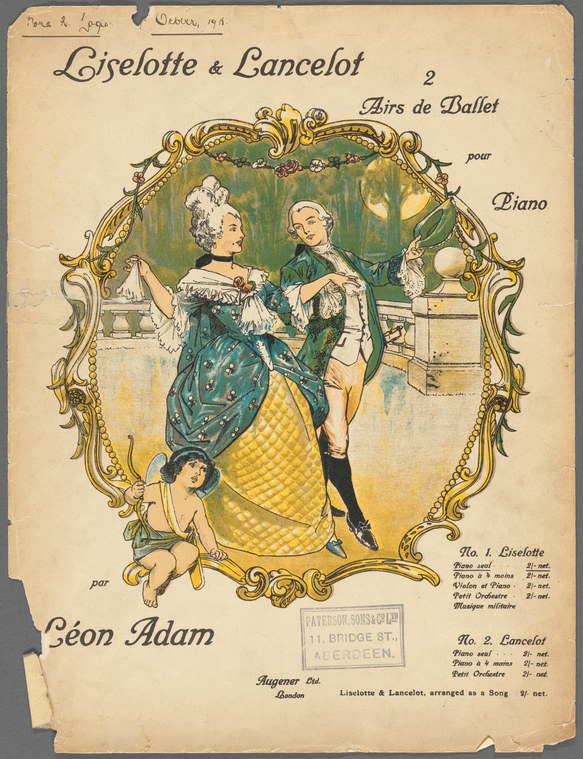
Liselotte & Lancelot, 2 airs de ballet pour piano par Léon Adam
Unknown artist
- Collection:
- Prints depicting dance
- Source:
- New York Public Library
- Rights:
- Public domain — free to use, share and adapt.
- Recorded as:
- Public Domain
This work documents how theatrical dance was circulated and consumed in the late 19th century—not as something one witnessed passively in a theatre, but as something one could buy, take home, and recreate in one's own parlour. The illustrated music cover was a primary engine of dance's entry into middle-class leisure culture. It also shows the conventions of costume, framing, and romantic narrative that governed how ballroom and theatrical dance were visualized and understood at the moment when ballet itself was undergoing radical change.
What you are looking at
This is a cover for a music score published in Paris, featuring an ornate rococo frame surrounding two figures in an 18th-century ballroom setting. A woman in an elaborate teal or blue-green gown with patterned lower skirts faces a man in pale breeches, waistcoat, and dark coat in an attitude suggestive of courtship or intimate conversation. A cupid figure occupies the lower left of the frame. The background shows a garden or park with trees and an urn. The setting is rendered in soft watercolour tones—pale yellows, greens, and whites—that suggest candlelit interior light or outdoor twilight. The ornamental gilt frame, with its scrollwork and flourishes, declares this as a work of theatrical or ballroom refinement from the late 19th century. The couple's posture and proximity suggest a romantic or narrative moment rather than active dance movement.
The dancing
The woman's weight appears to rest on one leg, her body tilted toward the man; her arm gestures expressively. The man leans in with an attentive posture, his arm extended toward or around the woman's waist in a gesture of courtship rather than a formed ballroom hold. Neither figure displays the upright frame or aligned posture of a ballroom dance in progression. The cupid at the base of the frame reinforces a romance or seduction narrative. Their proximity and body angle suggest a moment of dramatic conversation frozen within a dance or theatrical encounter rather than the execution of a specific step sequence.
The dance depicted
The title identifies this as airs de ballet—literally 'airs' or tunes for ballet, published as piano pieces by Léon Adam. Ballet airs of this period were theatrical miniatures, often incorporated into longer entertainments or used as vehicle pieces for soloists. The musical form suggests these were short character dances or romantic interludes rather than narrative ballet proper. The image does not show active technique: no turnout is evident, no balletic port de bras, no pointe work. Instead it shows the costume and setting convention of late 19th-century theatrical romance, with the couple posed in an intimate attitude that would frame such a piece. Without seeing the movement itself, we can infer only that these were likely solo or duet romantic scenes set to music, probably danced in the contemporary theatrical style of the 1880s–90s.
How it was made
This is a chromolithographic cover, a process that allowed full colour reproduction of artwork at commercial scale. The soft colour palette, the delicate hand-painted quality of the frame ornament, and the way the figures blend into the background are characteristic of chromolithography in France during the 1880s–1890s. This technique made illustrated music covers affordable and collectible, and they circulated widely among amateur musicians and theatre patrons. The ornamental frame itself—a rococo revival design that references 18th-century taste—was a marketing choice, situating these pieces within a fantasy of aristocratic leisure and romantic refinement.
About this work
This is the cover of a published music score for piano pieces titled Liselotte & Lancelot: 2 Airs de Ballet by Léon Adam, printed in Paris and now held in the New York Public Library's collection of dance imagery. It dates from the late 19th century, though the exact year is not recorded. The work represents a common commercial form of its period: theatrical miniatures published as sheet music for amateur performance, marketed to drawing-room musicians and dance enthusiasts through illustrated, chromolithographed covers that sold the romantic fantasy of the music as much as the music itself.
The cover shows a man and woman in late 18th-century costume posed in an intimate moment within a garden setting, framed by ornamental scrollwork. This costuming—a common convention of the period—places the 'ballet airs' in a timeless realm of romance and theatricality. The image tells us nothing about the actual steps or technique of these pieces, but it tells us a great deal about how theatrical dance was imagined and sold to the public: as spectacle, romance, and accessible fantasy.
How to look at it
Look first at the frame: its ornamental language declares this a work of fantasy and refinement, not documentary. The couple are not shown dancing—they are shown in a moment of dramatic pause or intimate conversation that frames the piece as a romantic narrative rather than a technical display. The soft, watercoloured rendering and the garden setting create a dreamlike quality far removed from the actual ballroom or theatre stage where such pieces would be performed. The cupid reinforces that we are looking at a fiction of courtship and desire, not an instruction manual. Read this as marketing: the image sells a fantasy of what the music promises to deliver.
The artist
Léon Adam was a French composer and pianist active in the late 19th century, working in the salon and theatrical music genres. Little is recorded of his biography or output beyond surviving scores and covers. The publication of these pieces by what appears to be a Paris music publisher suggests he worked within the commercial music industry catering to amateur musicians, producing character dances, waltzes, and other salon pieces meant for publication rather than concert performance.
The period
The 1880s–1890s saw the height of the illustrated music cover as a commercial art form in Europe. At the same time, theatrical ballet was in transition: classical ballet was being challenged by the Romantic revival and by new experimental choreography, yet salon dances, character dances, and theatrical miniatures remained central to both professional and amateur musical life. The rise of chromolithography made colour illustration affordable, and music publishers invested heavily in visual marketing aimed at women, who were the primary purchasers and performers of salon music. The rococo revival frame and the 18th-century costume were marketing devices that promised timelessness and refinement—qualities that helped situate dance and music at the respectable center of bourgeois culture.
Where it lives
This work is held in the Prints depicting dance collection at the New York Public Library, catalogued as a work of unknown date and artist attribution (the artist responsible for the cover illustration is not recorded, though the composer Léon Adam is credited on the title page). It entered the collection as an example of theatrical dance imagery in the commercial culture of the period.
Dance in this work
Questions about this work
What are 'airs de ballet'?
Airs (or airs) de ballet were short instrumental pieces—usually for solo piano—that captured the character, rhythm, and mood of a theatrical dance without being full ballet scores. They were designed for concert performance and domestic music-making, allowing amateur musicians to experience something of theatrical dance culture. In the late 19th century they became a standard commercial form, marketed to middle-class households through illustrated covers like this one.
Why is the couple dressed in 18th-century costume?
The rococo and 18th-century revival was a dominant marketing convention of the late 19th century, especially in music and dance imagery. It promised timelessness, refinement, and a fantasy of aristocratic leisure—qualities that enhanced the appeal of the music. The costume also allowed the publisher to situate these pieces in a realm of romantic fantasy rather than contemporary ballroom reality, making them more appealing to the target audience of amateur musicians.
Is this a painting or a print?
This is a chromolithograph—a colour lithographic print. The technique allowed publishers to produce affordable, full-colour illustrated covers at scale, making them accessible to middle-class households. The soft, painted quality is characteristic of chromolithography, which mimicked watercolour or oil painting but was a commercial printing process.
Who was Léon Adam?
Léon Adam was a French composer and pianist of the late 19th century whose work centred on salon music, character dances, and theatrical miniatures for amateur performance. Beyond what survives in published scores and covers, little biographical information has been recorded. He appears to have worked within the commercial music publishing industry rather than as a concert or opera composer.
More dance artwork





