49 works in this view — arrow keys or swipe to move between them.
Dance in Art
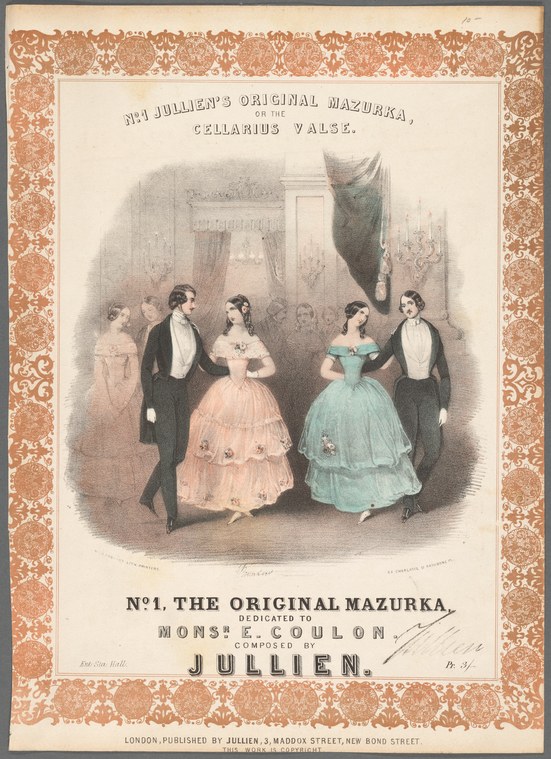
No. 1 Jullien's original mazurka, or the Cellarius valse
Unknown artist
- Collection:
- Prints depicting dance
- Source:
- New York Public Library
- Rights:
- Public domain — free to use, share and adapt.
- Recorded as:
- Public Domain
This print documents a specific moment in the history of ballroom dance when Parisian dance masters were codifying and standardizing the waltz and when the mazurka was newly fashionable across Europe. The attribution to Jullien and Cellarius signals the names and methods that shaped how the European middle and upper classes learned to dance in this period. For a dance historian or practitioner, the image preserves the exact positioning, arm placement, and social spacing of these dances as they were taught and performed.
What you are looking at
This is a hand-colored lithograph showing an elegant ballroom scene of the 1840s-50s. The composition centers on four figures in formal dress arranged around the floor of what appears to be a grand room with draped curtains and a chandelier visible in the background. Two couples occupy the foreground: a man in black tailcoat and white shirt front stands opposite a woman in a pale pink tulle ball gown with a fitted bodice and voluminous skirt; beside them, another couple features a woman in a mint-green tulle gown with a man in matching formal dress. A fifth figure, partially visible on the left, wears a similar ball gown in cream or pale pink. The setting is unmistakably aristocratic—the ornamental border of the print itself features a repeating damask pattern in rust and cream, establishing the commercial status of this as a published dance instruction or commemorative print. The lighting is soft and diffused, typical of lithographic technique, with careful attention to the texture and shimmer of the women's gauze skirts.
The dancing
The couples are positioned in what appears to be the opening or a moment of salutation within a formal dance—the nearest pair face each other at a respectful distance, the man's posture upright and formal, the woman's body aligned and composed. The dancers' hands are not in a closed ballroom hold; instead, they are either at their sides or in a position suggesting the beginning of a figure or a promenade position typical of quadrille or cotillion. The skirts of both women dominate the visual field, rendered in exquisite detail with the characteristic bell shape and horizontal flouncing of the 1840s. All figures stand with the elongated, corseted silhouette of the Gilded Age, with weight evenly distributed in a formal, presentational stance rather than one suggesting dynamic movement.
The dance depicted
The title identifies this as 'No. 1 Jullien's Original Mazurka, or the Cellarius Valse,' a reference to two distinct but contemporary fashions in 1840s European ballroom dancing. The mazurka, a Polish court dance in triple meter, gained enormous popularity in Western European salons during this period, while the waltz (especially in the style taught by Henri Cellarius, the leading Parisian dance master of the era) was the height of fashion. The print likely depicts one of these dances or, more probably, a hybrid or variation that combined elements of both, as was common in ballroom repertoire of the time. The positioning suggests the opening configuration of a quadrille or a formal cotillion figure rather than the continuous rotational movement of a waltz, pointing toward a structured, figured dance performed in sets rather than in continuous couples' rotation. This is a dance instruction or commemorative print, likely produced to market a published musical composition and dancing manual.
How it was made
This is a hand-colored lithograph, a technique that allowed for mass production and broad circulation of dance images in the nineteenth century. The soft tonality, the fine detail in the drapery and faces, and the capacity to render the delicate shimmer of tulle are all characteristic strengths of the lithographic process. The careful coloring—the judicious use of pale pink, mint green, cream, and rust—suggests this was either colored by hand after printing or was one of the finer commercially colored examples. The ornamental border printed in the same rust tone throughout indicates professional publication and commercial intent. As a lithograph, this work would have been relatively affordable and widely distributed, serving both as a souvenir of a fashionable dance and as a visual aid accompanying published dance instruction or musical scores.
About this work
This is a hand-colored lithograph documenting a moment in 1840s ballroom culture, specifically depicting the opening or a formal figure of a dance attributed to or popularized by the master teachers Jullien and Cellarius. The work sits at the intersection of dance instruction, commercial print culture, and the visual representation of fashionable society. It belongs in a gallery of dance in art because it preserves both the physical form of the dance—the positioning, the frame, the formal arrangement of bodies—and the material culture of dance in the Gilded Age: the silhouettes of gowns, the architectural setting, the social codes governing proximity and gesture. The image is evidence of how ballroom dancing was taught, sold, and imagined in the mid-nineteenth century.
How to look at it
Focus on the spacing and positioning of the bodies: note how the couples are arranged not in a continuous rotating hold but in a formal, face-to-face or side-by-side configuration, which tells you this is a figured dance (quadrille, cotillion, or mazurka) rather than a continuous waltz. Observe the women's skirts carefully—the precise rendering of the flounced hem and the bell-shaped silhouette are not decorative but documentary, showing exactly how the skirt would move and catch light in the actual dance. Look at the posture and arm position: the upright, presentational stance with little flexion in the knees or ankles is entirely typical of early-to-mid nineteenth-century ballroom dancing, very different from the looser, more grounded stance of twentieth-century ballroom or modern dance. The ornamental border and the typography of the title are also worth study: they signal this is a commercial, published object meant to circulate beyond a single court or salon.
The artist
The print is published by Jullien of London (printed at 3 Maddox Street, New Bond Street, according to the imprint), a significant music publisher and dance instruction business of the era. The composer and dance master Louis Antoine Jullien (1812–1860) was a major figure in London's musical and dance world, famous for orchestral promenade concerts and the publication of dance music and instruction manuals. The unnamed artist or lithographer of this work was likely employed by Jullien's publishing house to produce a commercially viable image for a dance instruction manual or musical score.
The period
The 1840s-50s were the height of the Romantic era in European ballroom dancing, when the waltz had achieved respectability and social prestige after decades of moral opposition, and when new dances from Central and Eastern Europe—particularly the mazurka and the polka—were becoming fashionable imports. In art, lithography was at its peak as a medium for commercial and fine art reproduction, allowing images of fashionable life, including dance, to reach a broad middle-class audience. Dance instruction was a major commercial enterprise, with master teachers like Henri Cellarius publishing elaborate manuals with engravings and lithographs to teach the proper execution of steps, figures, and deportment. This print is a product of that commercial system: it advertises both a dance manual and a dance master.
Where it lives
This work is held in the New York Public Library's prints collection depicting dance. The imprint confirms publication by Jullien in London; no accession number, acquisition date, or exhibition history is recorded in the available catalogue data.
Dance in this work
Questions about this work
What is the Cellarius Valse?
Henri Cellarius was the leading dance master in Paris during the 1840s-50s and the author of 'La Danse des Salons' (1847), a major ballroom dance manual. The 'Cellarius Valse' refers to his codified version of the waltz, taught with strict attention to posture, arm position, and the geometry of the dance. This print documents his method or a dance marketed in connection with his name.
What is a mazurka?
The mazurka is a Polish court dance in triple meter, with characteristic accents on the second or third beat and a distinctive posture and carriage. It became fashionable in Paris and London during the 1840s as an exotic import and feature of ballroom repertoire. Many composers, including Chopin, wrote mazurkas for piano and dance.
How do we know this is from the 1840s-50s?
The women's gown silhouettes—the bell-shaped skirts with horizontal flouncing, the fitted bodices, and the corseted waistlines—are characteristic of the 1840s-50s. The lithographic technique, the publishing imprint of Jullien of London, and the style of type and ornamental border all support this dating. The catalogue record lists the date as unknown, but the visual evidence is consistent.
Was this image used to teach dancing?
Yes, very likely. Dance instruction prints of this period served as visual supplements to written manuals and published music. A student or teacher could look at the precise positioning of bodies, the arrangement of couples on the floor, and the formal posture to understand how to execute the dance. The print may have accompanied a musical score or been sold as part of an instruction manual.
More dance artwork





