49 works in this view — arrow keys or swipe to move between them.
Dance in Art
Masked ball
Unknown artist
- Collection:
- Prints depicting dance
- Source:
- New York Public Library
- Rights:
- Public domain — free to use, share and adapt.
- Recorded as:
- Public Domain
For dance historians, the image documents the architectural and social context of courtly dancing, showing how space was organized and bodies distributed during an actual entertainment rather than an idealized or theatrical representation. It is evidence of the social function of dance in sustaining aristocratic identity and hierarchy. The work also demonstrates how prints shaped public understanding of courtly life—these images circulated widely and often reached viewers who knew of such events only through such visual accounts.
What you are looking at
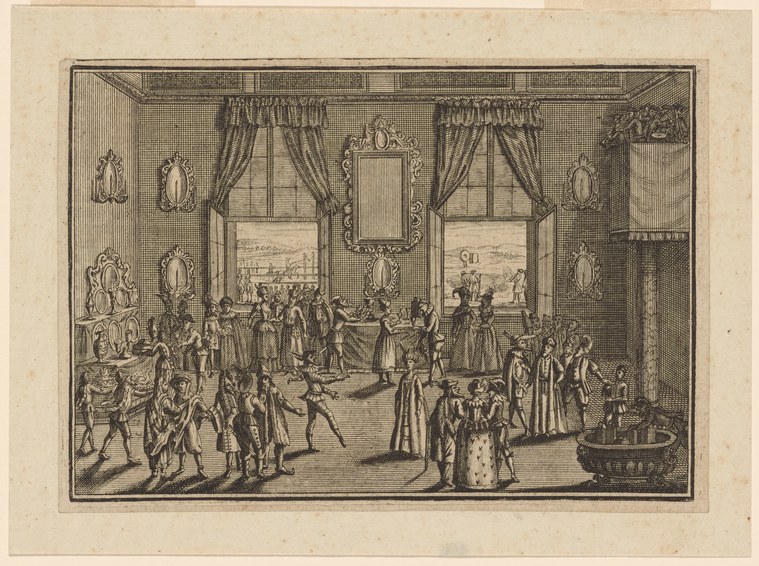
A grand interior reception or ball in progress, rendered in the precise linear style of early modern engraving. The space is a high-ceilinged hall with multiple tall windows offering views to gardens or grounds beyond, draped with heavy curtains. Oval portrait medallions hang on the walls between windows. A large mirror or architectural feature dominates the far wall. The floor is populated with roughly forty to fifty figures in formal dress: men in breeches, coats, and hats; women in full-skirted gowns and headdresses typical of the 17th century. Some figures stand in conversation; others are clearly dancing or moving through the space. The composition is crowded and animated, with bodies overlapping and occupying multiple depths. A large decorative vessel or fountain sits prominently in the lower right corner. The atmosphere is one of courtly ceremony and social interaction, the kind of entertainment that defined aristocratic life.
The dancing
The dancers visible in the composition are positioned in upright, formal stances rather than in close partnered holds. Several pairs appear to be moving in line or processional formation across the floor, with figures maintaining considerable distance from one another—consistent with period dance etiquette. Arms are extended or held at the sides with measured precision. The body carriage is vertical and constrained by the formal dress of the period. Footwork is not clearly rendered by the engraver, but the overall demeanor suggests measured, deliberate stepping rather than vigorous athletic movement. The predominance of standing figures and the formal groupings suggest a reception or court gathering punctuated by dancing rather than a continuous dance event.
The dance depicted
This is most likely a masked ball or formal court reception of the late 17th or early 18th century, the kind of entertainment depicted in countless courtly and aristocratic scenes of the era. The presence of masks is suggested by the title but not uniformly evident in the engraving itself, though the formal nature and scale of the gathering support a special occasion. The dances performed would have been the courtly dances of the Baroque period—minuets, courantes, and similar processional or line dances—characterized by formality, symmetry, and the maintenance of decorum. The image captures not a single dance but the social space in which dancing occurred as one element of an elaborate courtly performance.
How it was made
This is an engraving, identifiable by the fine parallel line-work (hatching and cross-hatching) used to create tone and shadow, the precise linear definition of architectural features, and the absence of color. The technique allowed for mass reproduction, making such scenes available to a broad educated audience interested in court life, etiquette, and fashion. The regularity and precision of the engraving line suggests professional workshop production. The print was likely published as a standalone sheet or as part of a series documenting court entertainments or architectural interiors.
About this work
This engraving documents a formal masked ball or court reception, a central institution of early modern aristocratic life. The work captures not the mechanics of any single dance style but the social and spatial context in which dancing occurred—a crowded, hierarchical gathering in a grand interior, where movement, dress, and decorum were equally important. The image is evidence of how elite society choreographed its own display through these events, and of the engraver's role in circulating an idealized vision of courtly ceremony to distant viewers who would never attend such an event themselves. The work belongs to a large body of prints documenting court life, fashion, and etiquette from the 17th and 18th centuries.
How to look at it
Attend first to the architectural frame: the emphasis on the grand interior, the windows, the mirrors, and the decorative elements tells you this is as much about displaying space and wealth as about the dancing itself. Notice the distribution of figures: how many are actively dancing, how many are standing and conversing, how the crowd is organized. Look at the posture and spacing of the dancers—they are upright, formal, and often at a distance from their partners, very different from later ballroom partnerships. The engraver has chosen to show a moment of social mixture and movement, not a frozen tableau, suggesting the liveliness and heterogeneity of the event. The medals on the walls and the formal dress are visual codes signaling rank and occasion.
The period
This engraving dates to the era when the masked ball or bal masqué became a fashionable entertainment in European courts, particularly in the late 17th and early 18th centuries. Court ballet had evolved from the 16th-century spectacles into more intimate and improvisational social dances performed by courtiers themselves rather than professional performers. The formal dances of the Baroque—minuet, courante, gavotte—were social markers of rank and education. Prints depicting such scenes served a didactic function, instructing viewers in the proper behavior, dress, and spatial organization of elite social life. The engraving medium, widely distributed and repeatedly copied and reworked, made such imagery a standard medium for documenting and idealizing courtly culture.
Where it lives
The work is held in the New York Public Library's collection of prints depicting dance. As part of a larger collection of documentary prints of court life and entertainments, it represents the circulation of such imagery through print networks across Europe.
Dance in this work
Questions about this work
Are the dancers actually wearing masks in this image?
The title identifies this as a masked ball, and a few figures in the crowd may be wearing them, but the engraver has not consistently depicted masks on all or most figures. This may reflect the conventions of engraving (which prioritized legibility of the scene over strict accuracy) or may suggest that masks were worn selectively or removed during parts of the evening. The title is a stronger witness to the event type than the image alone.
What dances would have been performed at such a ball?
The formal dances of the Baroque period—minuet, courante, gavotte, sarabande—would have dominated. These were processional, measured dances danced by couples or small groups, with steps and arm positions governed by strict rules. A masked ball might also have included more informal country dances or contredanses. The image does not depict specific steps, but the vertical carriage and distance between partners are consistent with the formal court repertory.
How do we know this is a 'masked ball' and not just a court reception?
The title supplied with the print is our primary evidence. Masked balls became fashionable entertainments in the 17th and 18th centuries, distinct from ordinary receptions and court dances in their permissiveness and theatricality. The large crowd and mixed groupings visible here are consistent with the social mixing that masks enabled.
More dance artwork





