49 works in this view — arrow keys or swipe to move between them.
Dance in Art
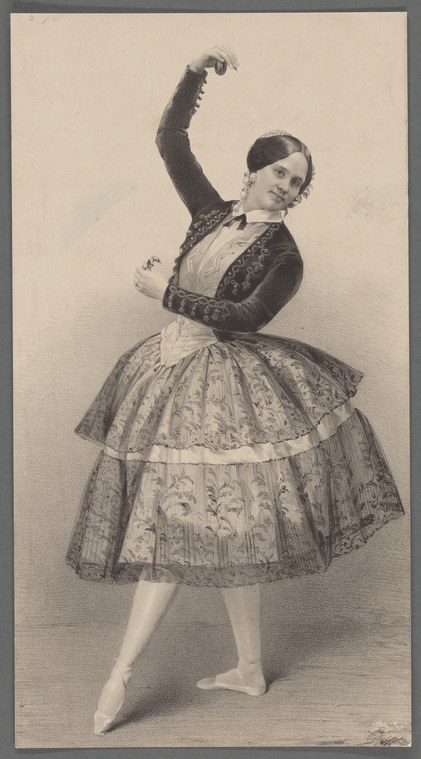
Female dancer with castanets
Unknown artist
- Collection:
- Prints depicting dance
- Source:
- New York Public Library
- Rights:
- Public domain — free to use, share and adapt.
- Recorded as:
- Public Domain
The image is evidence of how 19th-century European theatres adapted non-European dance traditions to their own formal and aesthetic systems. For historians of flamenco and Spanish dance, it documents the hybrid vocabularies and bodily practices that emerged when these traditions entered concert halls; for historians of theatre, it shows the labour of cultural translation that made exotic traditions legible to bourgeois audiences.
What you are looking at
A single female dancer is shown in a three-quarter-length studio portrait, posed in a moment of Spanish folk performance. She wears a dark bolero jacket over a white blouse and a voluminous skirt with ornate floral patterning and lace trim, the skirt's tiers creating the characteristic silhouette of 19th-century Spanish costume. Her right arm is raised in a curved gesture, hand relaxed; her left arm holds a pair of castanets. Her weight appears to be on her left leg with the right extended in a balletic line. She faces the viewer with a composed, serene expression. The image is rendered in the silvery tones and fine detail of a photographic print or photomechanical reproduction, against a plain studio background that throws all emphasis onto the figure and her costume.
The dancing
The dancer's posture is upright and controlled, combining elements of academic dance training with the gestural traditions of Spanish folk performance. Her raised right arm is soft and rounded, not angular; her left holds the castanets at waist level. The extended right leg and the turnout visible in her stance suggest ballet technique. There is a single dancer, isolated in the frame, with no interaction with other bodies — the image concerns individual performance and presentation rather than social or coupled movement.
The dance depicted
This depicts Spanish flamenco or related folk dance traditions, most likely from the mid-to-late 19th century based on costume and photographic technique. The castanets and the voluminous folkloric skirt are the primary indicators. The dancer's hybrid posture — combining ballet verticality with Spanish costume — was characteristic of the theatrical or concert presentation of Spanish dances in the European theatre of this era, when folk traditions were being adapted for bourgeois audiences. The image documents how Spanish dance was performed in a formal, presentational context rather than in its vernacular setting.
How it was made
This is a photomechanical reproductive print, likely a photogravure or similar process that could capture photographic detail with the permanence of an engraved plate. The silvery halftones and the fine resolution of textile patterns and facial features are characteristic of high-quality photomechanical reproduction rather than direct hand engraving. The technique allowed precise documentation of pose and costume and was well-suited to theatrical publicity and dance documentation — materials that circulated widely among theatre-goers and performers in the 19th century.
About this work
This work documents a moment in the 19th-century theatrical presentation of Spanish folk dance, when flamenco and related traditions were being formalized for European concert and theatre audiences. The dancer's hybrid vocabulary — castanets and folkloric costume combined with ballet posture and studio portraiture — shows the cultural translation at work: Spanish traditions presented through the lens of European theatrical training and bourgeois visual culture. It is a record of performance practice at a moment when folk dances were becoming cosmopolitan spectacles.
How to look at it
Attend to the pose itself: the dancer is not caught mid-movement but rather presented in a formal, sustained attitude — a classical *arabesque*-like leg extension combined with a relaxed, rounded arm gesture that speaks to Spanish gestural tradition. The castanets are held but not played; the skirt is full but not captured mid-swirl. The image is theatrical presentation rather than dance action — a portrait of a role and a body trained for display, frozen in a moment of composed elegance rather than dynamic movement.
The artist
The artist is not recorded. The work is a photomechanical reproduction rather than an original artwork, and may derive from a theatrical photograph or studio study commissioned by a dance impresario or theatre company. Such images were widely produced in the 19th century as promotional materials and archival records of performers and roles.
The period
The mid-to-late 19th century saw intense European appetite for Spanish, North African, and Oriental dance traditions, part of a broader Orientalism and exoticization of non-European cultures. In the same period, ballet was at its height of technical development and aesthetic influence; the pose here shows how non-European dances were often reframed through the disciplined, vertical body-vocabulary of academic ballet. Spanish dance had a particular prestige in Paris and London, where dancers like Carolina Otero and Lola Montez performed in a hybrid idiom that mixed castanets, folk costume, and classical technique.
Where it lives
The work comes from the New York Public Library's collection of prints depicting dance. It is an archival document of 19th-century theatrical practice rather than a signed or dated artwork.
Dance in this work
Questions about this work
Is this a photograph or an engraving?
It is a photomechanical reproduction — a process that combined photographic documentation with printmaking technology. This allowed the image to be reproduced and distributed widely while preserving photographic detail. The silvery tones and fine resolution are characteristic of photogravure or similar processes.
What are the castanets and why are they important?
Castanets are wooden hand-percussion instruments integral to Spanish flamenco and folk dance. The dancer holds them as an instrument she plays while she moves; they mark rhythm and add texture to the performance. Their presence here signals Spanish tradition specifically.
Why does she look so formal if she's dancing flamenco?
This is theatre flamenco — Spanish dance adapted for bourgeois concert audiences in 19th-century Europe. The formal ballet posture, the studio setting, and the composed presentation all show how folk traditions were reframed through European theatrical conventions to be legible and prestigious to concert-hall audiences.
Who was the dancer?
The dancer's identity is not recorded in the catalogue. She is documented as a performer of a type and a role rather than as an individual; this was common in 19th-century theatrical prints and promotional materials.
More dance artwork





