49 works in this view — arrow keys or swipe to move between them.
Dance in Art
Basse danse
Unknown artist
- Collection:
- Prints depicting dance
- Source:
- New York Public Library
- Rights:
- Public domain — free to use, share and adapt.
- Recorded as:
- Public Domain
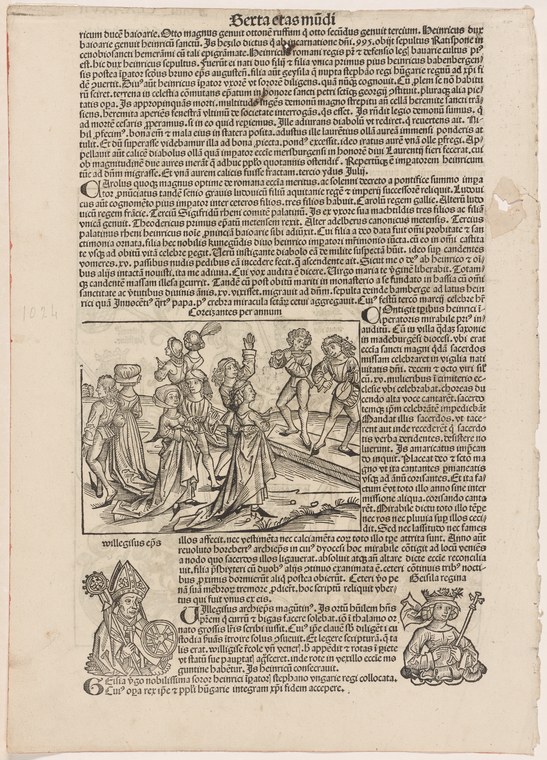
This is one of the primary visual sources for understanding how the Basse Danse was actually performed and understood during its period of dominance. It connects dance history directly to Renaissance humanism and the printed dissemination of knowledge, showing that dance was considered a subject worthy of systematic documentation and analysis—not mere entertainment, but a codified art form integral to courtly life.
What you are looking at
A woodcut or engraving from a printed book shows a group of aristocratic dancers in Renaissance dress arranged in a formal line or procession. The figures wear long gowns with elaborate trains and fitted bodices; the men wear hose, doublets, and feathered hats. They move with measured, stately bearing across a plain ground. The composition is vertical and densely packed with text above and below the image—this is a printed page from a dance manual or instructional treatise, as indicated by the Latin heading "Basse danse midsit" at the top. The dancers occupy roughly the central third of the page, while dense paragraphs of small printed text surround them, suggesting this image was made to illustrate and document the steps and deportment of a specific, codified dance form.
The dancing
The dancers stand in a linear formation, bodies upright and composed, with arms held at the sides or in gentle positions. There is no closed partner hold; instead, the figures maintain individual posture while moving in spatial relationship to one another. The weight appears centered and the movement suggests a forward progression rather than rotation or elevation. The formality of the pose and the uniform alignment of the group emphasizes order and courtly protocol rather than virtuosity or dynamic action.
The dance depicted
This is a Basse Danse, the dominant courtly dance of the 15th and 16th centuries in Western Europe. The title and the context of a printed instructional manual confirm the identification. The Basse Danse was a slow, processional dance performed by couples or small groups, characterized by gliding steps (pas) without jumping, and an emphasis on grace and measured deportment. It was a social and ceremonial dance of the nobility, and its primary purpose was to display courtesy, symmetry, and refined movement. The image captures the essential aesthetic: linear arrangement, upright carriage, and the forward motion that defines the dance's technique.
How it was made
This is a woodcut or engraving—likely a woodcut given the crisp black lines and the period—printed as part of a larger instructional text. The image appears in a printed book, not as a standalone artwork, which means it was reproduced in multiple copies and circulated among an educated, courtly audience. The technique allowed for precise line work and the integration of text and image, which was crucial for documenting and teaching dance. The prominence of the accompanying text suggests that the image was one component of a systematic written description of steps and movements.
About this work
This is a printed illustration from a Renaissance dance manual, showing the Basse Danse—a formal, processional courtly dance that dominated European aristocratic social life in the 15th and 16th centuries. The image documents not performance spectacle but rather the proper bodily deportment and spatial arrangement required by the dance, making it a visual record of court protocol and social refinement. The presence of dense instructional text surrounding the figure confirms that this work functioned as a teaching tool, part of a systematic effort to codify and transmit the rules of courtly behavior through movement.
How to look at it
Look first at the alignment and stillness of the bodies: the Basse Danse was not about speed or height, but about controlled, forward motion and dignified carriage. Note the absence of any dramatic gesture or asymmetry—the entire composition emphasizes uniformity and order. The positioning of the figures in profile or three-quarter view allows the viewer to assess the line of the body and the trajectory of movement. Finally, observe the relationship between text and image: the surrounding paragraphs are integral to understanding the image, not supplementary. The manual format reminds us that this dance was something to be learned from instruction, not merely observed for pleasure.
The artist
The artist is unknown; this is a page from a printed instructional manual. The work belongs to the tradition of Renaissance dance treatises, which emerged as printing became established and courtly culture increasingly emphasized the documentation and standardization of social practices. Such manuals were commissioned by or dedicated to noble patrons and written by dancing masters who served at court.
The period
The 15th and 16th centuries saw a profound systematization of courtly dance in Western Europe. Dancing masters, including figures such as Domenico da Piacenza and Jean-Antoine de Baïf, wrote treatises that codified technique and choreography. Simultaneously, the advent of printing made it possible to circulate these instructions widely among the nobility. Dance was understood as a moral and social practice—a means of displaying virtue, grace, and obedience to order. The Basse Danse represented the apex of this ideal: slow, measured, and utterly subject to written rule.
Where it lives
This page is held by the New York Public Library as part of a collection of prints depicting dance. It is a page from a printed book, reproduced multiple times in its original publication, making it a mass-produced instructional object rather than a unique work of art.
Dance in this work
Questions about this work
What is a Basse Danse?
The Basse Danse was the most prestigious courtly dance of the Renaissance, performed by nobility as a symbol of grace and social refinement. It was slow and processional, built on gliding steps without jumping, and was typically danced in couples or small groups. Its name comes from the low (bas) position of the feet—as opposed to high, jumping steps—and it was the standard social dance of European courts from the 15th through 16th centuries.
Why was this dance recorded in a printed manual?
Dance was considered a vital part of courtly education and etiquette. Printed manuals allowed dancing masters to systematize and teach the steps to a wide audience of nobility. These treatises positioned dance as a learned art form, subject to rules and principles, and essential to the performance of courtly identity. The manual format also reflected the Renaissance emphasis on documenting and standardizing knowledge.
What can we learn about Renaissance society from this image?
The image reveals that dance was not entertainment but an expression of social order and courtly virtue. The formality, the linear arrangement, and the emphasis on measured movement all reflect the Renaissance ideal of harmony and proportion. The fact that it was codified and printed shows that even bodily movement was subject to systematic rule and instruction—a sign of how thoroughly Renaissance culture attempted to order and rationalize every aspect of aristocratic life.
More dance artwork





