49 works in this view — arrow keys or swipe to move between them.
Dance in Art
Fête de village
Unknown artist
- Collection:
- Prints depicting dance
- Source:
- New York Public Library
- Rights:
- Public domain — free to use, share and adapt.
- Recorded as:
- Public Domain
This image captures the crucial moment when European social dance was becoming standardized across class boundaries—when the same basic forms appeared at court, in the city, and in the village. For historians of dance technique and social practice, it is a rare visual record of how ordinary people actually held their bodies and moved together. The print format confirms that images of dance were produced and consumed as popular knowledge, not merely as elite art.
What you are looking at
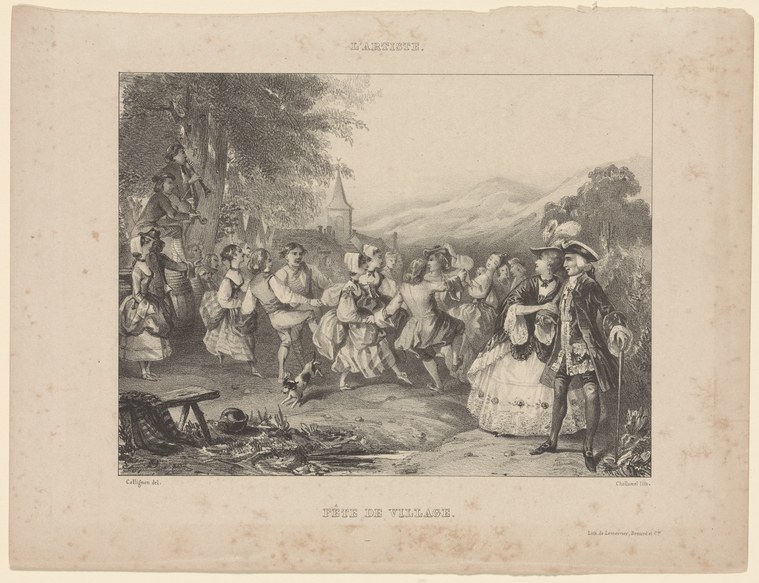
A village festival unfolds across a sunlit landscape, with a large crowd gathered in a clearing before a cottage and church. In the foreground, couples dance while musicians play and spectators watch from the sides—some seated on benches, others standing in animated conversation. The composition draws the eye from the active dancers in the center through layers of onlookers to the wooded hills and distant mountains. The light is soft and atmospheric, rendered through fine engraving lines that create depth and movement. Children dart between adults; dogs occupy the lower corners. The scene captures a moment of communal leisure, with the architecture and dress suggesting a rural European setting, likely 18th-century French or Germanic based on the architectural style and the title 'Fête de village.'
The dancing
The central couple dances in a closed or near-closed position typical of European court-influenced social dance of the period, their bodies angled toward one another with raised carriage. Their posture is upright and formal despite the rural setting. Around them, other couples maintain similar frames—arms extended, torsos engaged, weight forward. The dancers' legs are partially obscured by full skirts and breeches, making footwork difficult to assess, but the overall impression is of controlled, sprightly movement rather than vigorous leaping. The musicians at left play stringed and wind instruments, and their postures suggest they are actively performing rather than incidental.
The dance depicted
This depicts a social country dance, likely a 'contredanse' or similar folk-derived form popular at rural European festivals in the 18th century. Such dances were transitional forms—grounded in peasant tradition but increasingly shaped by court fashion and published instruction. The couple holds and posture suggest influence from Baroque dance technique. The presence of multiple couples dancing simultaneously in a loosely coordinated group, rather than a single couple, points to a group or 'longways' structure common to rustic versions of formal dances. The engraving captures the democratization of dance: the same basic forms performed at court filtered down to village celebrations, adapted to outdoor space and communal participation.
How it was made
This is a fine engraving, likely a steel or copper plate engraving given the delicate hatching and tonal gradation visible throughout. The signature at bottom left reads 'Callaert del.' (drawn by Callaert), with what appears to be a date or printer's mark at bottom right. The engraving technique allowed for precise detail and subtle modeling of light through crosshatching—visible in the tree foliage, the flesh tones of the figures, and the atmospheric recession into the distance. This medium was ideal for the wide circulation of popular imagery: engravings could be reproduced cheaply and distributed across Europe, making this the likely format for a published album or series of prints. The quality of execution and the subject matter suggest it was produced for a literate urban audience curious about peasant manners and rural life.
About this work
This is a documentary engraving of a village dance festival, capturing an 18th-century moment when folk celebration and courtly dance technique were mingling. The work records not just what people danced, but how they danced it—the posture, spacing, and social structure of a rural festival. It belongs in a dance gallery because it is evidence of lived practice: it shows us the actual bodies, holds, and communal contexts in which dance happened outside the court and theater. The engraving format tells us this image circulated, was looked at, was valued as a record of a world that urban viewers found worth knowing about.
How to look at it
Watch the couple in the center: their closed frame and upright carriage are formal even in a rustic setting, showing how deeply court-trained dance had penetrated popular practice. Notice the multiple couples dancing in loose formation rather than as a single focal pair—this is characteristic of group dances like the contredanse, where dancers might perform the same steps in sequence or in a longways set. The positioning of musicians at left and spectators all around shows this was a social event, not a performance for an audience, yet the artist has arranged it carefully for maximum visibility on the plate, suggesting the scene was meant to be 'read' and understood as an orderly whole.
The artist
The engraver is identified as 'Callaert' (or Callaerdt), a name that appears on several 18th-century prints, though firm biographical details remain scarce. The style and subject matter suggest a Flemish or Low Countries origin, with distribution through a larger publishing apparatus. Such prints were often produced in series—sets of customs, occupations, or festival scenes—and sold to middle-class collectors and cognoscenti of rural life. The artist's task was documentary and moralizing at once: to capture authentic manners while subtly improving and sentimentalizing them for an urban audience.
The period
In the early-to-mid 18th century, European social dance was undergoing rapid codification. The minuet, cotillion, and contredanse were being published in instruction manuals and taught across social classes. Simultaneously, there was growing urban curiosity about peasant life, customs, and celebrations—a romantic interest that preceded and anticipated the later folklore movements. Engravings like this one served that appetite: they offered urbanites a glimpse into village festivals, often with a gentle, sympathetic tone that suggested the peasantry had grace and order even outside court. In the visual arts, such genre scenes were becoming increasingly popular, particularly in Flemish and Dutch printmaking.
Where it lives
The work is held in the New York Public Library's Prints collection, classified under 'Prints depicting dance.' It comes with minimal cataloguing—no artist biography, date, or publication details are recorded—but the print itself bears identifying marks: the artist's signature and what appears to be a printer's mark or date. This suggests it was a published work, likely part of a series or album of genre scenes.
Dance in this work
Questions about this work
Is this a real event or an invented scene?
Almost certainly invented, or at least heavily idealized. The artist was creating a type—a picturesque village festival—rather than documenting a specific occasion. However, the dance steps, holds, and social structure are rooted in actual practice. The engraving is 'true' about how people danced together in rural settings, even if the particular moment is imaginary.
What dance are they doing?
Most likely a contredanse or a related country dance—a form that combined folk origins with courtly technique. The closed couples, the presence of multiple pairs, and the formal posture all point to this family of dances. Without music or more explicit instruction, we cannot name the specific dance or its figures.
Who made this print and when?
The engraver 'Callaert' signed it, but no firm biographical information is recorded. The style and subject matter place it in the 18th century, likely the first or second quarter. The print was almost certainly published as part of a series and circulated in Europe, particularly in Flemish-speaking regions.
How does this compare to dance images from the court or theater?
Court dance paintings and engravings typically show a few elegantly posed figures, often in profile, emphasizing grace and technical skill. This print is more crowded, more informal, and more interested in the social context—the musicians, the children, the spectators. It records dance as a communal event rather than as an art form to be admired.
More dance artwork





