49 works in this view — arrow keys or swipe to move between them.
Dance in Art
Ballet examination at the Paris Opéra
Unknown artist
- Collection:
- Prints depicting dance
- Source:
- New York Public Library
- Rights:
- Public domain — free to use, share and adapt.
- Recorded as:
- Public Domain
This is rare documentary evidence of ballet training and examination in its most formal institutional setting, preserved through direct observation rather than imagination or memory. It shows the Paris Opéra not as a stage but as a school and testing ground, and it records the precise technical standards and pedagogical relationships that defined professional ballet at a crucial moment in its history. For dancers and teachers, it is a record of how the classical technique they practice was formally evaluated and transmitted.
What you are looking at
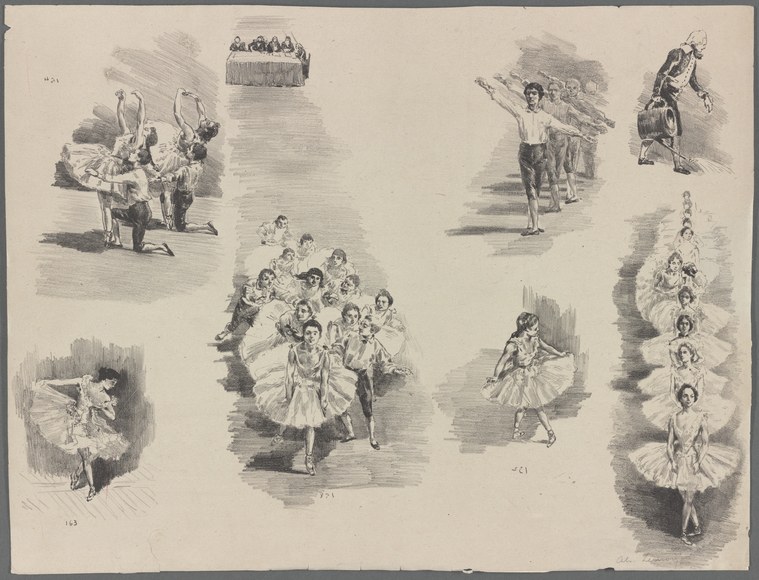
This is a composite study sheet of ballet examination or rehearsal scenes at the Paris Opéra, rendered in black ink with delicate cross-hatching. The sheet contains approximately eight separate vignettes arranged informally across the page, each depicting moments from a formal ballet class or examination. The largest and most prominent scene occupies the center-lower portion, showing a group of young female dancers in classical tutus arranged in a loose semi-circle or formation, some en attitude or in preparatory positions. Smaller studies surround this: pairs of dancers assisting one another or in partnered positions; individual female figures in profile demonstrating port de bras or arm carriage; male dancers or instructors gesturing or correcting; and what appears to be an examination panel or judges seated at a table watching the proceedings. The dancers wear the light classical tutus, fitted bodices, and pointe shoes standard to 19th-century academic ballet. The setting is rendered with spare background details—a few architectural lines suggest an interior studio or stage. The sketchy, energetic quality of the line work captures both the formal structure of examination and the individual concentration of each dancer.
The dancing
The dancers display the closed, turned-out posture characteristic of classical ballet technique: straight backs, raised diaphragms, and controlled arm positions. Several figures are shown en relevé or fully en pointe. One central figure stands in what appears to be attitude derrière; others hold arabesque or développé positions. The arm positions vary—some dancers show port de bras with arms raised in first or fifth position, others hold arms in preparatory positions or extensions. The smaller figures in the margins demonstrate specific corrections or technical points: one shows a dancer being guided by an instructor's hands; another captures the precise moment of a penché or extended balance. The male figures—likely instructors or examining masters—are shown gesturing, demonstrating, or observing. The overall frame and carriage are consistent with Vaganova or Cecchetti-influenced technique of the period.
The dance depicted
This is a documentary study of academic ballet training and examination at the Paris Opéra, likely late 19th century. The work captures the formal pedagogical setting of ballet instruction rather than a performance or social dance. The Paris Opéra Ballet was the most prestigious and regulated ballet institution in Europe, and its examination system was highly formalized. The notation 'Ballet examination at the Paris Opéra' in the title confirms this is a record of that specific institutional practice. The image shows the typical structure of such examinations: students demonstrating classical positions and movements before an examining panel, with corrections or demonstrations by the ballet master. This was not stage dancing but the rigorous technical assessment that formed the basis of professional ballet training.
How it was made
This is a pen-and-ink study, drawn with a fine nib and developed through cross-hatching and parallel lines to create tone and volume. The technique suggests a preparatory study or a direct observational sketch made at the Opéra itself—the kind of rapid but disciplined drawing an artist trained in academic practice would make while recording a live scene. The sketchy, energetic line work with minimal background detail is consistent with 19th-century French illustration practice. The arrangement of multiple studies on a single sheet was common for artists preparing material for larger finished works or for publication as illustrations in journals or newspapers documenting Parisian cultural life.
About this work
This is a study sheet documenting the formal examination of ballet students at the Paris Opéra, a major cultural institution and the training ground for European professional ballet. The work captures a specific moment in the history of academic ballet: the systematic, highly regulated pedagogy through which the Opéra maintained its artistic standards. The multiple vignettes allow the artist to record both the overall structure of the examination and the precise technical details—the exact arm carriage, the quality of a position, the relationship between dancer and instructor—that defined excellence in classical technique.
For dance historians, this is valuable documentary evidence of how ballet was actually taught and assessed in the 19th century, preserved through the eye of a skilled observational draftsman. The work sits at the intersection of dance, art, and institutional history, recording not a spectacular performance but the unglamorous, disciplined work of training that made performance possible.
How to look at it
Look at the central examination scene: notice how the dancers are arranged not in a performance formation but in a loose grouping that allows the examining panel to see each student's work. Observe the specific positions and corrections demonstrated in the smaller studies—the artist has isolated and emphasized the technical details that mattered most: the carriage of the arms, the alignment of the body, the precise degree of turnout. The sketchy, energetic line work conveys both the formal discipline of the setting and the individual concentration of each dancer. The arrangement of studies on a single sheet mimics the process of examination itself: breaking down complex movement into analyzable components.
The period
By the late 19th century, ballet had become highly professionalized and academicized, especially at the Paris Opéra under the direction of figures like Mérante and later Mauri. The rigorous examination system depicted here was central to maintaining the Opéra's reputation and the technical standards of its dancers. This was also the era of Romantic ballet's decline and the rise of academic classicism, a shift reflected in the formal, technique-focused nature of what is being examined. The Opéra's examination system was famous across Europe and was studied and imitated by other ballet schools. Simultaneous with this institutional formalization, French illustrated journalism and society papers were increasingly documenting Parisian cultural life, including behind-the-scenes moments at the Opéra, making this kind of observational study a natural subject for an artist.
Where it lives
This work is held in the New York Public Library's collection of prints depicting dance. It is a study sheet, likely created as a direct observation or as material for a larger work, and represents the kind of documentary illustration that circulated in French cultural publications of the period.
Dance in this work
Questions about this work
How do I know this is an examination and not a regular class?
The presence of the seated panel or judges, the formal arrangement of the dancers, and the title all indicate an examination rather than daily instruction. The emphasis on demonstrating complete positions and movements, with corrections shown separately, reflects the high-stakes, formal assessment structure of the Opéra's examination system.
What was the Paris Opéra Ballet examination system?
The Paris Opéra Ballet maintained one of the most rigorous professional training systems in Europe. Students were examined formally by the ballet master and panel of examiners, who assessed their technical proficiency in classical positions, movements, and style. Success in these examinations determined advancement and employment within the Opéra hierarchy.
What technique is being taught here?
The positions, arm carriage, and overall aesthetic shown here reflect the academic classical ballet technique that dominated European training in the 19th century. The specific school—whether Cecchetti, Vaganova, or Opéra house style—cannot be definitively stated from the image alone, but the formality and precision are consistent with the highest standards of the period.
Who is the artist?
The artist is not recorded in the catalogue information. The skilled, disciplined style suggests an artist trained in academic observation and illustration, likely working in Paris in the late 19th century, but identification requires further research.
More dance artwork





