49 works in this view — arrow keys or swipe to move between them.
Dance in Art
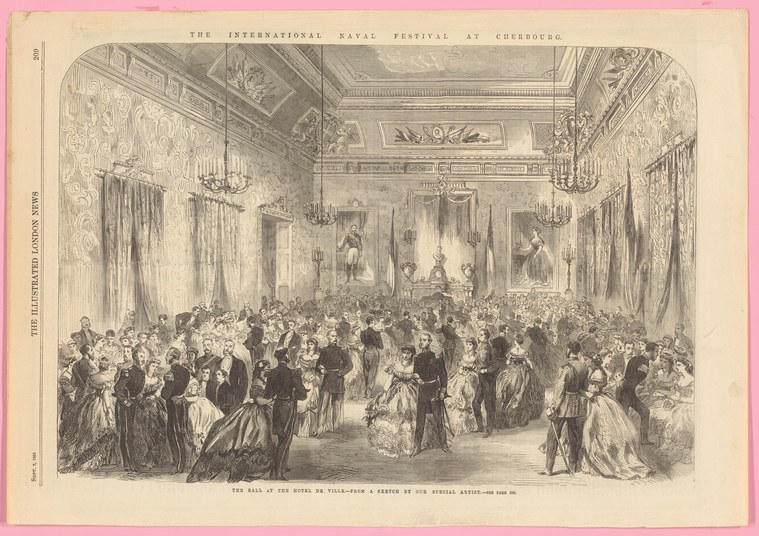
The international naval festival at Cherbourg: the ball at the Hotel de Ville
Unknown artist
- Collection:
- Prints depicting dance
- Source:
- New York Public Library
- Rights:
- Public domain — free to use, share and adapt.
- Recorded as:
- Public Domain
This image is one of the few detailed contemporary records of actual ballroom dancing practice in its natural social setting—a state occasion—rather than choreographed for theatrical display. It shows how waltz and quadrille were integrated into diplomatic ceremony and elite social ritual in the mid-nineteenth century, and how dance occupied only part of a larger evening of conversation and display. The scale and crowd also reveal something the individual portrait of a dance couple cannot: that ballroom dancing was a serial, turn-taking social activity that structured an evening, not a continuous spectacle.
What you are looking at
A grand ball in a formal nineteenth-century interior, rendered in engraved line and cross-hatching. The Hotel de Ville ballroom is crowded with over a hundred figures in evening dress—men in dark coats and white shirt fronts, women in elaborate full-skirted gowns. The ceiling is ornately coffered with neoclassical decoration; tall curtained windows and wall panels line the room, with candelabra providing light. The crowd is distributed across the floor in loose groupings, some standing in conversation, others moving through the space. At the center right, couples appear to be dancing; their poses suggest the measured, upright carriage of mid-nineteenth-century ballroom dance. The composition is deep and crowded, with foreground figures rendered in sharper detail and those receding into the middle distance and background suggested more schematically, creating atmospheric depth.
The dancing
The dancers visible in the center-right maintain the formal frame of social ballroom dance: upright posture, moderate distance between partners, the woman's full skirt allowing broad stepping space. Arms are held at the frame height typical of Victorian-era waltz or quadrille. The predominance of standing, conversing figures suggests this is a moment between dances or during a promenade. No visible footwork detail survives the engraving's resolution, but the overall carriage—the way weight is held, the stiffness of spine—is consistent with the ballroom protocols of the 1860s.
The dance depicted
This is a ballroom assembly, not a theatrical performance. The dances depicted are those of formal social ballroom practice in France during the Second Empire: waltzes, quadrilles, and formal promenades. The composition captures the ballroom as a social space where dance is one of several activities—standing, introduction, conversation—that structure an evening. The 'international naval festival' was likely a significant diplomatic or state occasion, making this both a document of dance practice and of elite social ritual. The formality and scale suggest the dances were modeled and structured, not improvised.
How it was made
This is a wood engraving or steel engraving, executed in fine parallel and crossing lines to create tone and shadow. The technique allows considerable detail in the rendering of costume, interior architecture, and the spatial depth of the crowded ballroom. Engravings of this period were widely reproduced and circulated in periodicals and gift books for middle-class audiences, making this work a document intended for public knowledge of fashionable life and diplomatic ceremony. The tonal subtlety achievable through engraving—the gradation of the ceiling, the fall of light from the candelabra—suggests a skilled practitioner and implies a substantial initial investment in the plate.
About this work
This engraved illustration documents a formal state ball held at the Cherbourg town hall, likely during the International Naval Festival of 1858 when the French and British fleets met at that port. It captures the ballroom as a social and diplomatic space, crowded with hundreds of figures in evening dress, with small groups dancing in waltz or quadrille formation while others circulate and converse. The work is a record of French ballroom practice and elite social ritual at a specific historical moment—the height of the Second Empire and Anglo-French alliance—rendered through the medium of fine engraving for circulation in the illustrated press or in commemorative albums. It belongs in a dance gallery because it documents both the forms of ballroom dance and their function within formal social and political ceremony.
How to look at it
Notice how the artist has used the crowded interior to show ballroom dancing not as a spotlight moment but as a serial social activity embedded in an evening of standing, conversation, and circulation. The detail of costume—the women's full skirts, the men's dark coats and white waistcoats—establishes the formality and fashion of the moment. Look at the posture and distance between the dancing couples: they embody the restraint and upright carriage of Victorian ballroom protocol, a marked contrast to earlier Regency waltz imagery. The composition's emphasis on the room itself—the ceiling, the curtains, the candelabra—situates the dance within architecture and ceremony, suggesting that the ballroom is as much the subject as the dancing.
The period
The 1850s were the height of the waltz and quadrille in French and European ballroom culture. The Romantic-era waltz had become the dominant form of social couple dance, though the quadrille remained the formal opening dance at state balls. This engraving dates to the aftermath of the Crimean War and represents a moment of Anglo-French diplomatic alliance; the International Naval Festival at Cherbourg in 1858 was a major celebration of that alliance. Illustrated periodicals like the *Illustrated London News* and French equivalents had created a mass market for images of fashionable life and state ceremonies. Ballroom dancing itself was undergoing systematization through dancing masters' instruction books and the codification of 'proper' form and hold that would lead eventually to the competitive ballroom dancing of the twentieth century.
Where it lives
This engraving is held in the New York Public Library's collection of prints depicting dance. It was likely published in an illustrated periodical or collected in a commemorative album of the 1858 Cherbourg festivities, reflecting the nineteenth-century practice of distributing images of state ceremonies and fashionable society events to a broad middle-class audience.
Dance in this work
Questions about this work
What was the International Naval Festival at Cherbourg?
It was a major diplomatic celebration held in 1858 to commemorate the alliance between Britain and France following the Crimean War. The French and British naval fleets met at the French port city of Cherbourg, and the occasion was marked by official ceremonies, banquets, and formal balls attended by high society.
What dances are being performed?
Based on the formal dress, ballroom setting, and the upright posture and frame of the visible couples, the dances are most likely waltzes and quadrilles, the two dominant social ballroom dances of the mid-nineteenth century. The waltz had become the principal couple dance of fashionable society by the 1850s, while the quadrille remained the formal opening dance at state balls.
Why is the room so crowded if people are dancing?
A formal ball was not a continuous dance; it consisted of several dances interspersed with periods of standing, conversation, and promenade. This engraving captures one of those moments when some couples were dancing while others circulated, introduced themselves, and socialized. The ballroom functioned as a space for both dance and social display.
How do I know this is an engraving and not a painting or drawing?
The technique is visible in the fine parallel and crossing lines—the 'hatching' and 'cross-hatching'—used to create tone and shadow. This is the characteristic mark of wood engraving or steel engraving, a printmaking technique that allowed for fine detail and wide reproduction, unlike a painting which would exist as a single object.
More dance artwork





