49 works in this view — arrow keys or swipe to move between them.
Dance in Art
Fanny Elssler
Unknown artist
- Collection:
- Prints depicting dance
- Source:
- New York Public Library
- Rights:
- Public domain — free to use, share and adapt.
- Recorded as:
- Public Domain
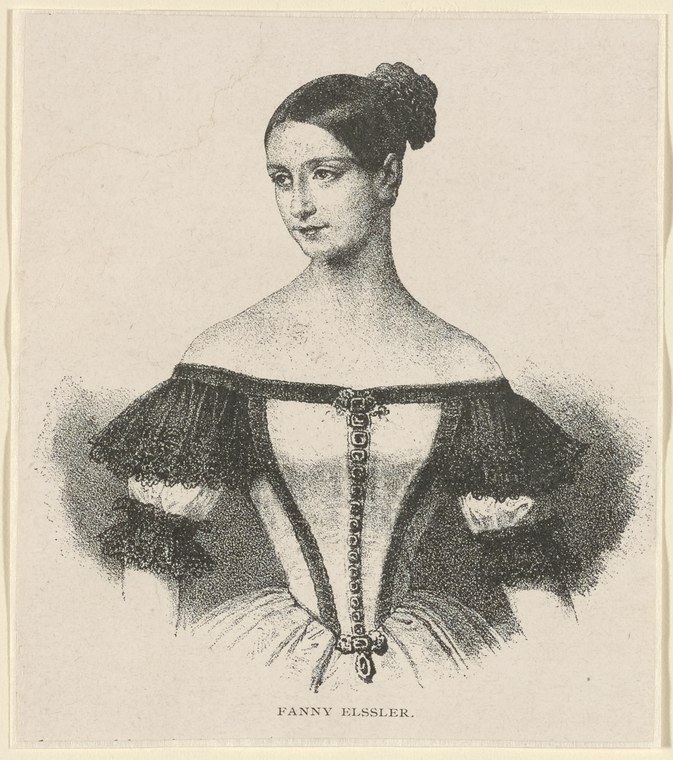
Elssler was a major rival to Marie Taglioni and expanded the vocabulary of Romantic ballet by bringing Spanish and character dances into the repertory. This portrait is evidence of her international fame and the circulation of theatrical celebrity images as mass-market commodities in the 19th century.
What you are looking at
A portrait of a woman in Romantic-era theatrical dress, shown from the waist up against a plain background. She wears an off-shoulder dress of black silk or taffeta with voluminous short sleeves ending in ruffled cuffs, and a decorative brooch or clasp at the center front of the bodice. Her dark hair is gathered into a knot at the crown of her head. The woman's gaze is direct and composed, her posture upright and dignified. The engraving technique renders her pale skin in fine stippled tones, creating a soft modeling of her face and neck, while the fabric is indicated through bold contrasts of light and shadow. The work is a formal portrait in the convention of mid-19th-century theatrical prints, documenting the appearance of the subject as a performer.
The dancing
The subject is shown in a static three-quarter view pose typical of theatrical portraiture, not in active dance. Her shoulders are relaxed and level, her neck elongated. There is no visible footwork or dancing frame; the figure is an upright standing portrait.
The dance depicted
Fanny Elssler was one of the most celebrated ballet dancers of the Romantic era (1810–1884), best known for her technical virtuosity and her role in popularizing national and character dances, particularly the *Cachucha* and other Spanish dances, which were distinct from the ethereal, otherworldly style associated with her rival Marie Taglioni. This portrait documents her as a public figure and star of the theatrical stage, but does not depict her in performance or mid-choreography. It is a representation of her person and her status as a dance celebrity rather than a document of dance technique.
How it was made
This is an engraving, likely a stipple or combination engraving and line work, rendered in black ink on paper. The technique allowed for fine tonal gradation in the face and delicate rendering of fabric texture, making it ideal for theatrical publicity prints. Engravings of this type were mass-produced and circulated widely among patrons of the theater and the general public, serving as souvenirs and tokens of celebrity. The medium implies a broad, middle-class audience for dance imagery during the Romantic period.
About this work
This is a mid-19th-century engraved portrait of Fanny Elssler, one of the Romantic era's most famous ballet dancers. It belongs in a gallery of dance art not because it depicts choreography in motion, but because it documents the cultural elevation of the dancer as a celebrated public figure and star of the theatrical world. The work is an artifact of the Romantic period's fascination with dance, celebrity, and the female performer's image.
How to look at it
Attend to the dress: the off-shoulder cut and short ruffled sleeves are characteristic of Romantic-era theatrical costume, neither classical Greek (as Taglioni favored) nor explicitly national in styling—they represent the fashionable stage dress of a leading ballerina of the 1840s. The composed, dignified bearing and direct gaze present the dancer as a respectable, accomplished woman of artistic standing, not a figure of fantasy. This was a deliberate choice in how ballerinas' images were marketed and distributed.
The artist
The artist is not recorded in the catalogue. Unsigned theatrical portrait engravings of this period were typically produced by established printmaking workshops or commercial engravers in major theatrical centers such as London, Paris, or Vienna, and were distributed by print sellers and theater box offices. Individual printmakers' names were often not preserved in archival records.
The period
This portrait dates to the height of Romanticism in theater and dance (approximately 1830s–1850s). The Romantic ballet privileged ethereal, otherworldly female dancers and supernatural narratives; Elssler's innovation was to introduce technically dazzling character dances and national idioms—particularly Spanish styles—into this refined tradition. She famously toured the United States (1840–1842) and achieved international stardom. During this period, theatrical prints and engravings were among the primary means by which the public encountered images of famous dancers, and they shaped how audiences understood and imagined dance performance.
Where it lives
Held in the New York Public Library's collection of prints depicting dance, part of their broader holdings of theatrical imagery and dance history. This type of engraved portrait was produced and distributed as part of the theatrical print trade and popular culture of the 19th century.
Dance in this work
Questions about this work
Was Fanny Elssler a ballet dancer?
Yes. Elssler (1810–1884) was one of the most celebrated ballet dancers of the Romantic era. She was known for her technical brilliance and for introducing Spanish and national character dances into the ballet repertory, in contrast to the ethereal, supernatural aesthetic favored by her rival Marie Taglioni. She achieved international stardom, with a famous tour of the United States in 1840–1842.
Why does this portrait not show her dancing?
Formal theatrical portraiture of the 19th century typically presented performers in static, dignified poses rather than in active performance. This convention elevated the performer's status by presenting her as a respectable, accomplished artist rather than merely documenting choreography. The portrait's purpose was to circulate her image as a celebrity and to be sold as a souvenir to admirers.
What is the significance of her costume in this portrait?
The off-shoulder black silk dress with short ruffled sleeves is typical Romantic-era theatrical wear for a leading ballerina, fashionable and refined but not explicitly referencing classical or national styles. It presented her as a contemporary stage star rather than a character or mythological figure.
More dance artwork





