49 works in this view — arrow keys or swipe to move between them.
Dance in Art
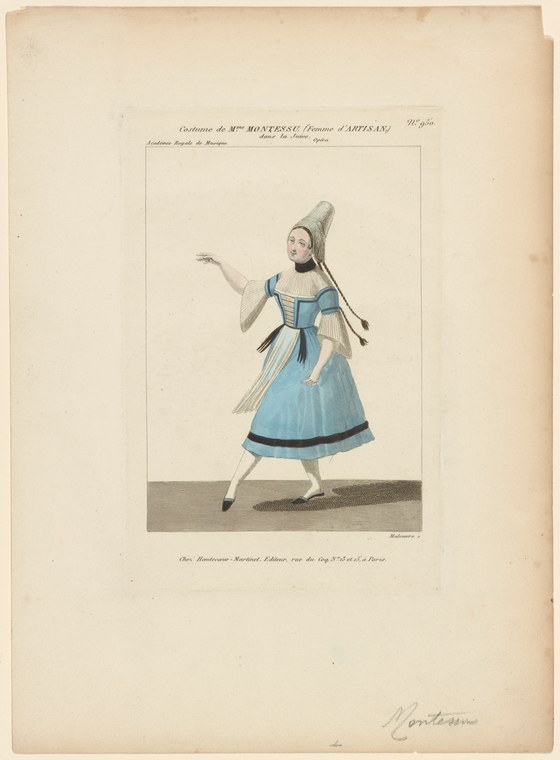
Costume de Mme. Montessu, femme d'Artisan, dans La Juive, opéra, Académie royale de musique
Unknown artist
- Collection:
- Prints depicting dance
- Source:
- New York Public Library
- Rights:
- Public domain — free to use, share and adapt.
- Recorded as:
- Public Domain
It documents a real performer in a canonical work of grand opera at the moment when opera itself was becoming a primary vehicle for choreographed spectacle and when the visual appearance of the stage body was standardized and circulated through prints. The image captures a convention of Romantic theatrical presence that dancers and opera scholars need to understand: the posed, expressive stillness that could carry as much meaning as movement itself.
What you are looking at
A single female figure stands against a plain background, posed in a theatrical moment of gesture and movement. She wears a pale blue Empire-waist dress with a darker blue horizontal stripe at the hemline, the skirt reaching to her ankles. Her posture is elegant and composed: the weight appears to be on her right leg while the left is relaxed, and her right arm extends outward in a graceful gesture of presentation or appeal, palm open. Her left arm hangs naturally. She wears a tall, pointed white headdress (possibly a bonnet or mob cap) and her hair is styled in the fashion of the early 19th century. Her feet are visible in dark slippers or shoes. The figure occupies the center of the composition, rendered in hand-colored print with careful attention to the drape of fabric and the articulation of limbs. There is no scenery, props, or other figures — only this single dancer against white space, presented as a portrait of a character or role.
The dancing
The dancer's frame is upright and dignified, with the torso held square and the shoulders relaxed. The extended right arm creates an open, welcoming line; the palm-up hand position suggests an invitation or expression of feeling rather than a technical balletic port de bras. Weight distribution and the angle of the supporting leg suggest ease rather than strain. The posture is one of social grace and courtly address, not virtuosity — the body speaks civility and emotional presence rather than technical difficulty. The costume and hairstyle place the work in the early 19th century or a theatrical recreation of that period.
The dance depicted
The image is a costume study for an operatic role: specifically, for Mme. Montessu, who performed in *La Juive* (The Jewess), the 1835 Fromental Halévy grand opera. This print documents what an audience would see on stage at the Académie royale de musique (the Paris Opéra). The pose captures a moment of expressive stillness rather than active dancing — a key convention of operatic presentation in which sung drama and formal tableau often superseded continuous movement. The extended arm and open palm suggest an emotional address or appeal, consistent with the dramatic moments of Romantic opera where gesture conveyed pathos and sincerity.
How it was made
This is a hand-colored engraving or etching, a standard format for documenting and circulating theatrical costume and performance imagery in the early 19th century. The delicate line work defining the figure's contours, the careful gradation of shading in the drapery, and the selective hand-coloring (applied to the dress, headdress, and face tones while leaving the background plain) are all typical of professional theatrical costume prints produced for sale to audiences and collectors. Such prints served both as souvenirs and as a form of performance documentation, allowing viewers who had not attended the opera to see what the stage spectacle looked like.
About this work
This is a costume study from the Parisian operatic stage, a print documenting the appearance of a performer in one of the most celebrated grand operas of the 1830s. It belongs in a dance archive not because it depicts active dancing but because it shows how operatic performance—which always included significant choreographic and gestural content—was conceived and presented. The print is also evidence of theatrical fashion and the visual culture of early Romantic opera, in which the body of the singer was styled and posed with as much care as the composition of music and drama. Such images tell us how performers understood their own presence on stage and what the paying public expected to see.
The work sits at the intersection of dance documentation and operatic history. It shows us a moment from a specific production and performer, captured and disseminated through a medium—the hand-colored theatrical print—that was a major form of visual culture in 19th-century urban France. For historians of dance, it offers evidence of how movement and stillness, costume and body, were coordinated in the theatrical productions of the period.
How to look at it
Attend to the precision of the hand-coloring and the delicacy of line in the engraving: they indicate that this is a high-quality professional print, not a cheap reproduction. Note the stillness of the pose—the artist has chosen a moment of repose and address rather than motion. The extended arm and the directness of the figure's gaze toward the viewer suggest this is a moment of emotional or dramatic significance within the opera, where the singer stops action to deliver a moment of pathos or revelation. The simplicity of the background throws all focus onto the body and costume, a theatrical convention that the print emulates directly.
The artist
The artist is not recorded in the catalogue, but the print's style, technique, and subject matter suggest it was produced by a professional theatrical engraver working for the Parisian operatic print trade in the 1830s. Such prints were typically commissioned or produced on speculation for sale to theatre-goers and collectors of theatrical memorabilia. The engraver's role was documentary and celebratory rather than interpretive—to render the performer and costume with clarity and appeal.
The period
This print dates to the era of Romantic opera and grand opera—the 1830s–1840s—when Paris was the European capital of operatic production and innovation. *La Juive* (1835) was one of the most successful and influential grand operas of the period, celebrated for its spectacle, dramatic intensity, and large-scale musical and scenic ambitions. In this same period, the relationship between opera and ballet was intensifying: operatic performances regularly included inserted dances, and opera houses employed corps de ballet and choreographers. The training, costume, and presentation of the operatic performer was becoming increasingly formalized. The theatrical costume print was a major form of popular visual culture, comparable to modern theatrical photography or fan merchandise.
Where it lives
This print is held by the New York Public Library in its collection of prints depicting dance. It is catalogued as a costume study for the Parisian operatic stage, part of the library's broader collection of 19th-century theatrical and dance-related prints and engravings.
Dance in this work
Questions about this work
Was this figure an actual dancer, or was she an opera singer?
The catalogue identifies Mme. Montessu as a woman (femme) of an artisan (d'artisan), performing in *La Juive* at the Paris Opéra. In the 1830s, grand opera houses employed both singers and dancers, sometimes in the same roles or in adjacent scenes. The term does not clarify her primary function, but the pose and formal costume study suggest theatrical performance of any kind—singing, acting, or dancing, or all three together as was common in grand opera.
What is *La Juive*, and why was it important?
*La Juive* (The Jewess) is a grand opera by Fromental Halévy, premiered in 1835 at the Académie royale de musique. It was one of the most successful operatic works of the century, celebrated for its ambitious score, historical spectacle, and emotional drama. It remained in the repertory for decades and was mounted with major stars and lavish staging.
Why would a dance archive collect a print of an opera performer?
Grand opera in the 19th century was a multimedia form that integrated music, drama, scenery, costumes, and choreographed movement. Dancers and choreographers were essential to the spectacle. Prints documenting operatic performance tell us about the conventions of theatrical body movement, costume, and presentation that shaped how all stage performance—including ballet—was understood and executed in that era.
How were these prints made and distributed?
This is a hand-colored engraving, produced from a copper plate. The image was engraved in fine lines, then each print was individually colored by hand with watercolor or gouache. These prints were sold to theatre-goers at the opera house and through print shops, serving as souvenirs, promotional images, and records of famous performers and roles.
More dance artwork





