49 works in this view — arrow keys or swipe to move between them.
Dance in Art
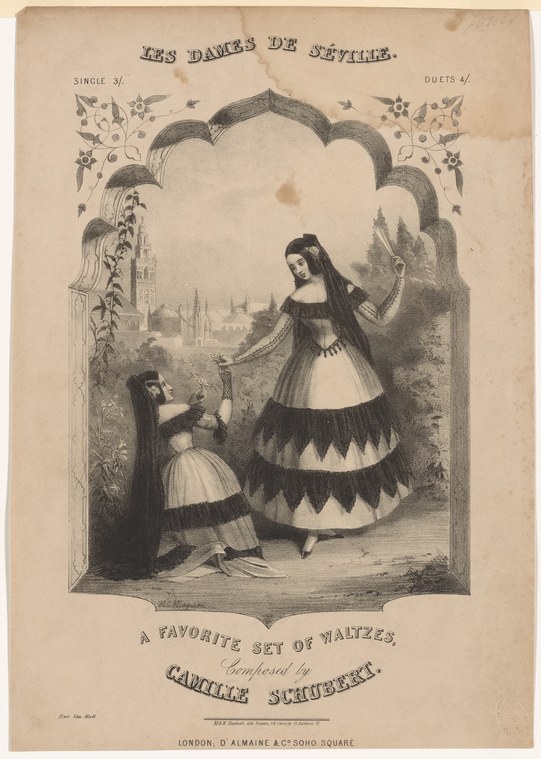
Les dames de Séville: a favorite set of waltzes, composed by Camille Schubert
Unknown artist
- Collection:
- Prints depicting dance
- Source:
- New York Public Library
- Rights:
- Public domain — free to use, share and adapt.
- Recorded as:
- Public Domain
As sheet music cover art, this object reveals how ballroom dance was marketed and imagined in the 19th century: not as an athletic or technical display, but as an opportunity for refined social performance and romantic fantasy. The image shows how Spanish and Mediterranean themes were exoticized and feminized for European audiences, a pattern that shaped both ballroom culture and concert dance for decades.
What you are looking at
A young woman in layered black and white skirts stands at the center, her torso leaning forward in a graceful contrapposto pose. She looks downward toward a child or young girl in a lighter dress who stands before her in a gesturing or reaching pose, as if making an appeal or request. The two figures are framed within an ornamental archway with decorative floral flourishes at the top corners. The background shows a distant cityscape with church spires—recognizably Seville—rendered in soft grey tones that recede behind the figures. The foreground is an interior or terrace space with paving. The overall composition is symmetrical and theatrical, with the arch creating a stage-like frame. The print is hand-colored or tinted, with careful attention to the contrast between the woman's elaborate black and white skirts and the softer palette of the background.
The dancing
Two female figures dominate; the adult woman's body is oriented to the side, her weight appearing to settle on one leg while the other is subtly extended. Her posture is elegantly curved rather than rigid—a balletic line without explicit dance position. The younger figure faces her directly, arms raised or extended in a gesture that suggests either imitation, supplication, or play. Both have long skirts that would restrict the range of movement, yet the composition suggests lightness and grace rather than constraint. The relative heights and scale suggest a hierarchical relationship—perhaps a dance mistress and student, or an older and younger performer.
The dance depicted
The title *Les Dames de Séville* (The Ladies of Seville), combined with the Spanish city backdrop and the 19th-century publication date, suggests this illustrates a waltz inspired by Spanish themes or characters—a common genre in European ballroom and theatrical music of the 1800s. The interaction between two female figures, the refined posture, and the layered skirts all point to a formal social or theatrical dance rather than authentic Spanish regional dance. The work is sheet music cover art for a composition by Camille Schubert, and the image likely depicts an imagined or theatrical scene of Spanish femininity rather than documentary evidence of how a waltz was actually danced.
How it was made
This is a lithographic print, identifiable by its fine tonal gradation, the way light is modeled in the background architecture, and the characteristic soft line quality of lithography. The ornamental frame and decorative typography are typical of 19th-century music publishing. Lithography allowed rapid and affordable mass production of illustrated sheet music covers, making such images accessible to amateur musicians and ballroom dancers—the primary market for published waltzes. The colored hand-tinting suggests this was a higher-end copy, as many were issued in black and white.
About this work
This is the cover art for a published waltz composition, a common artifact of 19th-century European popular music culture. The print depicts an imagined scene of Spanish-themed femininity—a common fantasy in European ballroom culture—framed as a narrative or theatrical moment between two women. Rather than documenting an actual waltz position or technique, the image uses the waltz as a vehicle for Romantic-era aesthetics: refined posture, elegant drapery, architectural framing, and sentimental narrative. The work sits at the intersection of music publishing, ballroom social dance, and Orientalizing theatrical fantasy.
How to look at it
Attend to the postural relationship between the two figures: neither is in an explicit ballroom waltz position (the closed hold that defined the dance), yet the framing and posture suggest an intimate, hierarchical moment of teaching or performance. The viewer is positioned as if watching a theatrical scene rather than participating in a social dance. The distant cityscape and ornamental frame elevate the scene from the everyday into an imagined, romantic space—typical of 19th-century sentimental popular art. The composition sacrifices anatomical accuracy for emotional and commercial appeal.
The artist
The artist is not recorded in the catalogue. The print was published by D'Almaine & Co. of London. The composer Camille Schubert (fl. mid-19th century) was a prolific publisher of light dance music and songs; little biographical information is widely available, but his name appears on numerous similar publications from the 1840s–1860s, suggesting he was a professional composer-publisher in the London music trade.
The period
The waltz was the dominant social dance of the 19th century, and the 1840s–1860s marked its commercial peak in sheet music publication. Spanish and Italian themes were fashionable in European Romantic culture—part of a broader taste for exoticism and historical romance. Concurrently, the theatrical waltz had become a standard feature of ballet and musical theatre, blurring the boundary between social dance and staged performance. Composers like Schubert capitalized on this demand by producing cheap, accessible publications with attractive illustrated covers that appealed to amateur dancers and household musicians.
Where it lives
The work is held in the New York Public Library's collection of prints depicting dance. It is identified as a music cover (sheet music wrapper), a printed ephemeral object produced in quantity for retail distribution.
Dance in this work
Questions about this work
Is this depicting an actual Spanish dance?
No. Despite the title and Seville setting, this is a European waltz—a ballroom dance from Central Europe—framed with Spanish-inspired imagery. The elaborate skirts and theatrical composition are consistent with 19th-century European fantasy rather than authentic Spanish regional dance or costume.
Who was Camille Schubert?
Little is documented about Schubert beyond his prolific output of light music and waltzes in the mid-19th century. He operated as a composer-publisher in London, producing affordable sheet music for the amateur domestic market. Many copies of his works survive in libraries, but biographical details remain scarce.
What was sheet music cover art for?
The illustrated cover was both marketing and product protection—it attracted buyers in music shops and wrapped the printed pages of music inside. These prints were collected, sometimes framed, and often discarded once the music was worn out, making originals relatively rare today.
Does this image show how waltzes were actually danced?
Not precisely. The closed hold and spinning motion of the waltz are absent here. The image prioritizes narrative and aesthetic appeal over technical accuracy, showing an imagined moment of encounter rather than documenting the dance itself.
More dance artwork





