49 works in this view — arrow keys or swipe to move between them.
Dance in Art
Selected plates from The art of dancing explained by reading and figures
Unknown artist
- Collection:
- Prints depicting dance
- Source:
- New York Public Library
- Rights:
- Public domain — free to use, share and adapt.
- Recorded as:
- Public Domain
Dance instruction manuals of this kind are among the primary sources for understanding how 18th-century court dances were actually performed, since no video exists and written descriptions alone were ambiguous. The careful depiction of body alignment, weight distribution, and arm carriage in such plates shaped the practice of generations of dancers. The survival of these engravings with hand-colouring shows the value placed on them and the care taken to preserve visual knowledge of courtly movement.
What you are looking at
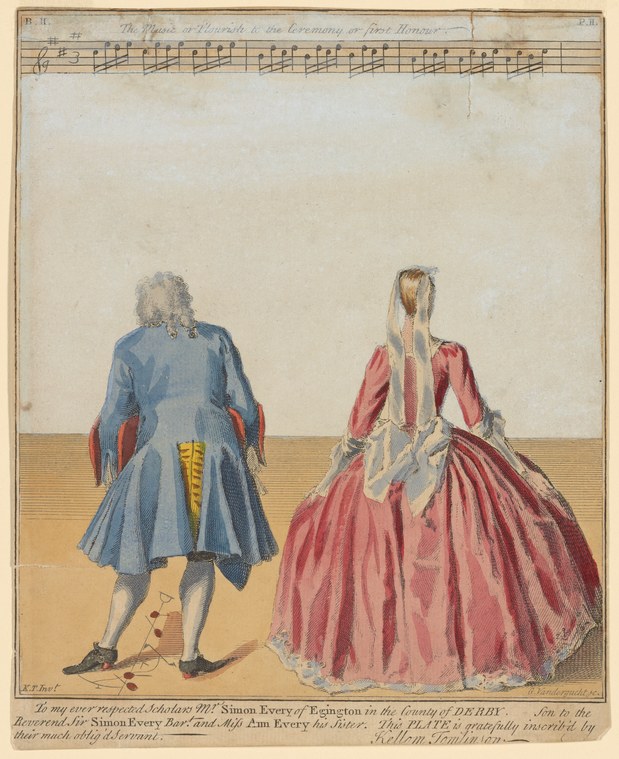
Two dancers are presented in rear view against a plain background, positioned on a brown ground line beneath a musical staff. The dancer on the left wears a blue coat with yellow lacing at the front, knee breeches, and white stockings; their white hair is in the rococo style. The dancer on the right wears an elaborate crimson or wine-coloured gown with enormous panniers extending the skirt to vast width, and blonde hair dressed high with decorative elements. The woman's immense skirt dominates the composition, gathered up in complex folds and swags that suggest both the weight of the fabric and the exaggerated silhouette of mid-18th-century court fashion. The figures are posed as if captured mid-movement, their bodies angled to show the line from back view—a choice that emphasises the visual spectacle of their clothing rather than the detailed positioning of their feet.
The dancing
Both dancers are shown from behind, with weight distributed evenly and bodies held upright in a formal, composed manner. The man's arm positions are not entirely clear from the angle, but his frame is erect and balanced. The woman's arms are raised and held away from her body, with the right arm extended backward—a gesture that suggests either a turning movement or a pose displaying the silhouette of her gown. Neither figure appears to be executing rapid footwork; the moment seems one of measured, stately progression rather than quick stepping.
The dance depicted
This plate depicts the minuet or a similar court dance of the 18th century, as evidenced by the formal dress, the musical staff above, and the character of the posture. The minuet was the principal dance of European aristocratic courts from the baroque into the rococo period and dominated social dance instruction. The image shows the dancers in costume rather than in the act of demonstrating technique, suggesting this is from a dance instruction manual where dress was as much part of the curriculum as the steps themselves. The notation or instructions above would clarify the specific dance and movement, but the visual evidence points to court dances of the 1750s–1770s period.
How it was made
This is an engraving or etched print, as indicated by the linear hatching visible in the shading of the garments and the characteristic parallel line work of the medium. The fine detail and the ability to render lace, pleats, and textile ornament with precision are typical of 18th-century engraved dance instruction plates. Such prints were made to be bound into dance manuals and sold to the gentry and aristocracy, meaning this was a commercial object aimed at people learning to dance or wishing to understand court fashion. The survival of hand-colouring—the blue coat, the crimson gown—indicates this was a hand-tinted example, suggesting a purchaser of some means.
About this work
This plate comes from *The art of dancing explained by reading and figures*, an 18th-century instructional manual that used engraved images and notation to teach court dances to the European aristocracy. The work is a specimen of didactic art, designed to convey both the aesthetic ideal of the dancer and the precise positioning of the body. It belongs in a dance archive because it is documentary evidence of how dancers were taught to present themselves, how costume functioned in dance, and how movement was notated and transmitted before the invention of photography. The dress is as much the subject as the dance; the two were inseparable in court practice.
How to look at it
Note the rear-view perspective, which was standard in 18th-century dance instruction: it shows the carriage of the back, the set of the shoulders, and the drape of the coat and skirt, all essential to the appearance of refinement. The woman's raised arm and the tilt of her body suggest a turning movement or a moment of compositional balance rather than a static pose. Observe how the artist has rendered the panniers in precise detail—the exaggerated width was not optional or exaggerated for effect, but literal. Look at the musical staff above: it would contain the melody and notation that governed the step patterns the dancers would execute to this visual template.
The period
The 18th century saw a flood of dance instruction manuals across Europe, particularly in France, Italy, and England, as the minuet became the central accomplishment of polite society. These books served the rapidly expanding middle classes who aspired to aristocratic manners; dancing masters used them as marketing tools and as a way to standardise notation and technique across different schools. The rococo period celebrated elegance, refinement, and the display of fine fabrics, and dance—which showed off both body and dress—was central to aristocratic life. Musical notation combined with figure illustrations became the standard format for such manuals, a hybrid language that predated modern Labanotation by a century.
Where it lives
This print is held in the New York Public Library's Prints collection, catalogued as part of a series of plates from *The art of dancing explained by reading and figures*. Such manuals were produced in multiple editions and states across the 18th century, often with variant colouring and different languages of instruction. The survival of this hand-coloured example suggests it was a valued teaching tool or a collector's copy.
Dance in this work
Questions about this work
Why are the dancers shown from behind?
In 18th-century dance instruction, the rear view was preferred because it showed the carriage of the back, the set of the shoulders, and the alignment of the spine—all markers of refinement and proper technique. It also displayed the train and drape of the woman's gown and the line of the man's coat. A front view would have shown the face but obscured the body's alignment.
What is that enormous skirt?
Those are panniers, side hoops that extended from the waist to create an exaggerated width. They were fashionable in the 1750s–1760s and were standard court dress. They made the dancer's silhouette dramatic and required the dancer to move carefully and with dignity—the skirt itself was part of the choreography.
What dance is this?
Based on the dress, the formal posture, and the period, this is almost certainly a minuet or a closely related court dance such as a gavotte or passepied. The minuet was the primary dance of this era. The notation above the figures would specify the exact dance and step sequence, but the image alone indicates a formal, stately court dance.
How would dancers use this image?
A dancing master would use plates like this to show pupils the correct posture, arm carriage, and body alignment for each dance. The student would then learn the step patterns by copying the master or by reading the notation. These manuals were also used for self-study by those wealthy enough to own them.
More dance artwork





