49 works in this view — arrow keys or swipe to move between them.
Dance in Art
Mme. Alexis Dupont
Unknown artist
- Collection:
- Prints depicting dance
- Source:
- New York Public Library
- Rights:
- Public domain — free to use, share and adapt.
- Recorded as:
- Public Domain
Commemorative portrait prints of named dancers are rare historical documents of theatrical celebrity in the Romantic era. They show us who was famous, how they were marketed and remembered, and how the dancing body was presented to an admiring public. This particular print, with the named subject inscribed at base, is an artifact of nineteenth-century theater culture and dance celebrity that would have hung in homes and studios.
What you are looking at
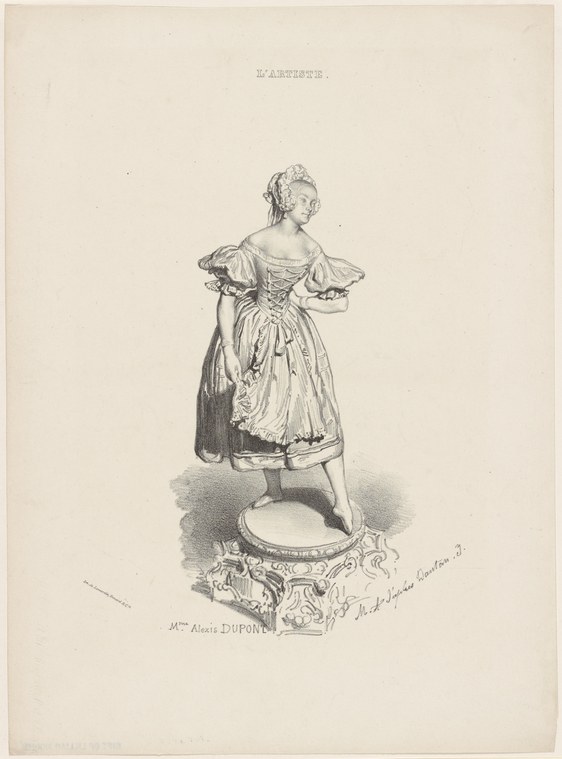
A young woman in Romantic-era dress stands alone on an ornate, leafy pedestal against a plain background, shown in three-quarter view. She wears a white or pale muslin dress with short, puffed sleeves and a fitted bodice, the skirt falling to mid-calf in soft folds. Her hair is arranged up with ribbons or ornamental fastening. Her posture is upright but relaxed, weight settled on one leg in a pose suggesting a moment captured mid-performance or mid-gesture rather than active dance movement. The pedestal beneath her is richly carved with rococo scrollwork and foliage, elevating her into an almost sculptural presentation. The print is finely detailed, using cross-hatching to model form and create shadow on the drapery and figure.
The dancing
A single standing female figure dominates the composition, posed in a relaxed contrapposto stance with her weight shifted slightly to one side. Her arms hang naturally at her sides with no formal frame or hold—she is alone. The pose suggests the moment after or between movement rather than an action unfolding: the body is composed and still, the gaze averted downward and to the side. Her dress hangs vertically without the distortion of active movement, and there is no evidence of turned-out positions, lifted leg, or the technical stance of trained theatrical dance.
The dance depicted
This appears to be a posed portrait of a named performer (Mme. Alexis Dupont, as inscribed), likely a celebrated dancer of the Romantic era, rather than a depiction of a specific dance or choreography. The dress, refined carriage, and presentation suggest she was a professional dancer of standing, possibly in ballet. The pose itself—formal, dignified, and static—is characteristic of how famous dancers were commemorated in prints: as celebrated individuals rather than as dancers in action. Without visible footwork, active movement, or choreographic context, the work functions as a celebrity image or commemorative portrait in theatrical dress rather than a documentation of technique.
How it was made
This is a finely detailed engraving or lithograph, evident from the precise line-work, cross-hatching for tonal modeling, and the careful rendering of texture in the muslin and carved pedestal. The technique of tonal gradation through parallel lines was characteristic of mid-nineteenth-century reproductive prints. The inscription and publisher information at the base (partially legible in the lower left) confirm this as a published commemorative print, likely one of a series of theatrical celebrities. The medium allowed rapid, affordable distribution to a broad public interested in celebrity performers and fashionable theatrical dress.
About this work
This is a commemorative portrait engraving of Mme. Alexis Dupont, likely dating to the 1830s–1850s based on the dress, styling, and printing technique. It documents her as a celebrated performer of the Romantic era, capturing not a moment of choreography but a formal presentation of a named and admired dancer in the fashionable dress of her profession. The work belongs in a gallery of dance imagery because it testifies to how dancers were publicly celebrated and circulated as celebrity personalities, and because the dress and bodily presentation encode the aesthetic ideals of Romantic-era theatrical dance: refinement, grace, lightness, and a certain aristocratic restraint. The pedestal emphasizes her status and elevates her almost to sculptural or allegorical status—she is not merely dancing, but being presented as a celebrated figure.
How to look at it
Attend to the absence of action: this is a posed, static image despite the subject being a professional dancer. The artist has chosen not a moment of choreography but a moment of formal presentation. Notice how the dress is rendered—carefully, elegantly, with no distortion by movement—and how it communicates status and refinement. The pedestal beneath the figure is unusually elaborate and ornamental, suggesting that the subject herself has become almost a work of decorative art, as much monument as performer. The lack of theatrical scenery or context further emphasizes that this is a portrait of the *person*, not a scene of the *dance*.
The period
The inscription and dress place this print in the 1830s–1850s, the height of the Romantic ballet era in Western Europe. During this period, dancers achieved unprecedented celebrity status, and lithographic and engraved portrait prints became a major medium for circulating images of famous performers—particularly famous women of the ballet. The soft, ethereal aesthetic embodied in the dress and pose reflects the ideals of Romantic choreography: weightlessness, otherworldliness, and a refined, genteel femininity. The refinement of the engraving process and the commercial production of such prints also reflects the growth of a mass theatrical audience with the leisure and means to acquire such souvenirs.
Where it lives
This print is held in the New York Public Library's collection of prints depicting dance. It is a published commemorative engraving or lithograph, likely one of a series, and represents the type of celebrity portrait that circulated widely in the nineteenth-century theatrical market.
Dance in this work
Questions about this work
Was Mme. Alexis Dupont a famous ballet dancer?
The inscription identifies her by name and the refined dress and presentation suggest she was a celebrated performer of the Romantic era, likely active in ballet in the 1830s–1850s. The fact that her portrait was published and circulated indicates professional renown. Specific biographical details and her choreographic roles would require historical research beyond what the print itself conveys.
Why is she standing still if this is a dance image?
This is a portrait, not a choreographic document. The static pose was standard for commemorative prints of dancers: it presented the performer as a celebrated individual in formal dress, for display in homes and studios. The elegance and refinement of the pose was itself part of the appeal, communicating grace and sophistication.
What does the pedestal mean?
The ornate pedestal elevates and frames the figure, conferring status and monumentality. It suggests that the dancer herself is a work of art or a celebrated public figure worthy of sculptural presentation. This was a common device in prints celebrating performers, musicians, and other celebrities.
More dance artwork





