49 works in this view — arrow keys or swipe to move between them.
Dance in Art
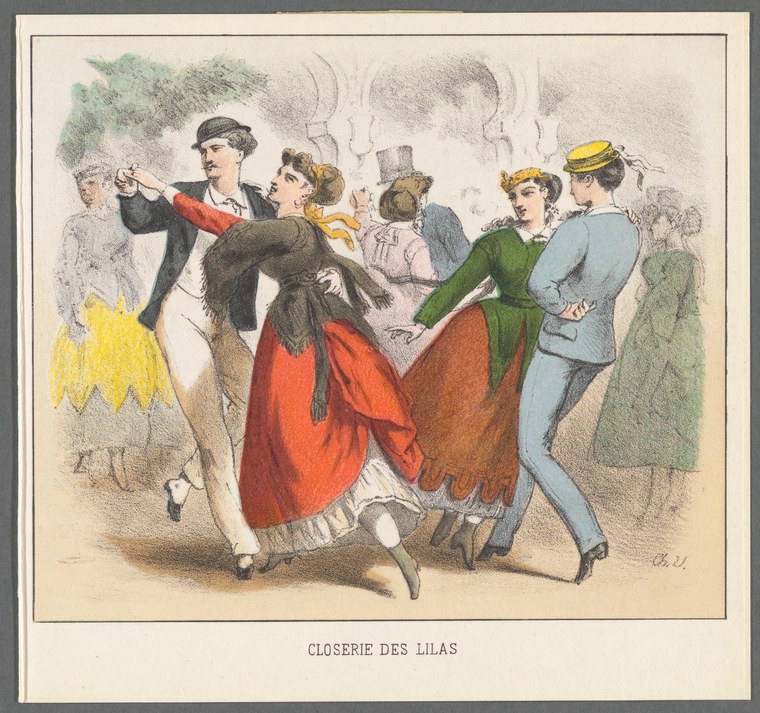
Closerie des lilas
Unknown artist
- Collection:
- Prints depicting dance
- Source:
- New York Public Library
- Rights:
- Public domain — free to use, share and adapt.
- Recorded as:
- Public Domain
This work documents a real place—the Closerie des lilas—and a specific mode of social dancing that was central to Parisian leisure culture but rarely survives in other records. It shows that recreational social dance of the era involved physical vigor, group participation, and playful transgression that formal ballroom conventions did not capture. As evidence of how people actually danced in urban cafés rather than how dancing masters prescribed it should be done, it is invaluable to anyone studying the social history of movement.
What you are looking at
A lively social gathering captured in colored lithography shows a group of people in mid-entertainment at what appears to be an outdoor or garden venue. The central figures are engaged in an energetic dance or game: a woman in a red skirt with white undergarments is being held and lifted by two men in dark jackets and hats, while a second woman in a green dress leans in from the right. Additional figures occupy the background—some watching, others partially obscured—suggesting this is a public social event. The setting evokes a Parisian entertainment garden or outdoor ballroom popular in the mid-19th century. The use of soft greens and browns in the background foliage contrasts with the vivid reds and blues of the foreground figures' clothing, drawing the eye to the central action. The overall mood is one of uninhibited gaiety and physical exuberance.
The dancing
The composition centers on three primary dancers in close contact. The woman in red is suspended or pivoted between two men, her body tilted horizontally with legs extended, a posture suggesting she is being lifted or swung. Her companions maintain firm holds on her limbs—one grasping her torso and arm, the other supporting from behind. The woman in green leans toward the action with engaged body language. The poses suggest vigorous partnered movement rather than the structured holds of ballroom dance; weight is distributed dynamically across the group rather than balanced between two partners in a closed frame.
The dance depicted
This appears to depict a popular 19th-century social dance or party game involving group participation and physical play, likely the kind of uninhibited revelry associated with Parisian café society of the Second Empire. The lifting and swinging of the central figure suggests either a folk-derived country dance adapted for urban entertainment, or a parlor game performed for amusement rather than formal choreography. The title *Closerie des lilas* refers to a specific venue—the famous garden café in Montparnasse known for bohemian gatherings—which places this firmly within the culture of informal, spontaneous social dancing of the 1860s–1880s. The physical energy and casual participation suggest this is not ballet or a structured ballroom form, but rather recreational movement among friends at a leisure venue.
How it was made
This is a hand-colored lithograph, identifiable by the characteristic soft grain and the addition of color through separate press passes or hand-coloring. Lithography allowed rapid production and wide circulation among the middle classes, and the visible signature at lower right confirms this is a commercial print rather than a unique work. The technique was ideal for capturing social scenes with naturalistic detail and humor—qualities evident here—and such prints were often sold individually or in series documenting Parisian social life. The color palette and figure style are consistent with mid-19th-century French printmaking conventions.
About this work
This hand-colored lithograph documents a moment of recreational social dancing at the Closerie des lilas, a famous Parisian garden café of the 1860s–1880s. It captures the physical exuberance and informal partnering of popular urban entertainment, where dancing was participatory, playful, and often involved the kind of vigorous lifting and group play shown here—quite distinct from the formal discipline of ballroom or theatrical dance. The work belongs to a rich visual tradition of French social satire and genre documentation that recorded how ordinary people danced for pleasure in the modern city.
For dancers and historians, the image is valuable not as an example of a named choreographic form but as evidence of how 19th-century urban society actually moved together. It shows that energy, physicality, and mixed-gender participation were central to popular entertainment; it captures a social moment now lost to history through the specificity of a named venue; and it demonstrates how the lithographic print made dance culture visible and marketable as entertainment for a broad audience.
How to look at it
Attend first to the posture of the woman in red: the artist has frozen a moment of suspension or swing, with her body nearly horizontal between two men. This is not a ballroom frame—there is no formal closed position or measured stride. Instead, the composition emphasizes the physical effort and abandon involved in the movement; the lifted figure and engaged onlookers suggest this is a moment of play and surprise rather than practiced choreography. The artist has positioned the viewer as if at ground level within the crowd, creating intimacy with the action. The colored lithography technique allows both fine detail in costume and a soft, celebratory overall tone that endorses rather than mocks this scene of urban gaiety.
The period
This print dates to the era of the Second Empire and early Third Republic in France (1860s–1880s), when Paris was actively reshaping itself as a modern leisure destination. Outdoor cafés, gardens, and entertainment venues proliferated; the waltz had recently arrived from Vienna and was still considered daring by conservatives; and a new urban culture of mixed-gender, informal socializing was emerging among the working and middle classes. Lithography and colored prints made contemporary social scenes—including dance—accessible to a broad market. The Closerie des lilas itself became a legendary gathering place for artists, writers, and bohemians, and this image is one of the few visual records of how such places functioned as sites of actual social dancing.
In the history of printmaking, this work represents the mature development of the colored lithograph as a vehicle for social documentation and satire, a genre that flourished in France and informed European visual culture throughout the 19th century.
Where it lives
This work is part of the New York Public Library's collection of prints depicting dance. It is housed as a single-sheet colored lithograph, typical of 19th-century commercial printmaking in France.
Dance in this work
Questions about this work
What is the Closerie des lilas?
A garden café in Montparnasse, Paris, that became famous from the 1860s onward as a gathering place for artists, writers, and bohemians. It was a site of informal social entertainment, including music and dancing, and has achieved legendary status in histories of Parisian avant-garde culture. The name translates to "lilac garden," reflecting its horticultural setting.
Is this a specific recognizable dance?
Not in the sense of a named choreography or ballroom form. The movement shown—lifting, swinging, and group participation—is consistent with informal social dancing, folk-derived country dances adapted for urban venues, or parlor games of the era. The physical exuberance and mixed-gender play suggest this is recreational movement rather than formal technique.
Who danced at places like this?
The Closerie des lilas attracted a mixed clientele of working-class Parisians, students, artists, and bohemians. Dancing was one of many entertainments offered, alongside food, drink, and conversation. The garden setting and informal atmosphere made it accessible to people of modest means, unlike the grand ballrooms of the aristocracy or wealthy bourgeoisie.
Why is this print valuable as historical evidence?
It documents a real place and a specific mode of social dancing that is otherwise largely invisible in historical records. While photographs, engravings, and paintings of formal ballroom dance survive in abundance, casual recreational dancing in urban cafés is rarely depicted. This image shows how ordinary people actually moved together for pleasure, as distinct from how dancing masters prescribed movement should be done.
More dance artwork





